Odisha Revises English Spellings of 64 Places to Honour Odia Pronunciation
Synopsis
Odisha has approved revised English spellings for 64 place names across 26 districts to align official records with authentic Odia pronunciation, marking a significant step in the state's long-standing effort to protect its linguistic identity and classical heritage.
Key Takeaways
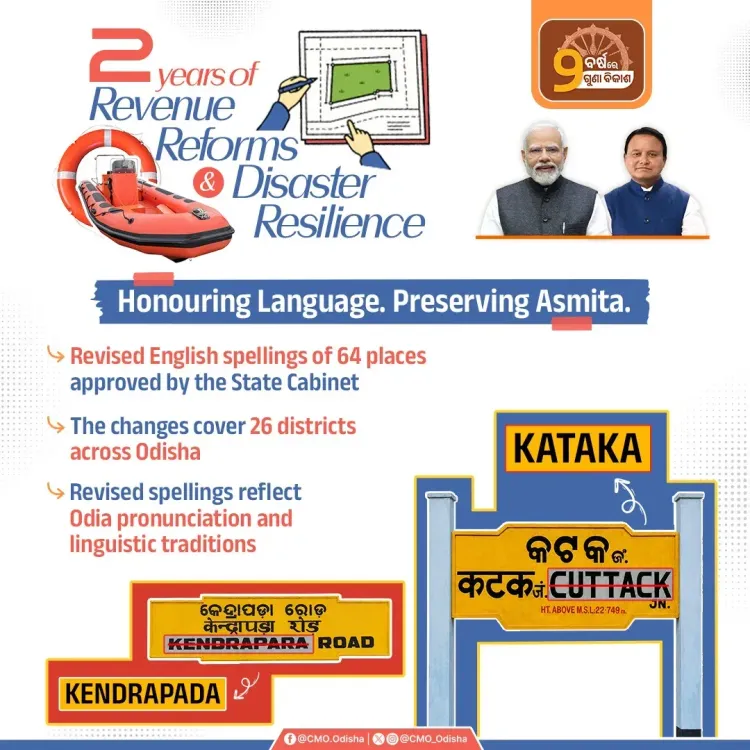
The Chief Minister's Office of Odisha announced revised English spellings for 64 place names across 26 districts on 9 July 2026 .
The move is aimed at aligning official English-language records with authentic Odia pronunciation , correcting colonial-era transliterations.
Odisha was India's first state formed on linguistic grounds in 1936 , and Odia received classical language status from the Government of India in 2014 .
The reform will require updates to land records, revenue documents, maps, and public signage across the affected districts.
The announcement was framed within a two-year governance milestone under the hashtag #2YearsofLokankaSarakar .
The step continues a broader pattern of state-driven cultural and administrative standardisation seen across several Indian states.
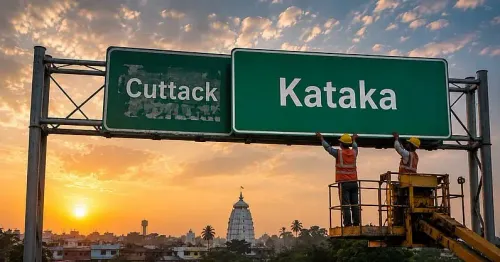
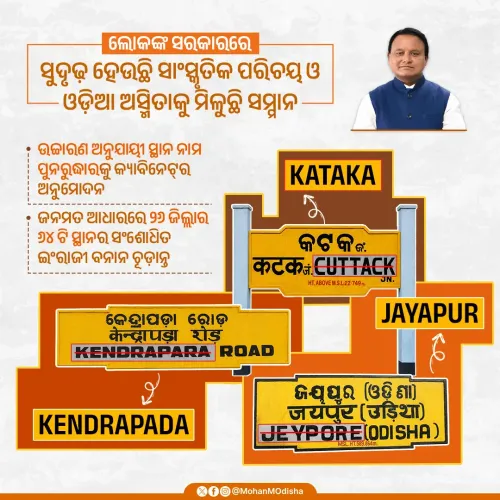
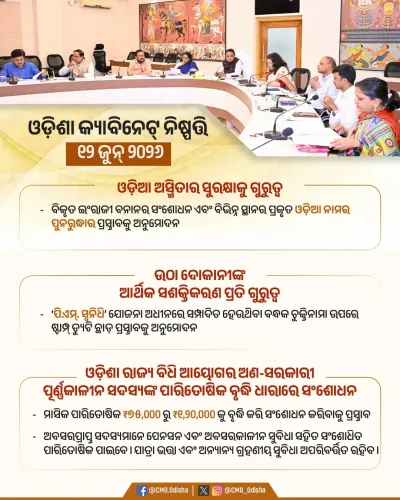
The Chief Minister's Office of Odisha announced on Thursday, 9 July 2026 that the state government has approved revised English spellings for 64 place names across 26 districts, a move framed as a historic step to honour authentic Odia pronunciation and safeguard the state's linguistic heritage.
Context
The CMO described the decision as an affirmation of Odia Asmita (Odia pride), stating: 'Language is the soul of identity, and preserving its authenticity is a matter of pride.' The revision covers place names spread across 26 of Odisha's 30 districts, making it one of the most sweeping standardisation exercises the state has undertaken in recent memory.
The announcement was made under the hashtags #2YearsofLokankaSarakar and #BikasharaDharaOdishaSara, situating the spelling reform within a broader two-year governance milestone being marked by the current state administration.
Policy Backdrop
Odisha holds a singular place in Indian constitutional history: it was formed on 1 April 1936 as the country's first state carved explicitly on linguistic lines, created to protect the Odia-speaking population's distinct identity. That founding logic has shaped the state's cultural policy ever since.
In 2014, the Government of India accorded Odia classical language status, recognising its ancient and unbroken literary tradition — one of only a handful of Indian languages to receive that designation. The current spelling revision builds on that recognition by ensuring that official English-language records reflect how Odia speakers actually name their own places, rather than retaining colonial-era transliterations that often distorted local phonology.
Several other Indian states have undertaken similar exercises over the decades — from renaming cities to correcting district and village spellings in official gazettes — as part of post-independence efforts to shed administrative legacies that misrepresented local languages.
Stakeholders and Impact
The most immediate impact will be felt by district administrations across the 26 affected districts, which will need to update land records, revenue documents, official correspondence, and public signage to reflect the new spellings. For Odia speakers — estimated at over 3.5 crore people — the change carries symbolic weight: it validates everyday pronunciation in the language of governance.
The reform also intersects with ongoing revenue and land-administration modernisation in the state. Place names embedded in property records, survey maps, and digital land databases will require systematic updating, a process that is likely to unfold in phases across government departments.
What's Next
The practical rollout will determine how consequential this reform proves in daily governance. Official notifications to district collectors, updates to state and national cartographic databases, and revisions to road signage will all need to follow. Public consultations or grievance mechanisms for residents of the affected localities may also be considered as implementation proceeds.
More broadly, the move signals that linguistic and cultural standardisation will remain a policy priority for the Odisha government — and it may encourage other states with similar unresolved place-name discrepancies to undertake comparable reviews of their own official records.
Point of View
The administration is signalling that cultural reclamation and administrative modernisation are complementary, not competing, priorities. The move fits a wider national pattern in which state governments use place-name standardisation as a low-cost, high-visibility way to reinforce regional pride. The real test, however, will be in implementation: whether revenue records, digital maps, and public signage are updated consistently will determine whether this reform endures beyond the announcement.
NationPress
8 Oct 2026
Frequently Asked Questions
Which 64 places in Odisha have had their English spellings revised?
The government has approved revised spellings for 64 place names spread across 26 districts of Odisha, but the specific list of localities has not yet been detailed in the official announcement. District administrations are expected to receive formal notifications as implementation proceeds.
Why is Odisha changing the English spellings of its place names?
The revision is intended to align official English-language spellings with authentic Odia pronunciation, correcting colonial-era transliterations that often distorted how local names are actually spoken by Odia speakers.
What is Odia Asmita and why does it matter?
'Odia Asmita' translates broadly as Odia pride or Odia identity. It refers to the cultural, linguistic, and historical consciousness of the Odia-speaking people, and has been a recurring theme in Odisha's state policy since its formation in 1936 as India's first linguistically defined state.
Does Odia have classical language status in India?
Yes. The Government of India accorded Odia classical language status in 2014, recognising its ancient and unbroken literary tradition. This makes Odia one of only a small number of Indian languages to hold that designation.
How will the revised place-name spellings be implemented across Odisha?
Implementation will require updates to land and revenue records, official government correspondence, survey maps, cartographic databases, and road signage across the 26 affected districts. The process is expected to roll out in phases through district administrations.