Owaisi slams SIR deletions, warns of 'permanent excluded class'

Synopsis
AIMIM president Asaduddin Owaisi attacked the Centre's proposed committee on illegal immigrants, linking it to SIR electoral roll deletions he pegged at 6.5 crore across 13 States and UTs. He warned of a 'permanent class of excluded Indians', flagged disproportionate impact on Muslims, women, the poor and migrants, and questioned the rationale when India's TFR is 2.0.
Key Takeaways
Owaisi claims SIR deleted nearly 6.5 crore names across 13 States and UTs .
He links the exercise to a proposed committee on identifying, detaining and deporting illegal immigrants.
He notes 27 lakh persons remain under adjudication and can re-apply via Form 6 .
Alleges those excluded are disproportionately Muslims, women, the poor and migrants.
Questions the need for the committee given India's TFR of 2.0 .
Flags reports of deleted voters being denied government scheme benefits.
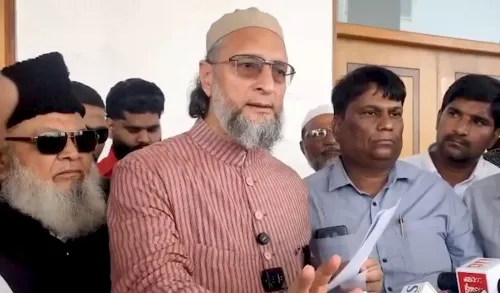
AIMIM president Asaduddin Owaisi on Wednesday, June 3, 2026, sharply criticised the Union Government's proposal to set up a committee to study exclusions from the Special Intensive Revision (SIR) of electoral rolls and design a permanent system to identify, detain and deport illegal immigrants. The Hyderabad Lok Sabha MP alleged that the SIR exercise, which he said deleted nearly 6.5 crore names across 13 States and Union Territories, would be weaponised to create a 'permanent class of excluded Indians'.
Context
In his post, Owaisi argued that the Centre 'first carried out a document-driven SIR that deleted nearly 6.5 crore names from electoral rolls' and now wants a committee to 'study those very exclusions and build a permanent system for the identification, detention, and deportation of illegal immigrants'. He framed the sequence as a deliberate pipeline from voter-list scrubbing to citizenship action.
He underscored that the right to vote is, in his words, 'the poor's only weapon against the powerful', warning that its loss would leave vulnerable citizens at the mercy of the state. Owaisi added that there were already 'reports of people being denied the benefits of government schemes' after deletions.
Policy backdrop
The Election Commission of India periodically undertakes intensive revisions of electoral rolls, and such exercises have preceded multiple general elections, including 2019 and 2024. Owaisi stressed the legal distinction that 'a deletion under SIR does not mean that a person is not a citizen', noting that 27 lakh persons remained under adjudication and that many could re-apply for enrolment through Form 6.
He also pointed out that the poll body 'itself has provided no data on the number of people it excluded because they were foreigners', and claimed that available data showed those excluded were disproportionately 'Muslims, women, the poor, and migrants'. The intersection of electoral roll revisions and citizenship verification has been a flashpoint since the Assam NRC update concluded in 2019, which left roughly 19 lakh persons off the final list pending verification.
Stakeholders and impact
The AIMIM chief questioned the rationale for a new committee at a time when, he said, 'the government's own data show that our demography and population have stabilised and that our TFR is 2.0'. He alleged the panel's real purpose was to sustain 'constant paranoia and fear directed against Muslims'.
National Family Health Survey rounds have indicated India's total fertility rate at or near replacement level, even as political discourse around illegal immigration continues in several border and metropolitan states. Civil society groups have long flagged that documentation-heavy exercises tend to fall hardest on internal migrants, women without inherited property papers, and low-income households without continuous address records.
Owaisi widened his critique to the broader governance style, saying the administration 'loves making Indians waste their time on documentation', citing repeated rounds of KYC, SIR and portal uploads. He contrasted this scrutiny of citizens with what he called the government's inability to 'conduct a simple exam properly', adding that 'common people are scrutinised by the government, but the government cannot be scrutinised by us'.
What's next
Attention will turn to any formal terms of reference for the proposed committee on illegal immigrants, and to whether the poll body releases a disaggregated break-up of SIR deletions by reason, religion, gender and migrant status. Legal challenges to mass deletions could also surface before high courts or the Supreme Court, particularly from persons whose names were removed despite continuing to hold Indian documentation.
The political question is whether opposition parties consolidate around the SIR issue ahead of upcoming state polls, or whether the debate remains confined to minority-rights advocacy. For affected voters, the practical implication is immediate: fresh enrolment via Form 6, document re-submission, and, in some cases, the loss of welfare access until rolls are reconciled.
Point of View
Dating to the CAA-NRC churn of 2019-20, that documentation drives end in citizenship adjudication. By framing SIR as the front-end of a detention-and-deportation pipeline, he is pre-empting the committee's terms of reference and forcing the poll body to publish granular deletion data. The invocation of a stabilised TFR is a deliberate counter to demographic-anxiety politics. Expect this argument to migrate from social media into parliamentary interventions and, possibly, writ petitions.
NationPress
16 Oct 2026
Frequently Asked Questions
What is the SIR of electoral rolls?
SIR, or Special Intensive Revision, is a door-to-door, document-based exercise by the Election Commission of India to update voter lists. It involves verification of existing electors and addition of new ones, and can result in deletions where entries are found to be ineligible or unverifiable.
How many names did Owaisi claim were deleted under SIR?
Owaisi said nearly 6.5 crore names were deleted across 13 States and Union Territories under the SIR exercise. He also said 27 lakh persons remain under adjudication.
Does a name deletion under SIR mean loss of citizenship?
No. As Owaisi noted, under the law a deletion from the electoral roll does not amount to a declaration that the person is not an Indian citizen. Affected persons can apply afresh for voter enrolment through Form 6.
What is Form 6 for voter enrolment?
Form 6 is the application used by Indian citizens to enrol as a new voter or to shift their enrolment to a new constituency. It is filed with the Electoral Registration Officer and can be submitted online or offline.
Why is Owaisi opposing a committee on illegal immigrants?
Owaisi argued that the committee, built on SIR exclusion data, would create a 'permanent class of excluded Indians' and target Muslims in particular. He questioned its rationale given that India's total fertility rate has stabilised at 2.0.