Owaisi slams Allahabad HC hijab order as 'attack on Islam', hits out at RSS over Manusmriti
Synopsis
Owaisi's Hyderabad address was more than a reaction to a court order — it was a sweeping political offensive. From the Allahabad HC hijab ruling to Manusmriti, Savarkar, and the UCC, he framed each issue as part of a single argument: that Muslim identity and constitutional rights are under coordinated assault. The speech signals AIMIM's intent to consolidate Muslim political sentiment ahead of upcoming electoral cycles.
Key Takeaways
AIMIM President Asaduddin Owaisi condemned the Allahabad High Court 's dismissal of a hijab petition by a minor student from Prayagraj as an 'attack on Islam'.
Owaisi argued the ruling violates Articles 25 and 19 of the Indian Constitution and questioned the court's authority to define essential religious practices.
He alleged that an RSS mouthpiece, on 30 November 1949 , called for Manusmriti to replace the Constitution drafted by Babasaheb Ambedkar .
Owaisi criticised the Uniform Civil Code implemented in Uttarakhand , Assam , and Gujarat , calling it Hindu personal law repackaged as a uniform code.
He invoked Muslim freedom fighters including Allama Fazl-e-Haq Khairabadi and Maulvi Alauddin to counter what he described as a selective reading of India's independence history.
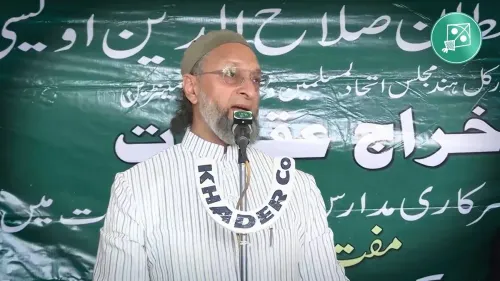
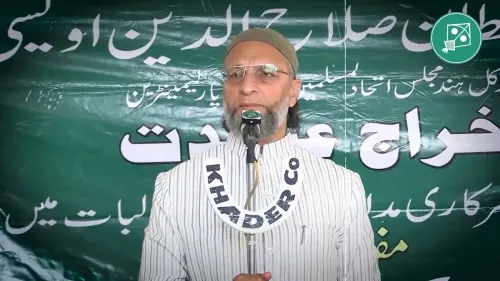
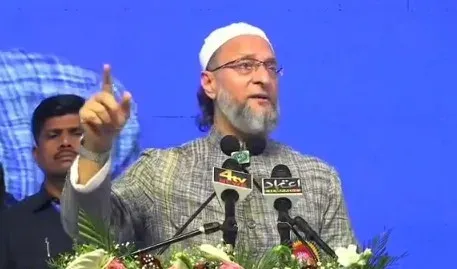
All India Majlis-e-Ittehadul Muslimeen (AIMIM) President Asaduddin Owaisi on Tuesday condemned the Allahabad High Court's dismissal of a petition filed by a minor student from Prayagraj, who had sought permission to wear a hijab alongside her prescribed school uniform. Speaking at a Jalsa-e-Rahmatul-lil-Alameen gathering at the AIMIM headquarters in Darussalam, Hyderabad, Owaisi called the verdict an 'attack on Islam' and alleged it violated constitutional provisions.
Owaisi's Challenge to the High Court Ruling
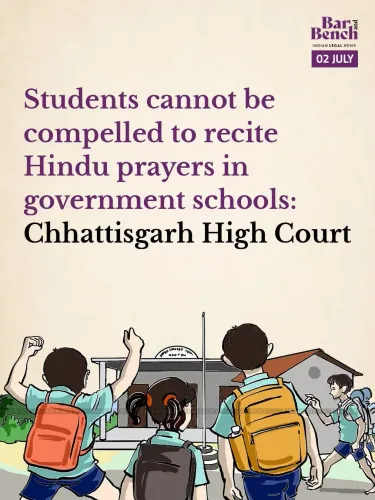
The Allahabad High Court had dismissed the petition on the grounds that the student failed to produce any religious scripture or material establishing that wearing a scarf was an 'essential' part of her faith. The court also noted that photographs submitted in the case showed other students from the same religious community attending school without scarves.
Owaisi rejected this reasoning outright. 'I disagree with this High Court judgment; I do not concur with it... Today's verdict violates Articles 25 and 19 of the Indian Constitution. Who are you to decide what is essential to Islam? Girls are wearing hijab on their heads, not on their minds. It is an attack on Islam,' he said. He further pointed out that the Sabarimala case — which also involves the question of essential religious practices — remains pending before the Supreme Court, arguing that the matter is far from settled in law.
RSS and Manusmriti: A Political Broadside
Owaisi also directed sharp criticism at the Rashtriya Swayamsevak Sangh (RSS) and the Bharatiya Janata Party (BJP), alleging that both organisations have historically prioritised Manusmriti over the Indian Constitution. He cited a specific historical claim to make his case.
'I am asking those associated with the RSS about Manusmriti. Is it not true that on 26 November 1949, we adopted the Constitution? However, four days later, on 30 November, a mouthpiece of the RSS published a complaint against it, stating that it 'wasn't a Constitution at all and it should have been the Manusmriti'. They had issues with the Constitution drafted by Babasaheb Ambedkar,' Owaisi said.
Savarkar, Andaman, and Muslim Freedom Fighters
The AIMIM President also targeted Hindutva ideologue V.D. Savarkar, drawing a pointed comparison between his conduct during imprisonment at the Andaman Cellular Jail and that of Muslim freedom fighters. 'Savarkar supported Manusmriti. While imprisoned in Andaman, he was writing letters to the British, saying, 'I am with you, please release me'. On the other hand, what were we (Muslims) doing? Allama Fazl-e-Haq Khairabadi was also in jail; he endured hardships but never wrote a 'love letter' to the British. Instead, he issued a fatwa for Jihad against them. Even today, his grave stands in Andaman as a testament,' he asserted.
Owaisi also claimed that the first prisoner in the Andaman cellular jail was not a figure associated with the RSS or BJP, but 'Hyderabad's Maulvi Alauddin, the Imam of Mecca Masjid'.
UCC Questioned as 'Hindu Personal Law in Disguise'
Turning to the Uniform Civil Code (UCC), which has been implemented in Uttarakhand, Assam, and Gujarat, Owaisi questioned whether laws modelled on existing Hindu personal statutes could legitimately be described as uniform. 'If the laws being enforced are essentially based on provisions of the Hindu Marriage Act, Hindu Divorce Act and Hindu Succession Act, then how can they genuinely be called a Uniform Civil Code? Why should these laws be imposed on Muslims when they are rooted in Hindu personal laws?' he said.
Commitment to Faith and Country
Concluding his address, Owaisi insisted that efforts to distance Muslims from their religious identity would not succeed, while simultaneously reaffirming his community's commitment to India. 'We love this country, we will protect this country, and while remaining committed to our faith, we will work to make India a superpower,' he said, invoking freedom fighters including Turrebaz Khan. All quotes from Owaisi were made at the Hyderabad gathering and have been attributed accordingly. How the BJP and RSS respond to these allegations, and whether the Allahabad HC ruling faces a further legal challenge, will shape the next phase of this debate.
Point of View
But the real target is the BJP-RSS ideological project ahead of election season. By linking the court ruling to Manusmriti and the UCC in a single address, he is building a unified grievance narrative rather than responding to isolated events. What mainstream coverage misses is the Sabarimala reference: by flagging a pending Supreme Court case on essential religious practices, Owaisi is laying groundwork for a potential legal challenge rather than just political theatre. The UCC critique is also sharper than it appears — the question of whether state-level codes are genuinely 'uniform' or Hindu-personal-law proxies is a legitimate constitutional debate that has not been adequately interrogated.
NationPress
26 Aug 2026
Frequently Asked Questions
What did the Allahabad High Court rule on the hijab petition?
The Allahabad High Court dismissed a petition filed by a minor student from Prayagraj who sought permission to wear a hijab with her school uniform. The court held that the petitioner failed to produce religious scripture or material establishing that wearing a scarf was an 'essential' part of her faith, and noted that other students from the same community attended school without scarves.
Why did Owaisi call the Allahabad HC hijab order an 'attack on Islam'?
Owaisi argued that the ruling violates Articles 25 and 19 of the Indian Constitution, which protect freedom of religion and expression. He contended that courts are not qualified to determine what constitutes an essential religious practice, and drew a parallel with the Sabarimala case still pending before the Supreme Court.
What is Owaisi's allegation against the RSS regarding Manusmriti?
Owaisi alleged that four days after India adopted its Constitution on 26 November 1949, an RSS mouthpiece published a piece stating the Constitution 'wasn't a Constitution at all' and that it 'should have been the Manusmriti'. He used this to argue that the RSS has historically preferred Manusmriti over the Ambedkar-drafted Constitution.
What did Owaisi say about the Uniform Civil Code in Uttarakhand, Assam, and Gujarat?
Owaisi questioned whether the UCC implemented in these three states is genuinely uniform, arguing that the laws are essentially drawn from the Hindu Marriage Act, Hindu Divorce Act, and Hindu Succession Act. He asked why such laws should be imposed on Muslims when they are rooted in Hindu personal law frameworks.
Who is Allama Fazl-e-Haq Khairabadi, cited by Owaisi?
Allama Fazl-e-Haq Khairabadi was a Muslim scholar and freedom fighter who was imprisoned in the Andaman Cellular Jail during the British colonial period. Owaisi cited him as an example of a Muslim freedom fighter who resisted the British and issued a fatwa for Jihad against them, contrasting this with his characterisation of V.D. Savarkar's conduct during imprisonment.