Ming dynasty Tushu Bian mapped all human knowledge in 1613
Synopsis
A Ming dynasty scholar's 127-volume encyclopaedia published in 1613 — too costly to print in his lifetime — is now being recognised as a non-Western counterpart to landmark European knowledge-mapping texts, challenging the assumption that systematic world encyclopaedias were a uniquely Western invention.
Key Takeaways
Zhang Huang , a Neo-Confucian scholar , compiled the Tushu Bian over several decades, drawing on more than 200 printed sources .
The encyclopaedia spans 127 volumes and was published in 1613 , covering the concepts of heaven, Earth and humanity.
The work was too expensive to print during Zhang Huang 's lifetime and was eventually carved on woodblocks and printed posthumously.
Information designer Paul Kahn compared the Tushu Bian with six Western knowledge-mapping texts in his book Mapping Knowledge Across Time: Seven Books That Visualised the World .
The comparison includes landmark Western works such as the Catalan Atlas and the Atlas Historique from Amsterdam , reframing the Tushu Bian as a global peer.
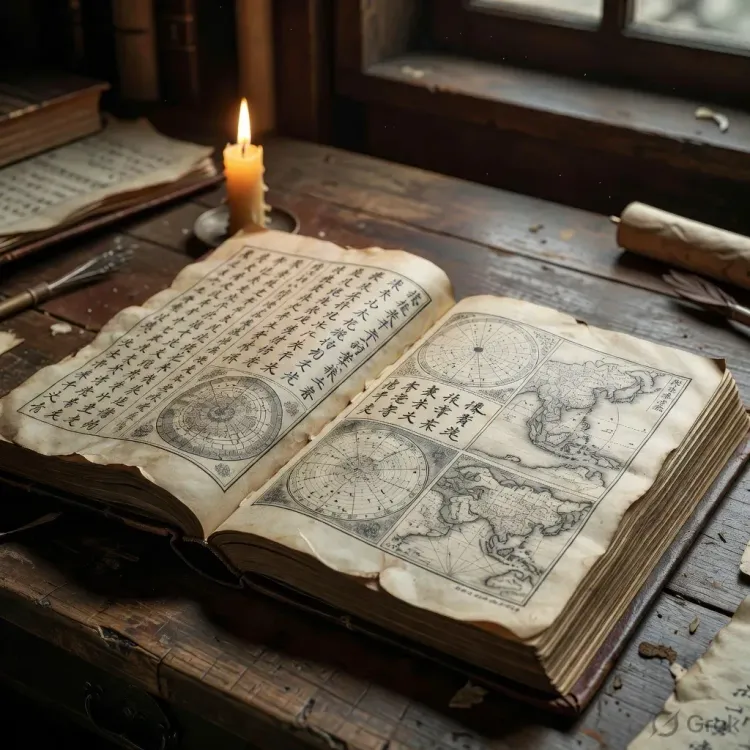
Zhang Huang, a Neo-Confucian scholar of the Ming dynasty, spent several decades compiling the Tushu Bian — a 127-volume encyclopaedia published in 1613 that documented the concepts of heaven, Earth and humanity from a distinctly Chinese perspective, drawing on more than 200 printed sources.
What the Tushu Bian set out to do
The work, whose full title translates as Compendium of Illustrations and Texts, was conceived as a comprehensive repository of knowledge for educated readers of the era. Information designer Paul Kahn, who analysed the encyclopaedia extensively, described its ambition plainly: Zhang Huang's 'goal was to gather all the illustrations and texts an educated person needed to understand the world.'
The scope was vast — spanning cosmology, geography, and the full range of human affairs as understood through a Chinese intellectual lens. It stands as one of the most systematic attempts to organise knowledge in pre-modern Asia.
Why it matters: a non-Western knowledge tradition
The Tushu Bian offers a counterpoint to the dominant Euro-Mediterranean tradition of encyclopaedic knowledge, which has long shaped how the world understands its own intellectual history. Kahn placed the work alongside six other landmark books — including the Catalan Atlas and the Atlas Historique, produced in Amsterdam — that described the world from Western perspectives, foregrounding the contrast.
His comparative study, published in the book Mapping Knowledge Across Time: Seven Books That Visualised the World, argues that the Tushu Bian deserves recognition alongside those canonical Western texts as a foundational act of knowledge visualisation.
The cost that nearly silenced it
Despite its ambition, the encyclopaedia was too expensive to print during Zhang Huang's own lifetime. According to Kahn, 'it was eventually carved on woodblocks and printed after his death' — a fate that delayed but did not erase its influence on Chinese scholarly culture.
The woodblock printing process, laborious and costly, was nonetheless the technology that ultimately preserved the work for posterity, connecting it to a broader tradition of knowledge dissemination that predated the printing press in Europe.
The competitive backdrop: East versus West in knowledge mapping
The Ming dynasty period that produced the Tushu Bian was also the era of Admiral Zheng He's maritime expeditions and the flourishing of the Grand Canal as a commercial artery — a time when China was a centre of global civilisation. The encyclopaedia's existence challenges the assumption that systematic, illustrated knowledge organisation was a uniquely Western achievement.
Comparable intellectual projects were underway across the world in the same centuries, from the Mughal Empire to Japan, suggesting a global impulse toward documentation that mainstream Western historiography has often underweighted.
What's next
As digital humanities projects increasingly digitise and cross-reference pre-modern texts, works like the Tushu Bian are poised for renewed scholarly and public attention — raising the question of how platforms and archives will make non-Western knowledge traditions accessible to a global audience.
Point of View
But Zhang Huang's 1613 compendium predates or contemporises many canonical Western texts. What Paul Kahn's comparative framework surfaces is not merely an academic curiosity but a structural gap in how global intellectual history has been taught and archived. As digital humanities infrastructure scales, the institutions that control digitisation pipelines will disproportionately shape which pre-modern knowledge traditions gain visibility — and which remain marginal.
NationPress
26 Aug 2026
Frequently Asked Questions
What is the Tushu Bian?
The Tushu Bian , or Compendium of Illustrations and Texts , is a 127-volume encyclopaedia compiled by Ming dynasty scholar Zhang Huang and published in 1613 . It drew on more than 200 printed sources to document the concepts of heaven, Earth and humanity from a Chinese intellectual perspective.
Who compiled the Tushu Bian and when?
Zhang Huang , a Neo-Confucian scholar of the Ming dynasty , compiled the encyclopaedia over several decades. It was published in 1613 , though it was only printed after his death due to the prohibitive cost of production during his lifetime.
Why was the Tushu Bian not printed during Zhang Huang's lifetime?
The work was too costly to print while Zhang Huang was alive. According to information designer Paul Kahn , it was 'eventually carved on woodblocks and printed after his death,' preserving it for future generations.
How does the Tushu Bian compare to Western encyclopaedias?
Paul Kahn placed the Tushu Bian alongside six Western knowledge-mapping texts — including the Catalan Atlas and the Atlas Historique from Amsterdam — in his book Mapping Knowledge Across Time: Seven Books That Visualised the World . The comparison highlights that systematic, illustrated knowledge organisation was not exclusively a Western achievement.
Why is the Tushu Bian significant today?
The Tushu Bian is significant because it represents a major non-Western tradition of encyclopaedic knowledge that has been largely overlooked in mainstream global intellectual history. As digital humanities projects expand, works like this are increasingly accessible to researchers and the public worldwide.