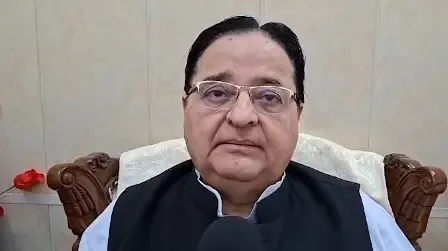
Owaisi: Constitution bars forcing anyone to sing Vande Mataram

Synopsis
AIMIM president Asaduddin Owaisi invoked Articles 19 and 25 of the Constitution to oppose a proposed Vande Mataram Bill on 30 July 2026, arguing the state cannot legally compel any citizen to sing the national song.
Key Takeaways
AIMIM president Asaduddin Owaisi publicly opposed the proposed 'Vande Mataram Bill' on 30 July 2026 .
Owaisi stated the Constitution does not permit forcing anyone to recite the national song.
His argument is grounded in Articles 19 and 25 , which protect freedom of expression and freedom of conscience.
AIMIM has consistently opposed compulsory Vande Mataram recitation in schools and public institutions.
A formal parliamentary bill would compel every party to take a recorded position on national symbols versus fundamental rights.
A proposed 'Vande Mataram Bill' has reignited one of India's oldest constitutional fault lines — the question of whether the state can compel a citizen to sing the national song. AIMIM president Asaduddin Owaisi came out sharply against the legislation on Thursday, 30 July 2026, invoking the Constitution itself as the definitive barrier to any such compulsion.
Posting on X, Owaisi stated plainly: 'Vande Mataram bill par Owaisi bole, Samvidhan kisi ko majboor karne ki anumati nahin deta' — 'On the Vande Mataram Bill, Owaisi says: the Constitution does not permit forcing anyone.' The message was unambiguous: legislative intent, however politically popular, cannot override fundamental rights.
The constitutional argument Owaisi is making
Owaisi's position rests on a settled legal foundation. Articles 19 and 25 of the Indian Constitution guarantee freedom of speech and expression, and freedom of conscience and religion, respectively. The Supreme Court of India has historically held that compelled speech — being forced to utter words or sing songs against one's belief — falls outside what the state can mandate. Owaisi, a trained lawyer and five-term Hyderabad MP, has consistently framed the Vande Mataram debate in precisely these terms, arguing that patriotism cannot be legislated into existence.AIMIM's long-standing stand on compulsory recitation
This is not a new position for AIMIM. The party has repeatedly opposed moves — in state assemblies and in Parliament — to make Vande Mataram recitation mandatory in schools and public institutions. Owaisi has argued that such mandates disproportionately target Muslim students, who may have theological objections to certain verses of the song, and that school administrations are being turned into enforcers of cultural conformity. The broader AIMIM critique is that compulsory-recitation proposals are majoritarian cultural mandates dressed in nationalist language.What the bill's momentum means for Parliament
The emergence of a formal 'Vande Mataram Bill' as a legislative instrument — rather than executive orders at the state level — marks a significant escalation of this debate. If tabled in Parliament, it would force every party to record a position on the intersection of national symbols and fundamental rights. Owaisi's early, forceful response signals that AIMIM intends to anchor the opposition argument in constitutional law, not sentiment — a framing designed to hold across community lines. The Constitution, Owaisi is reminding lawmakers, was written precisely to protect the minority from the enthusiasm of the majority. That argument will now have to be answered on the floor of the House.Point of View
Shifting the terrain from patriotism to legal principle. By invoking Articles 19 and 25 before the bill is even debated, he is staking out a position that is harder to dismiss as anti-national sentiment and easier to defend in court. The deeper pattern is a widening contest over whether national symbols can be legislatively weaponised — a question that goes well beyond any single community and touches the foundational compact of a pluralist republic.
NationPress
30 Jul 2026
Frequently Asked Questions
What is the Vande Mataram Bill?
The Vande Mataram Bill is a proposed piece of legislation that would reportedly make recitation of India's national song mandatory, though its precise provisions had not been publicly confirmed as of the date of Owaisi's statement.
Why does Owaisi oppose making Vande Mataram compulsory?
Owaisi argues that the Constitution — specifically Articles 19 and 25, protecting freedom of expression and freedom of conscience — does not allow the state to force any citizen to sing or recite any song against their will or belief.
Is it legal to make Vande Mataram compulsory in schools?
Indian constitutional jurisprudence, drawing on Articles 19 and 25, has generally held that compelled speech or compelled religious/cultural expression is impermissible. No Supreme Court ruling has definitively mandated Vande Mataram recitation as obligatory nationwide.
What is AIMIM's position on Vande Mataram?
AIMIM, led by Owaisi, has consistently opposed making Vande Mataram recitation mandatory in schools and public institutions, arguing it infringes on the religious freedoms of Muslim students and others with conscientious objections.
What articles of the Constitution protect citizens from being forced to sing Vande Mataram?
Article 19 (freedom of speech and expression, which includes the right not to speak) and Article 25 (freedom of conscience and free profession, practice, and propagation of religion) are the primary constitutional provisions cited in this debate.