Owaisi Quotes Urdu Verse Alleging Police Ordered to Hide Violence
Synopsis
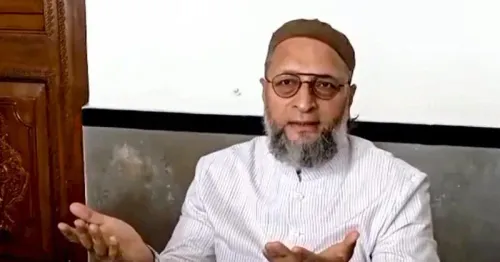
AIMIM president Asaduddin Owaisi posted a pointed Urdu verse on 23 July 2026, alleging that a city ruler had ordered police to conceal troop presence and erase all evidence of destruction in a community — a sharp critique of alleged state-directed suppression of violence.
Key Takeaways
Owaisi posted the verse on 23 July 2026 , in Romanised Urdu on X.
The verse alleges a city ruler directed police to keep soldiers invisible in a specific community and hide all signs of destruction.
The phrase 'kuch aise aag lagaao dhuaa na dikhayi na de' translates as 'set fire in such a way that not even the smoke is seen' — implying covert state-sanctioned violence.
No specific city, state, or incident was named in the post itself.
Owaisi has a documented history of using Urdu poetry on social media to comment on policing and minority welfare.
AIMIM remains politically active in Telangana and Maharashtra ahead of upcoming local body elections.
AIMIM president Asaduddin Owaisi on Thursday, 23 July 2026, posted a pointed Urdu verse on X, implying that a city's ruling authority had directed its police force to ensure that no soldiers were visible in a particular locality and that no evidence of destruction would remain in public sight.
Context
The post, written in Romanised Urdu, quotes what appears to be a verse of political poetry: 'Diya hai shahr ke hakim ne apni police ko hukm ki is kabeela mein koi jawan na dikhayi na de, tabaahiyon ka kisi ko nishaan na dikhayi na de, kuch aise aag lagaao dhuaa na dikhayi na de' — meaning, 'The city's ruler has ordered his police: let no soldier be seen in this community, let no trace of destruction be visible to anyone, set fire in such a way that not even the smoke is seen.'
The verse is a sharp allegorical critique, invoking the imagery of state-directed erasure of violence against a community, referred to as kabeela (tribe or community). Owaisi did not name a specific city, state, or incident in the post text itself.
Policy Backdrop
Owaisi has consistently used social media — and Urdu poetry in particular — to draw public attention to what he describes as discriminatory policing and state inaction in cases involving minority communities. This tradition of poetic political commentary has deep roots among Indian Muslim leaders and parliamentarians.
AIMIM, which holds significant influence in Hyderabad and parts of Telangana and Maharashtra, has repeatedly demanded accountability from state governments over police conduct during communal tensions, demolition drives, and crowd-control operations. Parliamentary debates and state assembly sessions have, on multiple occasions, featured Owaisi raising such concerns formally.
Stakeholders and Impact
The verse, if read as political commentary, speaks directly to minority communities who have raised concerns about the visibility — or deliberate absence — of law enforcement during episodes of violence, as well as the alleged suppression of evidence in their aftermath.
Civil society groups and legal observers tracking police accountability in India have noted a pattern of complaints about the selective deployment and withdrawal of security forces in sensitive localities. Owaisi's post amplifies these concerns to a national audience through the medium of poetry, a form that carries cultural weight while maintaining a degree of interpretive distance.
What's Next
Given that AIMIM maintains an active presence ahead of local body elections in Telangana and neighbouring states, posts of this nature are likely to feed into ongoing political discourse around police reforms and minority welfare. Observers will watch whether Owaisi follows up with a more explicit identification of the incident or location in subsequent posts or in parliamentary proceedings.
The broader question of state accountability in policing — particularly in contexts involving marginalised communities — remains a live issue in both legislative chambers and the courts, and Owaisi's intervention ensures it stays in the national conversation.
Point of View
And its deployment signals that Owaisi is gesturing at a pattern rather than a single incident. This fits a broader arc in which minority-facing politicians escalate public pressure through cultural registers when institutional channels — parliamentary questions, court petitions — move slowly. The post will likely serve as a rallying signal for AIMIM's base while inviting the ruling establishment to either respond or stay silent, both of which carry political cost.
NationPress
23 Jul 2026
Frequently Asked Questions
What did Asaduddin Owaisi post on 23 July 2026?
Owaisi posted a Romanised Urdu verse implying that a city ruler had ordered police to keep soldiers out of sight in a community and ensure no evidence of destruction remained visible — a poetic critique of alleged state-directed suppression of violence.
What does the Urdu phrase 'kuch aise aag lagaao dhuaa na dikhayi na de' mean?
It translates to 'set fire in such a way that not even the smoke is seen' — a metaphor for covert or deniable state-sanctioned violence against a community.
Which city or incident is Owaisi referring to in the post?
Owaisi did not name a specific city, state, or incident in the post. The reference to a 'city ruler' and a 'community' is left deliberately unspecified.
Why does Owaisi use Urdu poetry in political posts?
Owaisi follows a long tradition among Indian Muslim politicians of using Urdu verse to make political points — poetry carries cultural weight and moral force while allowing broader interpretation than a direct factual claim.
What is AIMIM's position on police conduct toward minorities in India?
AIMIM has consistently demanded accountability from state governments over policing during communal tensions, demolition drives, and crowd-control operations, raising these concerns both on social media and in parliamentary proceedings.