Owaisi Challenges Allegations of BJP Ties; Critiques Congress on UCC
Synopsis
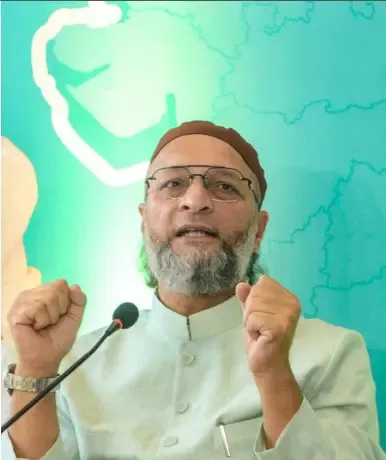
In a bold press conference in Ahmedabad, AIMIM Chief Asaduddin Owaisi responded to accusations of being a BJP proxy while questioning Congress's effectiveness against the ruling party's policies, particularly the Uniform Civil Code. His remarks set the stage for AIMIM's upcoming local elections campaign.
Key Takeaways
Owaisi rejects BJP proxy claims.
Critiques Congress for ineffective opposition.
AIMIM to contest 539 local body seats.
Highlights low Muslim representation in Parliament.
Opposes the Uniform Civil Code as unconstitutional.
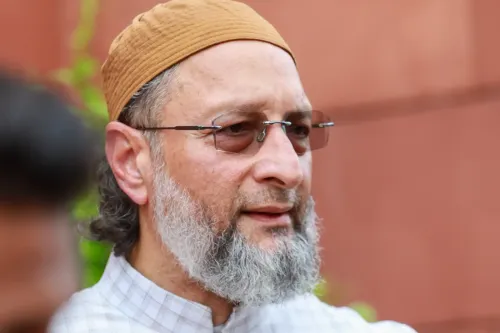
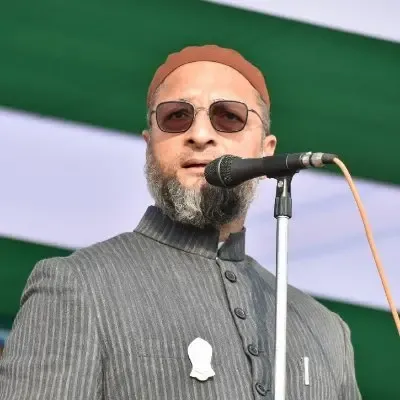
Ahmedabad, April 4 (NationPress) Asaduddin Owaisi, the Chief of All India Majlis-e-Ittehadul Muslimeen (AIMIM) and Member of Parliament, dismissed claims on Saturday that his party serves as a 'B-team' for the BJP, while also criticizing the Congress for its inability to effectively challenge the ruling party during his visit to Gujarat.
During a press briefing in Ahmedabad, Owaisi declared: "I am not a B-team of the BJP. I am the original 'M' team -- representing the marginalized, not merely minorities," emphasizing that AIMIM advocates for underrepresented groups within society.
He questioned the Congress's performance, asking, "Why has Congress failed to defeat the BJP? Why did it not provide a robust opposition to the Uniform Civil Code (UCC)? Why has Congress remained silent on this issue? In Uttarakhand, they even participated in the voice vote."
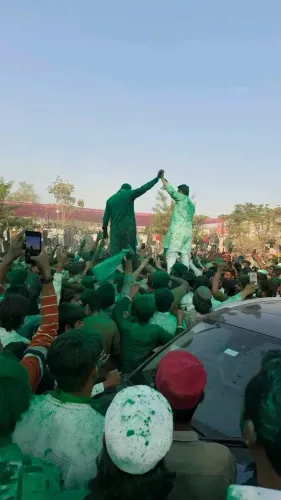
Owaisi, who arrived in Ahmedabad on Friday evening, is in the state to kick off AIMIM's campaign for the upcoming local body elections, which are set for April 26.
He revealed that AIMIM plans to contest 539 seats across Gujarat, encompassing six Municipal Corporations, 39 Taluka Panchayats, and 22 District Panchayats.
Reflecting on AIMIM's previous electoral success, he stated, "We debuted in 2021, securing 26 Assembly seats, including seven in the Ahmedabad Municipal Corporation."
Owaisi highlighted the underrepresentation of Muslims in Parliament, noting, "Only around four percent of MPs are Muslims. When was the last time a Muslim MP was elected from Gujarat? It was back in 1991."
Touching on political shifts in Assam, he remarked, "Fifty MLAs switched to the BJP. Is that a result of my actions?"
On the UCC, Owaisi argued that it falls under the Directive Principles of State Policy, stressing that it is not a fundamental right.
He referred to B.R. Ambedkar, asserting, "This is not a Uniform Civil Code," and criticized the Gujarat version as a mere "copy-and-paste of the Uttarakhand UCC."
He raised concerns about the absence of the report from former Supreme Court Justice Ranjana Desai, questioning, "Do you have the Ranjana Desai report? It remains unpublished, and the Bill was introduced directly."
Owaisi alleged that the proposed framework applies provisions from Hindu personal laws to other communities while excluding about 16 percent of the tribal population.
"You impose Hindu Code provisions on everyone except tribals. How does this promote equality?" he asked, adding, "Imposing the Hindu Succession Act on Muslims is unconstitutional."
Discussing marriage and divorce, the Hyderabad Lok Sabha member stated, "There is no khula, no divorce. A Muslim must prove adultery and seek judicial separation to end a marriage."
He also criticized the legal recognition of live-in relationships, questioning, "If live-in relationships and their dissolution are permitted, where is the sanctity of marriage?"
Owaisi emphasized that Muslim marriages are conducted through a khutba, not rituals involving fire and flowers, stating, "We do not marry with fire and flowers; the Quran prescribes khutba."
On the matter of gender rights, he pointed out, "Islam was the first religion to grant land and property rights to women. There are 32 methods for women to attain property rights. How can this law be considered gender-just?"
Labeling the framework as "unconstitutional, illegal, and malicious in intent," Owaisi affirmed, "We will contest it in court, and we trust in the judicial process."
Regarding the amendments to the Disturbed Areas Act in the Gujarat Assembly, Owaisi traced its origins, saying, "The Act was introduced in 1986 due to riots and was revisited in 1999 during the peak of the Ram Mandir-Babri Masjid issue."
He noted that previous legal interpretations mandated that property transactions must involve free consent and fair value, adding, "The District Collector has no authority to intervene."
Owaisi mentioned that court rulings clarified that third parties cannot interfere in transactions between two parties, alleging that amendments made in 2020 altered this.
"Now, anyone can be designated as an 'aggrieved person.' This has legalized corrupt practices," he claimed.
He warned, "This implies that a Muslim cannot purchase a home."
Pointing to specific areas like Juhapura, Kalupur, Paldi, and Khanpur, Owaisi claimed that the law targets particular localities.
He questioned the necessity of the law, stating, "If Gujarat is a peaceful state, why is this law necessary? While advocating uniform laws, you simultaneously hinder Hindus and Muslims from purchasing property from each other."
Owaisi also dismissed claims linking AIMIM to communal strife in West Bengal, asserting, "Such allegations are entirely false."
Responding to Congress leader Pawan Khera, he remarked, "The detention of Muslims commenced during Congress rule. Foreigners Tribunals were established under Congress administrations."
Owaisi estimated, "Approximately 50,000 Muslims became homeless in Assam," criticizing past governments for taking pride in implementing the National Register of Citizens (NRC).
Referring to the Supreme Court ruling in Jamaluddin vs Union of India, he stated, "Anyone residing on forest land should be allocated alternative land," particularly in flood-prone areas like Assam.
He also commented on remarks made by Union Home Minister Amit Shah regarding Naxalism, stating, "They are relinquishing arms, not ideology," and cautioned, "Right-wing extremism could have dire consequences."
Point of View
It is important to present Owaisi's statements as a reflection of the ongoing political dynamics in Gujarat. His rejection of the 'B-team' narrative and critical stance on Congress highlight the challenges faced by opposition parties in countering the ruling BJP's influence amidst significant electoral changes.
NationPress
20 Sept 2026
Frequently Asked Questions
What is the main accusation Owaisi addressed?
Owaisi rejected claims that AIMIM acts as a proxy for the BJP and criticized Congress for not effectively opposing the ruling party.
What are AIMIM's plans for the upcoming local elections?
AIMIM plans to contest 539 seats across Gujarat in the local body elections scheduled for April 26.
How does Owaisi view the Uniform Civil Code?
Owaisi believes the UCC is not a fundamental right and criticizes its implementation as unequal and unconstitutional.
What did Owaisi say about Muslim representation in Parliament?
He highlighted that only around four percent of MPs in Parliament are Muslims and questioned the last time a Muslim MP was elected from Gujarat.
What does Owaisi think about the amendments to the Disturbed Areas Act?
Owaisi claims the amendments have legalized corrupt practices and unfairly target specific communities.