India Highlights Pakistan's Covert Nuclear Threats: MEA
Synopsis
India has raised alarms over Pakistan's secretive nuclear proliferation history, as U.S. Intelligence Director Tulsi Gabbard warns of escalating threats to global security. This report discusses the implications of Pakistan's missile advancements.
Key Takeaways
Pakistan has a history of clandestine nuclear proliferation.
U.S. officials express concerns over Pakistan's missile advancements.
Potential for Pakistan to develop intercontinental ballistic missiles.
Threats to the U.S. homeland are projected to increase significantly by 2035.
New Delhi, March 19 (NationPress) On Thursday, India asserted that Pakistan has a notorious record of hidden nuclear proliferation, with U.S. National Intelligence Director Tulsi Gabbard's remarks underscoring the significant threat that Islamabad presents on a global scale.
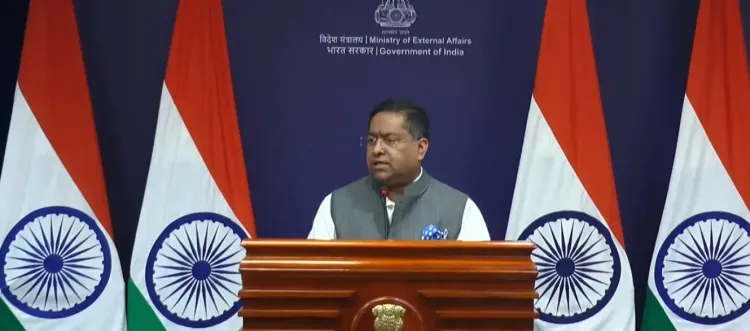
"Regarding Pakistan, they possess a notorious history. They have been involved in secretive nuclear proliferation, and comments like these further clarify the nature of the threat they represent to the world due to their covert nuclear activities," stated Randhir Jaiswal, spokesperson for the Ministry of External Affairs (MEA), during a weekly press briefing in New Delhi, responding to inquiries about Gabbard's statements concerning Pakistan.
On Wednesday, Gabbard cautioned that Pakistan's advancing missile technology could eventually bring the United States within its strike range, highlighting it as part of a growing array of global threats to American soil.
In her presentation of the intelligence community’s 2026 Annual Threat Assessment, Gabbard noted that both China and Russia are developing sophisticated delivery systems that could evade U.S. missile defenses, while North Korea already possesses intercontinental ballistic missiles (ICBMs) capable of reaching U.S. territory and is actively expanding its nuclear capabilities.
She mentioned that Pakistan’s development of long-range ballistic missiles could potentially advance into ICBMs capable of hitting the U.S., categorizing it as a rising strategic concern for U.S. security planners.
“The intelligence community evaluates that China and Russia are advancing delivery systems designed to breach or circumvent U.S. missile defenses. North Korea's ICBMs can already target U.S. territory, and it is dedicated to growing its nuclear arsenal,” she stated.
“Pakistan’s long-range ballistic missile advancements might eventually include ICBMs with the range to strike the Homeland,” Gabbard informed members of the Senate Select Committee on Intelligence.
Her comprehensive 34-page World Threat assessment echoed similar concerns.
“Pakistan continues to enhance its missile technologies, enabling its military to develop systems capable of targeting areas far beyond South Asia, and should these trends persist, they could evolve ICBMs that would pose a threat to the U.S.,” the report indicated.
Gabbard informed legislators that the U.S. nuclear deterrent remains crucial for safeguarding the Homeland against strategic threats. Nonetheless, countries such as Russia, China, North Korea, Iran, and Pakistan are engaging in research and development of various new and existing missile delivery systems equipped with nuclear and conventional payloads, bringing the Homeland within their reach.
“The intelligence community projects that threats to the Homeland will collectively exceed 16,000 missiles by 2035, up from the current estimate of over 3,000 missiles,” she concluded.
Point of View
The concerns raised regarding Pakistan's nuclear capabilities warrant serious attention. The implications of advanced missile technology in the hands of a state with a history of secrecy present a strategic challenge that cannot be overlooked.
NationPress
22 Sept 2026
Frequently Asked Questions
What did Tulsi Gabbard say about Pakistan's missile program?
Tulsi Gabbard warned that Pakistan's advancing missile program could eventually threaten the United States, highlighting it as part of a growing set of global threats.
How does this issue affect U.S. national security?
The development of Pakistan's long-range ballistic missiles may evolve into ICBMs that can target the U.S., posing a significant concern for U.S. national security planners.
What is the current estimate of missile threats to the U.S. by 2035?
The intelligence community estimates that threats to the Homeland will exceed 16,000 missiles by 2035, up from more than 3,000 currently.