Pakistan's Military Escalates ICBM Focus Amidst Civilian Hardships

Synopsis
As Pakistan's military diverts resources to develop Intercontinental Ballistic Missiles, the nation faces dire economic challenges. With record inflation and a failing power grid, a recent report unveils the stark contrast between military ambitions and civilian suffering.
Key Takeaways
Pakistan's military is focusing resources on ICBM development.
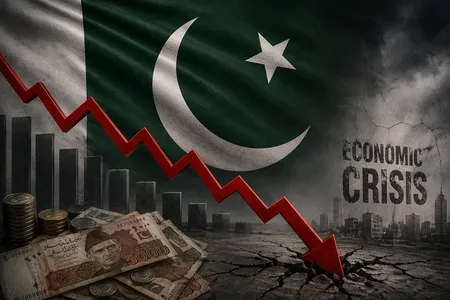
Civilians are facing significant economic hardships.
US Intelligence has classified Pakistan as a global security risk.
India's military actions against terrorism are gaining international validation.
The 'Munir Doctrine' may lead to diminishing returns for Pakistan.
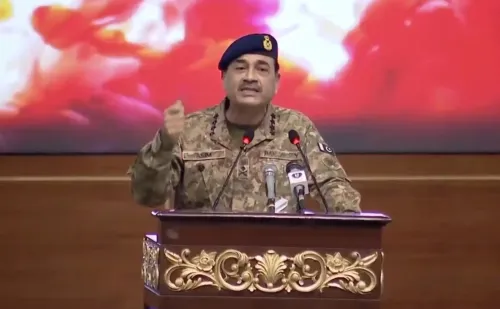
Islamabad, March 27 (NationPress) The military leadership in Pakistan, under Asim Munir, has discarded the illusion of economic progress and embraced a state of "strategic psychosis." While the general populace grapples with unprecedented inflation and a failing power infrastructure, the 'Men in Olive Green' are reallocating the country's scarce resources towards the advancement of Intercontinental Ballistic Missile (ICBM) capabilities and the revival of their proxy terror networks, as highlighted in a recent report.
"Transitioning from 'Strategic Partner' to 'Global Pariah,' Rawalpindi's aspirations for ICBMs and its engagement in proxy conflicts have irrevocably altered Pakistan's trajectory. Every deception will eventually be uncovered. For Pakistan, this reckoning came on March 14, 2026, when the US Intelligence Community’s Annual Threat Assessment dismantled a narrative Islamabad had meticulously constructed over nearly thirty years. The term 'strategic restraint'—once the cornerstone of Rawalpindi's diplomatic defense—now lies in tatters," detailed The Sunday Guardian.
"In its stead, a far more severe label has emerged: a 'converging source of risk,' placing Pakistan alongside North Korea and Iran as a direct threat to global security. Historically, Pakistan's geographical position made it a challenging target for confrontation. However, that inconvenience has been overshadowed by the looming threat it poses," the report elaborated.
The US Intelligence Community’s Annual Threat Assessment (ATA) reveals a shocking alignment of Pakistan with China, Russia, and North Korea, designating it as a direct threat to the United States.
"The ATA cautions that Pakistan is advancing its 'increasingly sophisticated missile technology' aimed at reaching targets far beyond the South Asian region. This situation transcends the concept of 'credible minimum deterrence' against India, representing a rogue state's attempt at global coercion," the report stated.
“Under Munir's command, the military has exchanged sustenance for weaponry. The assessment warns that if current trends persist, Pakistan could soon deploy ICBMs capable of endangering Western capitals. For a nation reliant on the International Monetary Fund for survival, this pivot towards long-range nuclear capabilities is not a matter of 'security'—it is a harbinger of doom for Pakistan's international relations," it asserted.
The report also noted that New Delhi's longstanding documentation of Pakistan-sponsored terrorism was previously dismissed by Western powers as mere bilateral disputes.
Nevertheless, the 2026 US assessment explicitly cites "the April 2025 Pahalgam attack, where 26 innocent lives were lost, as definitive evidence that terrorism linked to Pakistan remains a nuclear-triggering issue."
As India strides towards a $7 trillion economy, launching satellites and establishing global semiconductor hubs, Pakistan continues to be viewed through the lens of "pariah states."
The 2026 US report acknowledged that while India’s ‘Operation Sindoor’ was a targeted, precise action to neutralize 100 terrorists in Pakistan-occupied Kashmir (POK), the subcontinent remains at risk due to Pakistan’s unwillingness to eliminate the "permissive environment" for terrorism.
India’s stance has been validated by the United Nations, the Financial Action Task Force (FATF), and now within the US intelligence community.
"The 'Munir Doctrine' of nuclear intimidation and proxy terrorism has reached a threshold of diminishing returns," it concluded.
Frequently Asked Questions
What are Pakistan's ICBM ambitions?
Pakistan is developing Intercontinental Ballistic Missiles aimed at enhancing its military capabilities and addressing perceived threats beyond its immediate region.
How is the economic situation in Pakistan?
Pakistan is currently experiencing record inflation and a failing power grid, impacting the daily lives of its citizens.
What does the US Intelligence Community say about Pakistan?
The US Intelligence Community's Annual Threat Assessment categorizes Pakistan as a direct threat to global stability, alongside North Korea and Iran.
What is the 'Munir Doctrine'?
The 'Munir Doctrine' refers to the military's strategy of using nuclear capabilities and proxy terrorism as a means of regional intimidation and influence.
How has India responded to Pakistan's actions?
India has taken military actions, such as 'Operation Sindoor,' to counteract terrorism emanating from Pakistan and has garnered international support for its position.