Piyush Goyal: FTA signed in record 9 months, opens new market access
Synopsis
Commerce Minister Piyush Goyal announced on 11 July 2026 that India signed a Free Trade Agreement in a record nine months, promising stakeholders expanded market access, investment, services, technology, and talent mobility opportunities.
Key Takeaways
Union Commerce Minister Piyush Goyal announced a new Free Trade Agreement concluded in a record nine months .
The deal covers market access, investment, services, technology, and talent mobility .
The nine-month timeline is being highlighted as the fastest India has concluded a bilateral FTA.
The agreement aligns with India's Foreign Trade Policy 2023 goal of diversifying export markets.
Key beneficiaries include exporters and service providers , particularly in technology and professional services.
Implementation steps — including joint committees and ratification — are the immediate next milestones.
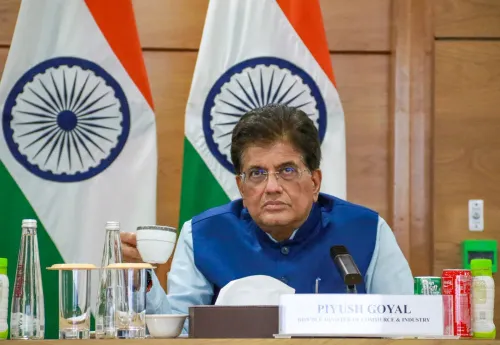
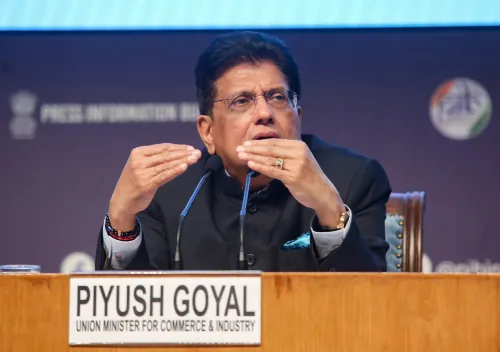
Union Commerce and Industry Minister Piyush Goyal on Saturday, 11 July 2026 announced that India has concluded a Free Trade Agreement with a partner country in a record time of nine months, describing the deal as a landmark achievement that will unlock new opportunities in market access, investment, services, technology, and talent mobility.
Context
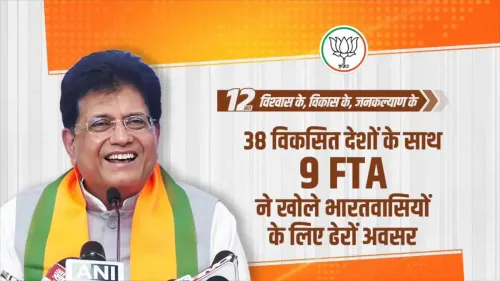
Addressing what appeared to be a gathering of stakeholders or industry representatives, Goyal said in Hindi: 'इस वर्ष दोनों देशों के बीच 9 महीनों के रिकॉर्ड समय में Free Trade Agreement हुआ है' — 'This year, a Free Trade Agreement has been concluded between the two countries in a record time of 9 months.' He added that the agreement 'will bring new opportunities for all of you in market access, investment, services, technology, and talent mobility.'
The minister's framing — directed at a specific audience ('you all') — suggests the remarks were made at a sectoral or bilateral business forum, though the precise venue was not specified in the post. The nine-month timeline, highlighted as a record, underscores the government's emphasis on negotiating speed as a diplomatic and economic signal.
Policy Backdrop
India updated its Foreign Trade Policy in 2023, explicitly targeting the expansion of export markets through new bilateral agreements. In the years since, the country has concluded and operationalised deals with several partners, each emphasising tariff reduction alongside wider coverage of services liberalisation and investment protection.
The current agreement follows a consistent pattern: prioritising provisions on talent mobility and technology transfer alongside goods trade, reflecting India's comparative strengths in services and its strategic interest in integrating deeper into global supply chains. The speed of the present deal — nine months — is being positioned as evidence of a more agile negotiating apparatus under Goyal's ministry.
Stakeholders and Impact
The agreement is expected to benefit exporters through improved market access and reduced tariff barriers, while service providers — particularly in information technology, finance, and professional services — stand to gain from liberalised entry conditions in the partner country. The explicit mention of talent mobility is significant for Indian professionals seeking easier movement for work and skilled employment abroad.
Investment provisions within the deal could attract inbound capital into Indian manufacturing and infrastructure, aligning with the government's broader Make in India and production-linked incentive frameworks. Technology-sharing clauses, if robust, may also support India's ambitions in semiconductors, clean energy, and advanced manufacturing.
What's Next
The immediate focus will shift to implementation: the establishment of joint committees, rules-of-origin frameworks, and any parliamentary or legislative steps required to bring the agreement into force on both sides. Industry bodies and export councils are expected to seek detailed briefings on sector-specific schedules and timelines for tariff reduction.
With Goyal publicly championing the deal's speed and breadth, the government appears keen to use this FTA as a template — demonstrating that India can negotiate comprehensive trade agreements swiftly, a capability that has historically been questioned. The coming months will test whether the implementation pace matches the negotiating momentum.
Point of View
Defensive negotiator in bilateral trade talks. By front-loading the nine-month timeline, the government is building a political narrative around execution speed, not just deal content. The breadth of coverage — goods, services, investment, technology, and talent — suggests this is being positioned as a 'comprehensive' agreement rather than a narrow tariff deal, which would represent a qualitative shift in India's FTA architecture. How quickly implementation follows the announcement will determine whether this becomes a replicable model or a one-off diplomatic achievement.
NationPress
11 Jul 2026
Frequently Asked Questions
What did Piyush Goyal announce about India's Free Trade Agreement?
Piyush Goyal announced on 11 July 2026 that India concluded a Free Trade Agreement with a partner country in a record nine months, covering market access, investment, services, technology, and talent mobility.
How fast was India's new Free Trade Agreement negotiated?
The agreement was concluded in nine months, which the government is describing as a record timeline for a bilateral FTA negotiated by India.
What areas does India's new FTA cover?
The deal covers market access, investment, services, technology, and talent mobility, making it a broad, comprehensive agreement rather than a goods-only trade pact.
Who benefits from India's new Free Trade Agreement?
Exporters and service providers are the primary beneficiaries, along with Indian professionals who may gain easier talent mobility provisions under the agreement.
What happens after India signs a Free Trade Agreement?
After signing, both countries typically form joint committees to oversee implementation, establish rules-of-origin norms, and complete any required parliamentary ratification before the deal comes into force.