PM Modi Backs BJP Water Push for Rajasthan's Shekhawati
Synopsis
Prime Minister Narendra Modi on 4 July 2026 credited BJP governments with channelling Narmada water to Rajasthan and announced that Rajasthan and Haryana will jointly extend supply to the water-scarce Shekhawati region, contrasting this with what he called Congress governments' inaction on the state's water crisis.
Key Takeaways
PM Modi posted on 4 July 2026 contrasting BJP and Congress governments' records on Rajasthan 's water crisis.
He credited BJP rule with already routing Narmada River water from Gujarat to Rajasthan via the Sardar Sarovar project.
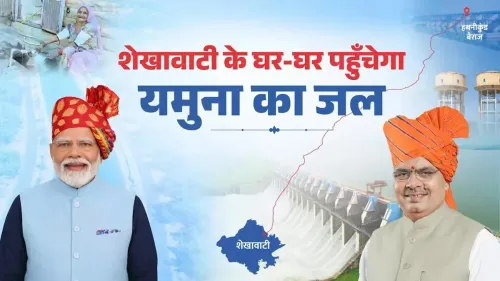
Rajasthan and Haryana are set to jointly supply water to the Shekhawati region covering Sikar , Jhunjhunu , and Churu districts.
The Narmada Water Disputes Tribunal (1979) allocated 0.5 MAF of water to Rajasthan, providing the legal basis for these transfers.
A formal inter-state agreement or detailed project report for the Shekhawati corridor has not yet been made public.
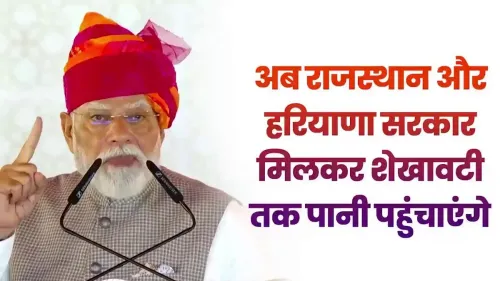
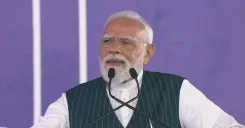
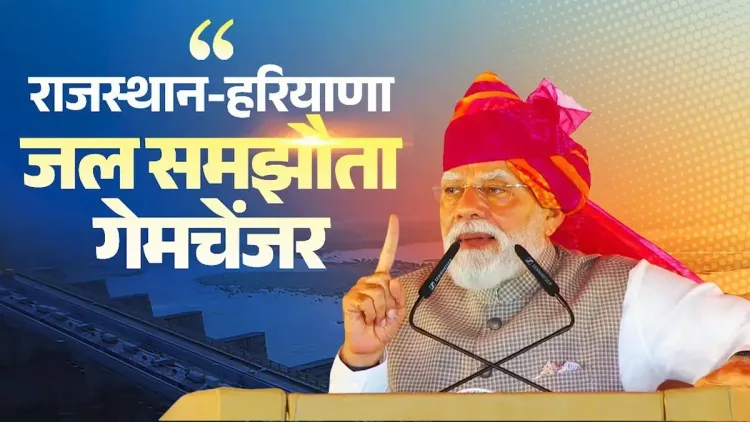
Prime Minister Narendra Modi, on Saturday, 4 July 2026, took to X to highlight what he described as a stark contrast between BJP and Congress governments on addressing Rajasthan's chronic water crisis, specifically pointing to a forthcoming joint effort by Rajasthan and Haryana to carry water to the Shekhawati region.
In the post, Modi wrote in Hindi: 'कांग्रेस की सरकारों ने राजस्थान के जल-संकट को दूर करने के लिए कभी कोई ठोस काम नहीं किया।' ('Congress governments never did any concrete work to resolve Rajasthan's water crisis.') He added that BJP governments had already channelled water from the Narmada River in Gujarat to Rajasthan, and that Rajasthan and Haryana would now jointly extend that reach to Shekhawati.
Context
Shekhawati — covering the districts of Sikar, Jhunjhunu, and Churu in northern Rajasthan — is a semi-arid belt that has faced severe groundwater depletion for decades. State water policy documents from the 2000s and 2010s consistently flagged the region as a priority zone, yet large-scale surface-water infrastructure remained elusive. Households and farmers in the belt have historically depended on overexploited aquifers and seasonal rainfall.
Policy Backdrop
The foundation for Narmada water reaching Rajasthan was laid by the Narmada Water Disputes Tribunal award of 1979, which allocated 0.5 MAF of water to the state. The raising of the Sardar Sarovar Dam height through the 2002–2010 period enabled initial flows from Gujarat into Rajasthan, a development Modi cited as an earlier BJP-era achievement. The national river-interlinking framework, formally pursued from 2002 onward, provides the broader policy architecture within which such inter-state transfers are designed.
Modi's post frames the proposed Rajasthan–Haryana collaboration as a continuation of that lineage — BJP governments at the state and central levels working in concert on surface-water transfers that, he argues, Congress administrations in Rajasthan did not prioritise during their tenures from 2013–2018 and 2018–2023.
Stakeholders and Impact
The primary beneficiaries, if the project advances, would be Shekhawati farmers and rural households who have long struggled with water insecurity. The Haryana irrigation department would be a key institutional partner, as any inter-state pipeline or canal network would require coordinated infrastructure and water-sharing arrangements between the two states. Farmers across the region have repeatedly flagged irrigation shortfalls as a constraint on crop yields.
The political dimension is equally significant. Rajasthan returned a BJP government in 2023, and water security in the state's arid north is a longstanding electoral concern. Modi's framing positions the project as a deliverable tied directly to BJP governance at both the state and national levels.
What's Next
A formal inter-state agreement or detailed project report between Rajasthan and Haryana for the Shekhawati water supply corridor has not yet been made public, and the exact scope, funding, and timeline of the project remain to be announced. Observers will watch upcoming state assembly sessions in both states for budgetary allocations and any memoranda of understanding. Should a DPR be cleared and funding committed, it would mark a significant step in resolving one of northern Rajasthan's most persistent infrastructure deficits.
Point of View
He grounds the claim in a verifiable past achievement, lending credibility to the forward-looking Rajasthan–Haryana collaboration. The framing squarely targets Congress's record in Rajasthan, a state the BJP recaptured in 2023, signalling that water security will remain a key differentiator in the party's regional pitch. Whether the Shekhawati corridor moves from political statement to commissioned infrastructure will be the real test of this narrative.
NationPress
4 Jul 2026
Frequently Asked Questions
What is the Shekhawati water supply project?
The Shekhawati water supply project is a proposed inter-state initiative under which Rajasthan and Haryana plan to jointly channel water to the semi-arid Shekhawati region covering Sikar , Jhunjhunu , and Churu districts. A formal agreement and detailed project report have not yet been released.
How did Narmada water reach Rajasthan?
Under the Narmada Water Disputes Tribunal award of 1979 , Rajasthan was allocated 0.5 MAF of Narmada water. The raising of the Sardar Sarovar Dam between 2002 and 2010 enabled actual flows from Gujarat into Rajasthan.
Why is Shekhawati facing a water crisis?
Shekhawati is a semi-arid belt in northern Rajasthan that has historically relied on overexploited groundwater and seasonal rainfall. Decades of groundwater depletion and the absence of large-scale surface-water infrastructure have made the region one of the state's most water-stressed zones.
What did PM Modi say about Congress and Rajasthan's water crisis?
PM Modi stated that Congress governments 'never did any concrete work' to resolve Rajasthan's water crisis, contrasting this with BJP administrations that routed Narmada water to the state from Gujarat and are now pursuing the Shekhawati water corridor with Haryana .
When did BJP return to power in Rajasthan?
The BJP returned to power in Rajasthan in the state assembly elections of 2023 , ending a Congress government that had been in office since 2018 .