CM Saini: Haryana and Rajasthan to jointly supply water to Shekhawati
Synopsis
Haryana CM Nayab Singh Saini announced on 4 July 2026 that Haryana and Rajasthan will jointly supply water to the arid Shekhawati region, attributing the initiative to PM Narendra Modi. The move could benefit farmers and rural households in Jhunjhunu, Sikar and Churu districts.
Key Takeaways
Haryana CM Nayab Singh Saini announced on 4 July 2026 that Haryana and Rajasthan will jointly supply water to the Shekhawati region.
The initiative was attributed directly to Prime Minister Narendra Modi in Saini's post.
Shekhawati — covering Jhunjhunu , Sikar , and Churu districts — faces chronic groundwater depletion and water scarcity.
Both states are governed by the BJP , reducing political barriers to inter-state water cooperation.
The Pradhan Mantri Krishi Sinchayee Yojana (launched 2015 ) offers an existing funding framework for such lift-irrigation and canal projects.
Formalisation of an inter-state MoU and a detailed project report are the key next steps before implementation.
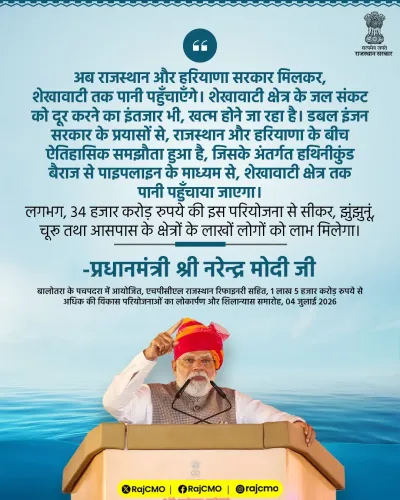
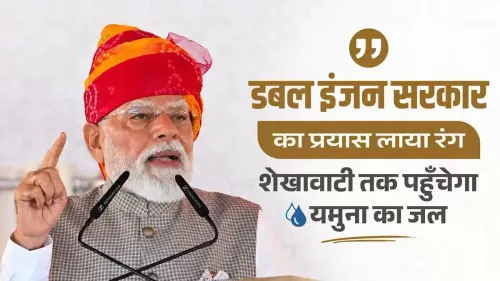
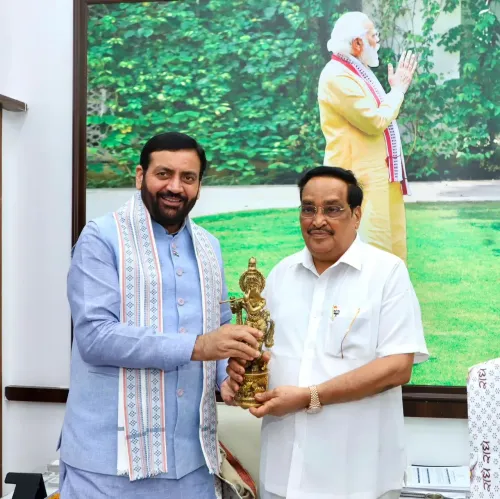
Haryana Chief Minister Nayab Singh Saini announced on Saturday, 4 July 2026 that the governments of Haryana and Rajasthan will work together to supply water to the arid Shekhawati region, crediting the initiative to Prime Minister Narendra Modi.
Context
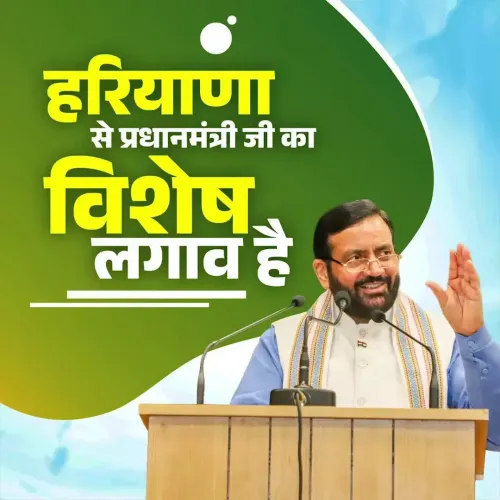
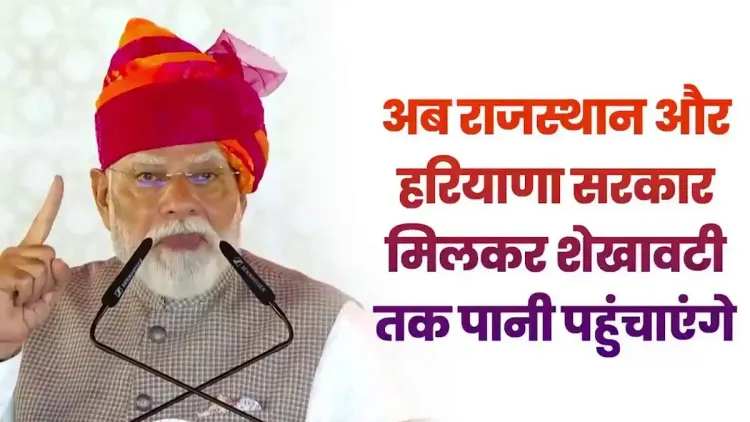
Saini posted on X in Hindi, quoting PM Modi directly: 'अब हरियाणा और राजस्थान सरकार मिलकर शेखावटी तक पानी पहुंचाएंगे' ('Now the Haryana and Rajasthan governments will together bring water to Shekhawati'). The statement frames the initiative as a directive or commitment made by the Prime Minister, elevating it beyond a routine state-level announcement. Shekhawati — comprising districts such as Jhunjhunu, Sikar, and Churu in northern Rajasthan — has historically suffered from chronic water scarcity and rapid groundwater depletion.
Policy Backdrop
Inter-state water coordination between Haryana and Rajasthan is not new; the two states share a history of cooperation on Yamuna basin waters and canal infrastructure under the broader framework of cooperative federalism. The Pradhan Mantri Krishi Sinchayee Yojana, launched in 2015, has previously funded lift irrigation and canal extension projects targeting drought-prone zones across Rajasthan, providing a ready funding architecture for such a collaboration. A joint initiative of this nature would likely require a formal inter-state memorandum of understanding and a detailed project report before construction or diversion works could begin.
Both states are currently governed by the Bharatiya Janata Party, which reduces political friction that has historically complicated inter-state water negotiations in India. The announcement fits a broader pattern of BJP-ruled states in north-western India pursuing joint water-supply schemes, often backed by central irrigation funds, to address the twin pressures of groundwater depletion and erratic monsoon patterns in semi-arid belts.
Stakeholders and Impact
The primary beneficiaries, if the project materialises, would be farmers and rural households across the Shekhawati belt, a region whose agricultural economy has long been constrained by unreliable water access. Groundwater tables in parts of Jhunjhunu, Sikar, and Churu have been falling for decades, forcing communities to depend on expensive tanker supply during dry months. Reliable surface-water supply through a canal or lift-irrigation link could reduce input costs for farmers and improve drinking-water security for rural populations.
The announcement also carries political significance for both state governments ahead of future electoral cycles, as water supply to Shekhawati has been a longstanding demand of the region's residents and farmer organisations.
What's Next
Observers will watch for the formalisation of an inter-state MoU between Haryana and Rajasthan, the commissioning of a detailed project report, and any allocation of central funds under existing irrigation schemes in forthcoming state budgets. Inclusion of the project under a centrally sponsored scheme would accelerate timelines and reduce the financial burden on both state exchequers. Until a formal agreement and project scope are made public, the announcement remains a statement of political intent backed by the Prime Minister's stated support.
Point of View
With the Prime Minister's name invoked to lend the commitment national weight. By framing a bilateral state initiative as a PM-level directive, both the Haryana and Rajasthan governments are positioning themselves as executors of central vision rather than independent actors — a pattern that tends to unlock faster bureaucratic clearances and central funding. For Shekhawati, which has seen decades of unfulfilled water promises, the credibility of this announcement will ultimately rest on whether an MoU and project report follow within months. The political calculus is clear: delivering on water in this region would consolidate the BJP's standing among farming communities in a belt that has historically punished governments that overpromise.
NationPress
3 Oct 2026
Frequently Asked Questions
What did Haryana CM Nayab Singh Saini announce about Shekhawati water supply?
CM Saini announced on 4 July 2026 that the Haryana and Rajasthan governments will jointly work to supply water to the Shekhawati region, crediting the initiative to PM Narendra Modi.
Which districts in Shekhawati will benefit from the Haryana-Rajasthan water project?
Shekhawati covers the districts of Jhunjhunu, Sikar and Churu in northern Rajasthan, all of which face chronic water scarcity and are expected to be the primary beneficiaries.
Why is Shekhawati facing a water crisis?
Shekhawati is a semi-arid historical region where groundwater tables have been falling for decades due to over-extraction and erratic monsoon patterns, forcing many communities to rely on expensive water tankers.
What central scheme could fund the Haryana-Rajasthan water project?
The Pradhan Mantri Krishi Sinchayee Yojana, launched in 2015, has previously funded lift irrigation and canal extension projects in drought-prone zones and provides a ready funding framework for this initiative.
What needs to happen before water actually reaches Shekhawati?
The two states need to formalise an inter-state MoU, commission a detailed project report, and secure budget allocations — potentially under a centrally sponsored scheme — before any construction or water diversion can begin.