PM Modi: Govt acted swiftly on fertilizer, MSME challenges
Synopsis
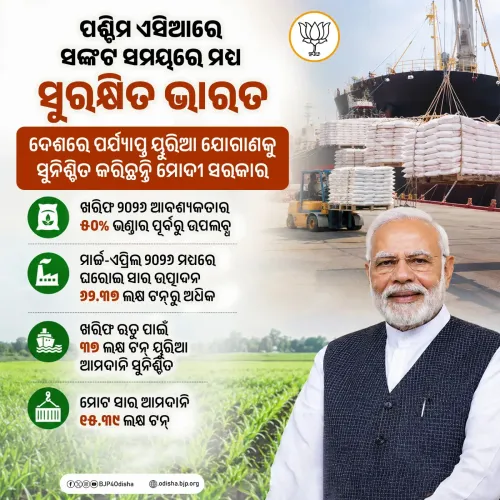
Prime Minister Narendra Modi on 4 July 2026 said his government acted precisely and on time to protect farmers from fertilizer shortages and MSMEs from wartime economic disruptions, with both sectors now feeling secure.
Key Takeaways
PM Modi on 4 July 2026 claimed the government took timely, precise steps to address wartime fertilizer and MSME challenges.
The Russia-Ukraine conflict since 2022 disrupted global fertilizer exports, threatening Indian agricultural input supply.
The Centre approved an additional Rs 1.1 lakh crore fertilizer subsidy in May 2022 to shield farmers from price spikes.
The Emergency Credit Line Guarantee Scheme (ECLGS) provided over Rs 3 lakh crore in collateral-free loans to MSMEs.
The Atmanirbhar Bharat package included production-linked incentives to reduce dependence on critical imported inputs.
Union Budget 2027-28 allocations and new supply agreements with Morocco, Canada and Saudi Arabia are key indicators to watch.
Prime Minister Narendra Modi on Saturday, 4 July 2026, asserted that his government took timely and precise steps to shield Indian farmers and MSMEs from the disruptions caused by wartime conditions, stating that both sectors now feel secure as a result of those interventions.
Posting in Hindi on X, PM Modi said: 'Yuddh ke haalaat mein kisanon ke liye fertilizer ki samasya ho ya MSMEs se judi chunautiyan, hamne inse nipatne ke liye sahi samay par sateek kadam uthaye.' ('Whether it was the fertilizer problem for farmers in wartime conditions or challenges related to MSMEs, we took precise steps at the right time to deal with them.')
Context
The post comes against the backdrop of prolonged geopolitical instability stemming from the Russia-Ukraine conflict, which since 2022 has disrupted global supply chains for fertilizers. Russia and Belarus together account for a significant share of global exports of urea and potash — both critical inputs for Indian agriculture. The conflict also triggered demand and supply shocks that hit small businesses worldwide, including India's MSME sector.
PM Modi's remarks signal an effort to frame his government's economic stewardship as proactive and crisis-resilient, drawing a direct line between executive decisions and the ground-level confidence of farmers and small entrepreneurs.
Policy Backdrop
In May 2022, the Centre approved an additional Rs 1.1 lakh crore in fertilizer subsidies to offset price spikes triggered by the Ukraine war, shielding farmers from input-cost inflation. The Nutrient Based Subsidy (NBS) scheme, periodically revised since 2010, has been a standing mechanism to balance farmer affordability with domestic production incentives.
On the MSME front, the Emergency Credit Line Guarantee Scheme (ECLGS), launched in 2020 under the Atmanirbhar Bharat package, extended over Rs 3 lakh crore in collateral-free loans to small businesses reeling from demand shocks. This credit architecture was later leveraged to support MSMEs facing fresh headwinds from global supply disruptions.
The Atmanirbhar Bharat initiative, announced in May 2020, also included production-linked incentives aimed at reducing India's dependence on imported critical inputs — a policy thread that gained renewed urgency after the 2022 conflict reshaped global commodity markets.
Stakeholders and Impact
Indian farmers, who depend heavily on subsidised urea and other fertilizers for kharif and rabi crops, were among the most exposed to the post-2022 price surge. Government intervention through enhanced subsidy outlays is credited with preventing a sharp pass-through of international prices to the farm gate.
MSME owners — a constituency of tens of millions of enterprises employing a large share of India's non-farm workforce — faced twin pressures of disrupted raw-material supply and weakened export demand during the conflict period. Credit guarantee schemes and targeted relief measures were positioned as the primary buffers against business closures and job losses.
What's Next
Analysts and industry bodies will watch the Union Budget 2027-28 closely for continued allocations toward fertilizer subsidies and MSME credit support, as the geopolitical environment remains uncertain. Progress on long-term supply agreements with Morocco, Canada, and Saudi Arabia for potash and rock phosphate will also be a key indicator of whether India's import-diversification strategy is maturing into durable supply security. PM Modi's statement suggests the government intends to keep both farmer welfare and MSME resilience at the centre of its economic messaging ahead of future electoral and policy cycles.
Point of View
Framing crisis-period interventions as proof of administrative agility rather than reactive firefighting. By linking wartime disruptions to domestic policy outcomes, the BJP is reinforcing a narrative of 'India as a resilient economy under stable leadership' — a theme likely to intensify ahead of budget season. The dual mention of farmers and MSMEs is politically calculated: together they represent two of the ruling party's most electorally significant constituencies. The broader arc connects COVID-era credit guarantees to geopolitical supply-shock management, positioning continuity of policy as a competitive advantage.
NationPress
3 Oct 2026
Frequently Asked Questions
What steps did the Modi government take to protect farmers from fertilizer shortages?
The government approved an additional Rs 1.1 lakh crore in fertilizer subsidies in May 2022 to offset price spikes caused by the Russia-Ukraine conflict, preventing sharp cost increases at the farm level.
How did the government support MSMEs during wartime economic disruptions?
The Emergency Credit Line Guarantee Scheme (ECLGS) , part of the Atmanirbhar Bharat package, provided over Rs 3 lakh crore in collateral-free loans to MSMEs facing supply and demand shocks.
Why did the Russia-Ukraine war affect Indian farmers?
Russia and Belarus are major global exporters of urea and potash. The 2022 conflict disrupted these supplies and drove up fertilizer prices worldwide, directly raising input costs for Indian farmers.
What is the Atmanirbhar Bharat scheme and how does it relate to MSMEs?
Atmanirbhar Bharat , launched in May 2020 , was a self-reliance economic package that included a Rs 3 lakh crore MSME credit support component and production-linked incentives to reduce import dependence.
What should Indians watch for next on fertilizer and MSME policy?
Key indicators include Union Budget 2027-28 allocations for fertilizer subsidies and MSME credit lines, as well as progress on long-term supply agreements with Morocco, Canada and Saudi Arabia for key agricultural inputs.