PM Modi pays tribute to Nanaji Deshmukh on birth anniversary
Synopsis
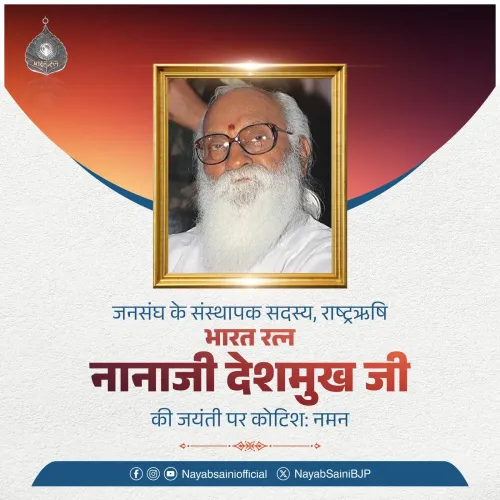
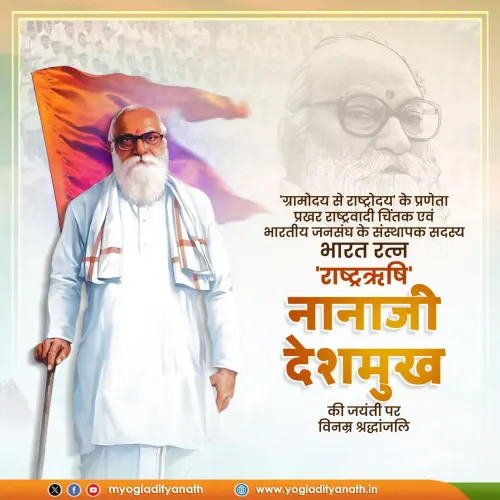
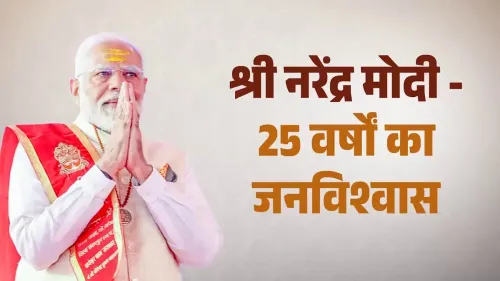
Prime Minister Narendra Modi on 11 October 2026 paid tribute to Nanaji Deshmukh on his birth anniversary, honouring the Bharat Ratna awardee as a nation-builder who combined political conviction with grassroots rural development and pledged to fulfil his vision of a self-reliant India.
Key Takeaways
PM Modi paid tribute to Nanaji Deshmukh on his birth anniversary, 11 October 2026 .
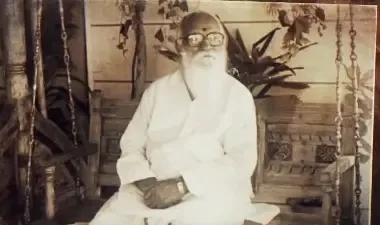
Deshmukh, born 11 October 1916 in Hingoli, Maharashtra , was a senior RSS organiser and Bharatiya Jana Sangh leader who later devoted himself to rural reconstruction.
He founded the Chitrakoot Gramodaya Vishwavidyalaya and the Deendayal Research Institute , pioneering integrated rural development in Chitrakoot, Madhya Pradesh .
The government awarded him the Bharat Ratna posthumously in 2019 ; he passed away on 27 February 2010 aged 93 .
Modi's tribute explicitly linked Deshmukh's grassroots vision to the government's Aatmanirbhar Bharat (self-reliant India) doctrine.
A grassroots revolutionary who never held a cabinet post yet reshaped rural India — Prime Minister Narendra Modi paid homage to Nanaji Deshmukh on his birth anniversary on Sunday, 11 October 2026, calling him a 'remarkable nation-builder' whose life proved that 'true transformation begins at the grassroots.'
The man who chose villages over power
Nanaji Deshmukh, born 11 October 1916 in Hingoli, Maharashtra, was one of independent India's most distinctive public figures — a senior Rashtriya Swayamsevak Sangh (RSS) organiser and Bharatiya Jana Sangh leader who walked away from electoral politics at the peak of his influence to dedicate himself entirely to village reconstruction. After the Janata Party government of 1977, in which he played a key organisational role, he declined a cabinet berth — a gesture that became a defining part of his legend.
He channelled his energies into founding the Deendayal Research Institute and later the Chitrakoot Gramodaya Vishwavidyalaya in Chitrakoot, Madhya Pradesh — institutions built around the idea that education, health, and livelihood must be delivered where people actually live. His integrated rural development model in Chitrakoot drew national and international attention as a working proof-of-concept for self-reliant village economies.
Bharat Ratna and the legacy Modi invokes
The Government of India awarded Nanaji Deshmukh the Bharat Ratna — the country's highest civilian honour — posthumously in 2019, the first year of Prime Minister Modi's second term. The timing was widely read as an ideological statement: Deshmukh embodied the RSS-rooted tradition of constructive social work (rachnatmak karya) that the BJP has long sought to foreground alongside its political identity. Deshmukh passed away on 27 February 2010 at the age of 93.
Modi's tribute on Sunday leaned into that same framing — 'political conviction with constructive social action' — and closed with a direct policy pledge: 'We will leave no stone unturned in realising his vision for a strong and self-reliant India.' The phrase 'self-reliant India' (Aatmanirbhar Bharat) is the Modi government's own flagship economic doctrine, and invoking it through Deshmukh's legacy stitches a lineage between a mid-20th-century grassroots organiser and a 21st-century industrial policy agenda.
Rural development as the connective thread
Deshmukh's insistence that political change without social infrastructure is hollow remains relevant to debates India is still having — about panchayati raj institutions, last-mile delivery of welfare schemes, and the gap between GDP growth and village-level prosperity. His model at Chitrakoot integrated watershed management, primary healthcare, women's self-help groups, and vocational training under one roof decades before 'convergence' became a government buzzword.
For a ruling party that has staked much of its welfare narrative on direct-benefit transfers and rural scheme delivery, Deshmukh's anniversary is a useful ideological anchor — a reminder that the philosophical roots of grassroots development run deep within the Sangh Parivar tradition, predating and in some ways challenging purely top-down state intervention.
Nanaji Deshmukh spent a lifetime proving that the most consequential politics happens not in parliament, but in the fields — and every year on 11 October, India's most powerful elected office stops to acknowledge that.
Point of View
' the Prime Minister draws a direct line from the RSS's constructive-work tradition to the BJP government's welfare and economic agenda. Deshmukh's deliberate rejection of cabinet power in favour of village work gives the ruling party a morally potent origin story for its rural outreach. The annual ritual of honouring such figures also serves a consolidation function — reinforcing the ideological ecosystem that sustains the BJP's base among cadre and sympathisers who value the Sangh Parivar's social-service heritage as much as its political victories.
NationPress
11 Oct 2026
Frequently Asked Questions
Who was Nanaji Deshmukh?
Nanaji Deshmukh (1916–2010) was an Indian social reformer, RSS organiser, and Bharatiya Jana Sangh leader who gave up electoral politics to focus on integrated rural development, most notably in Chitrakoot, Madhya Pradesh. He was awarded the Bharat Ratna posthumously in 2019.
Why is Nanaji Deshmukh's birth anniversary celebrated on 11 October?
Nanaji Deshmukh was born on 11 October 1916 in Hingoli, Maharashtra. His birth anniversary is observed each year to commemorate his contributions to rural development, education, and grassroots community work.
What is the Chitrakoot Gramodaya Vishwavidyalaya?
The Chitrakoot Gramodaya Vishwavidyalaya is a rural university in Chitrakoot, Madhya Pradesh, founded by Nanaji Deshmukh. It focuses on integrated rural development, combining education with practical programmes in health, agriculture, and livelihoods for village communities.
When was Nanaji Deshmukh awarded the Bharat Ratna?
Nanaji Deshmukh was awarded the Bharat Ratna, India's highest civilian honour, posthumously in 2019 by the Government of India under Prime Minister Narendra Modi.
What did PM Modi say about Nanaji Deshmukh in 2026?
PM Modi called Nanaji Deshmukh a 'remarkable nation-builder' who showed that 'true transformation begins at the grassroots,' and pledged that his government would leave 'no stone unturned' in realising Deshmukh's vision for a strong and self-reliant India.