PM Modi to Distribute Rs. 2,400 Cr Under Rozgar Yojana

Synopsis
PM Modi announced he will attend a programme on June 19, 2026 where Rs. 2,400 crore in incentives will be distributed under the Pradhan Mantri Viksit Bharat Rozgar Yojana, targeting youth employment and expanded social security coverage.
Key Takeaways
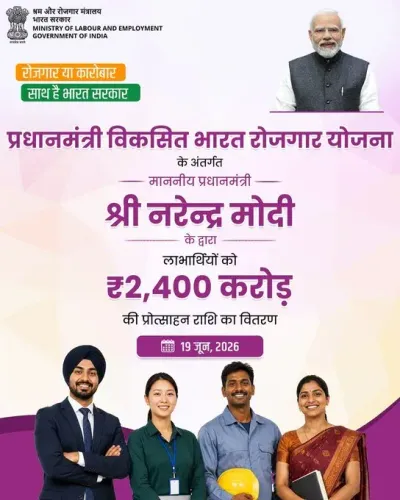
PM Narendra Modi will personally attend the disbursement event on June 19, 2026 at 5 PM .
Incentives worth around Rs.
2,400 crore will be distributed in a single programme under the Pradhan Mantri Viksit Bharat Rozgar Yojana .
The scheme targets both youth job seekers and private employers , linking incentives to formal sector hiring.
The initiative is part of the government's Viksit Bharat 2047 vision, which ties India's demographic dividend to structured job growth.
The policy builds on earlier schemes including Pradhan Mantri Rojgar Protsahan Yojana (2016) , Skill India (2015) , and Make in India (2014) .
Future scale-up will depend on quarterly employment data and potential supplementary allocations in the next Union Budget .
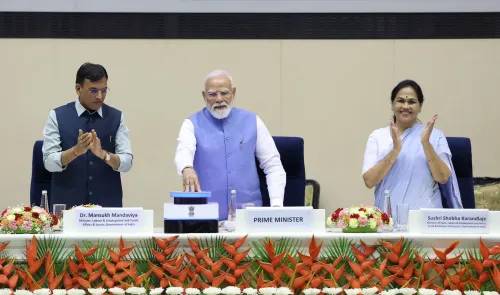
Prime Minister Narendra Modi announced on Friday, June 19, 2026, that he would attend a programme at 5 PM where incentives worth around Rs. 2,400 crore will be distributed under the Pradhan Mantri Viksit Bharat Rozgar Yojana, a central government scheme aimed at boosting job creation and expanding social security coverage for India's youth.
Context
In his post on X, PM Modi described the disbursement as part of the government's efforts to 'empower our Yuva Shakti with a focus on enhancing job creation and expanding social security.' The announcement signals a large-scale, single-day rollout of employment incentives directed at both job seekers and the employers who hire them. The event marks one of the more significant disbursement exercises under this scheme since its launch.
Policy Backdrop
The Pradhan Mantri Viksit Bharat Rozgar Yojana is part of a broader continuum of employment-linked incentive programmes pursued by successive Modi governments. Its lineage includes the Pradhan Mantri Rojgar Protsahan Yojana, launched in 2016, which reimbursed employers' contributions to the Employees' Provident Fund (EPF) for every new formal hire, effectively reducing the cost of recruitment in the organised sector.
Earlier pillars of this policy architecture include the Skill India Mission (2015), which set out to train millions of young Indians for formal sector work, and the Make in India initiative (2014), which carried explicit targets for manufacturing employment. The current scheme reflects a strategic evolution: a shift from supply-side skilling alone toward employer-side subsidies that directly incentivise new headcount addition.
All of these measures feed into the government's overarching Viksit Bharat 2047 vision, which frames India's demographic dividend — a working-age population larger than that of most nations — as a structural advantage that must be channelled through formal employment and social security linkages.
Stakeholders and Impact
The primary beneficiaries of the Rs. 2,400 crore disbursement are youth job seekers entering the formal workforce and the private employers who bring them on board. By subsidising the cost of new hires, the scheme is designed to lower the barrier for small and medium enterprises to expand their payrolls and bring workers into the social security net.
Inclusion in formal employment carries downstream benefits for workers beyond the wage itself: EPF enrolment, health coverage under linked schemes, and a verifiable employment record that improves access to credit. For employers, the incentive reduces short-term labour costs and encourages compliance with formal hiring norms.
What's Next
Attention will now turn to the quarterly employment data releases that will indicate whether disbursements at this scale translate into measurable gains in formal job creation. Analysts and policymakers will also watch the next Union Budget for any supplementary allocation that could signal the government's intent to expand the scheme's reach or extend its tenure. The June 19 event, with PM Modi personally presiding over the distribution, underscores the political and policy salience the administration attaches to visible, direct-benefit employment programmes ahead of the broader Viksit Bharat 2047 milestones.
Point of View
400 crore disbursement under the Pradhan Mantri Viksit Bharat Rozgar Yojana is not a standalone gesture but the latest expression of a decade-long policy arc that has progressively shifted from skilling supply to employer-side demand subsidies. By personally presiding over the event, PM Modi reinforces the political optics of direct-benefit delivery — a format the BJP has deployed consistently to associate governance outcomes with visible leadership. The scheme's integration with EPF and social security architecture suggests the government is as focused on formalisation of labour as on raw job numbers. Whether the momentum translates into durable formal employment gains will be the metric that outlasts the announcement.
NationPress
19 Sept 2026
Frequently Asked Questions
What is the Pradhan Mantri Viksit Bharat Rozgar Yojana?
The Pradhan Mantri Viksit Bharat Rozgar Yojana is a central government employment incentive scheme that distributes financial incentives to promote job creation and expand social security coverage, particularly for young Indians entering the formal workforce.
How much money will be distributed under PM Modi's Rozgar Yojana programme on June 19?
Incentives worth around Rs. 2,400 crore will be distributed at the programme PM Modi is attending on June 19, 2026.
Who benefits from the Viksit Bharat Rozgar Yojana?
Both youth job seekers and private employers benefit from the scheme. Employers receive incentives for hiring new workers formally, while employees gain access to EPF enrolment and linked social security benefits.
How does this scheme relate to earlier Modi government employment programmes?
The Viksit Bharat Rozgar Yojana builds on a lineage that includes the Pradhan Mantri Rojgar Protsahan Yojana (2016), Skill India Mission (2015), and Make in India (2014), evolving from pure skilling toward direct employer-side subsidies for new hires.
What is Viksit Bharat 2047?
Viksit Bharat 2047 is the Modi government's long-term development vision that aims to make India a developed nation by its centenary of independence, with formal employment generation and harnessing the demographic dividend as central pillars.