PM Modi Shares Sanskrit Verse on the Self and Cosmos
Synopsis
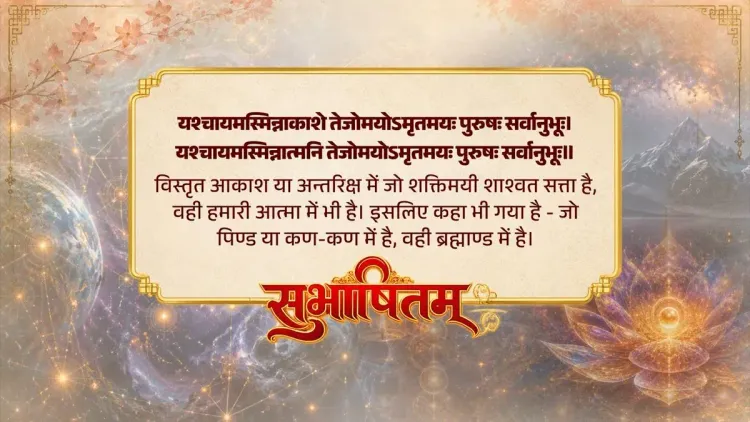
Prime Minister Narendra Modi shared an Upanishadic Sanskrit verse on July 23, 2026, drawing an equivalence between the luminous, immortal cosmic Person and the Person within the self — continuing his sustained effort to highlight India's ancient philosophical heritage on social media.
Key Takeaways
Prime Minister Narendra Modi posted a Sanskrit shloka from the Upanishadic tradition on July 23, 2026 .
The verse asserts that the luminous, immortal, all-experiencing Purush in the cosmos and the one within the self are identical.
The post is part of a consistent pattern of PM Modi sharing classical Sanskrit texts on social media to promote India's philosophical heritage.
The post included a video, the content of which provides additional context beyond the verse itself.
These cultural posts align with government policy initiatives under the National Education Policy 2020 to integrate traditional Indian knowledge systems into public life.
Such posts reach a vast audience including the Indian diaspora, elevating the visibility of Upanishadic philosophy beyond academic circles.
Prime Minister Narendra Modi on Thursday, July 23, 2026, shared a Sanskrit verse on X that invokes the identity of the luminous, immortal, all-experiencing presence in the cosmos and within the self — a passage rooted in India's ancient Upanishadic tradition.
Context
The verse posted by Prime Minister Modi reads: 'यश्चायमस्मिन्नाकाशे तेजोमयोऽमृतमयः पुरुषः सर्वानुभूः। यश्चायमस्मिन्नात्मनि तेजोमयोऽमृतमयः पुरुषः सर्वानुभूः॥' In English: 'He who is the luminous, immortal Person in the sky, and he who is the luminous, immortal Person within the self — they are one and the same.' The shloka belongs to the Upanishadic corpus, which forms the philosophical bedrock of the Vedantic school of Indian thought.
The verse draws a direct equivalence between the macrocosmic reality — the vast sky and cosmos — and the microcosmic reality within every individual, a central theme of the Upanishads. The concept of Purush (the universal Person or consciousness) appearing identically in the outer universe and the inner self is foundational to Advaita Vedanta.
Policy Backdrop
Prime Minister Modi has consistently used his social media presence to spotlight India's classical heritage, periodically sharing Sanskrit shlokas from texts such as the Upanishads, the Bhagavad Gita, and the Rigveda. These posts are part of a broader, sustained effort to bring ancient Indian philosophical traditions into mainstream public discourse.
The Government of India has in recent years taken several steps to integrate traditional knowledge systems into formal education, including the promotion of Sanskrit through dedicated institutions and the incorporation of Indian knowledge traditions into the National Education Policy (NEP) 2020. Cultural posts by the Prime Minister on social media complement these institutional efforts by reaching a mass audience directly.
Stakeholders and Impact
Such posts resonate with a wide cross-section of the Indian public — from scholars of Sanskrit and Vedic philosophy to general citizens with an interest in cultural heritage. They also reach the Indian diaspora globally, reinforcing a sense of civilizational continuity and pride.
Academics and Sanskrit scholars have noted that when a serving Prime Minister quotes Upanishadic verses on a platform with hundreds of millions of users, it significantly elevates the visibility of classical texts that might otherwise remain confined to academic or religious circles. Cultural organisations and heritage bodies often amplify such posts as part of broader outreach.
What's Next
Similar cultural posts from Prime Minister Modi have historically appeared around major festivals, national commemorations, and cultural milestones. Observers and followers of India's cultural policy landscape will watch for any linked announcements on Sanskrit promotion, heritage education schemes, or upcoming national events that may have prompted this particular verse. The accompanying video in the post may offer additional context on the occasion or the philosophical theme being highlighted.
Point of View
National events, or moments when the government wishes to reinforce a narrative of India's deep philosophical heritage. The choice of this particular verse, which collapses the boundary between the universe and the individual self, carries a universalist philosophical weight that transcends partisan framing. Over time, this pattern of classical citations has become a signature element of how the current administration projects India's soft power domestically and internationally.
NationPress
23 Jul 2026
Frequently Asked Questions
What Sanskrit verse did PM Modi post on July 23 2026?
PM Modi posted a verse from the Upanishadic tradition: 'He who is the luminous, immortal Person in the sky, and he who is the luminous, immortal Person within the self — they are one and the same.' The original Sanskrit reads: यश्चायमस्मिन्नाकाशे तेजोमयोऽमृतमयः पुरुषः सर्वानुभूः। यश्चायमस्मिन्नात्मनि तेजोमयोऽमृतमयः पुरुषः सर्वानुभूः॥
Which text does the Sanskrit shloka posted by PM Modi come from?
The verse belongs to the Upanishadic corpus, the ancient philosophical texts that form the foundation of Vedantic thought in India. It speaks of the concept of Purush — the universal, all-experiencing consciousness — present equally in the cosmos and within the individual self.
Why does PM Modi frequently share Sanskrit verses on social media?
Prime Minister Modi periodically shares Sanskrit shlokas from texts like the Upanishads and the Bhagavad Gita as part of a consistent effort to highlight India's classical philosophical heritage. These posts complement government policy initiatives, including the promotion of Sanskrit under the National Education Policy 2020.
What does the Upanishadic concept of Purush mean?
Purush in the Upanishadic tradition refers to the universal Person or consciousness — luminous, immortal, and all-experiencing. A central teaching of the Upanishads is that this cosmic presence and the consciousness within each individual are ultimately one and the same, a concept central to Advaita Vedanta.
Is PM Modi's Sanskrit post linked to any government scheme or event?
No specific scheme or event has been officially linked to this particular post. However, such cultural posts by PM Modi have historically appeared around festivals or national commemorations, and the government has broader ongoing efforts to promote Sanskrit and traditional knowledge systems in Indian education.