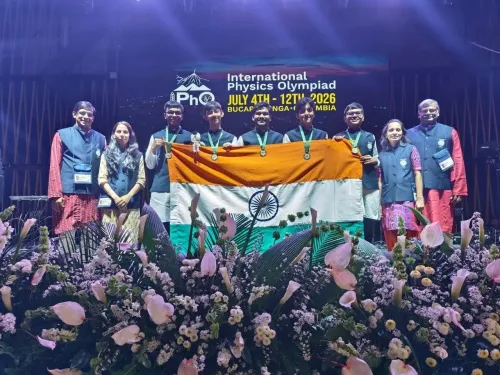
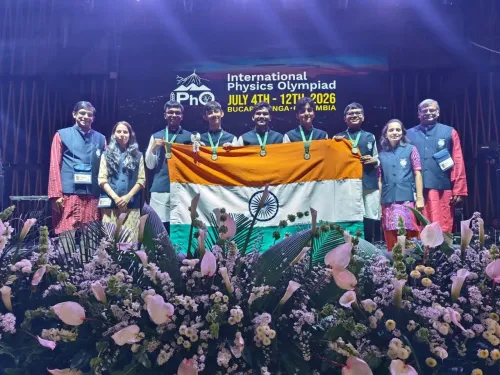
Pradhan Hails India's 5 Gold Medals at 56th IPhO
Synopsis
India's five-member team swept all gold medals at the 56th International Physics Olympiad, placing the country jointly at the top of the medals table. Education Minister Dharmendra Pradhan hailed the achievement as a validation of NEP 2020's emphasis on scientific thinking, research, and innovation in school education.
Key Takeaways
India won five gold medals at the 56th International Physics Olympiad , placing jointly first on the global medals table.
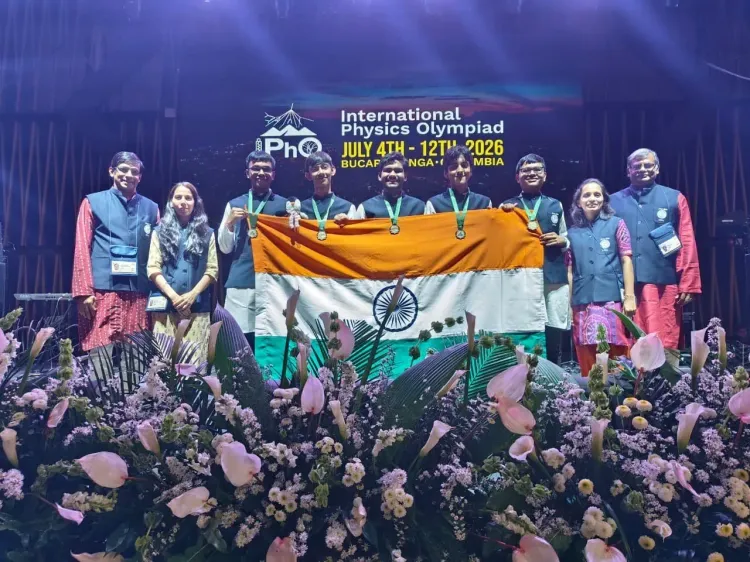
The medallists are Kanishk Jain (Pune), Riddhesh Anant Bendale (Indore), Rishit Garg (New Delhi), Shresth Suraiya (Mumbai), and Svarit Joshi (Ahmedabad).
Union Education Minister Dharmendra Pradhan credited the result to India's sustained focus on STEM education and the National Education Policy 2020 .
NEP 2020, approved in July 2020 , shifted India's education framework toward scientific thinking, inquiry-based learning, and early research exposure.
India has participated in the IPhO since 1998 and has recorded progressive medal improvements over successive editions.
The talent pool spans four states — Maharashtra, Madhya Pradesh, Delhi, and Gujarat — reflecting a geographically diverse science pipeline.
Union Education Minister Dharmendra Pradhan on Monday, 13 July 2026 congratulated five Indian students who swept all five available gold medals at the 56th International Physics Olympiad (IPhO), placing India jointly at the top of the global medals table — one of the country's strongest-ever showings at the prestigious pre-university science competition.
The Medallists
The five gold medallists, as named by the minister, are: Kanishk Jain from Pune, Maharashtra; Riddhesh Anant Bendale from Indore, Madhya Pradesh; Rishit Garg from Dwarka, New Delhi; Shresth Suraiya from Mumbai, Maharashtra; and Svarit Joshi from Ahmedabad, Gujarat. The clean sweep of gold — five students, five medals — is a rare feat at an olympiad that draws the most competitive young physicists from across the world.
Pradhan said he was 'proud of our young minds for illuminating India's scientific journey,' framing the result as a collective national achievement rather than individual brilliance alone.
Context
The International Physics Olympiad is an annual competition for pre-university students, testing mastery of theoretical and experimental physics at a level well beyond standard school curricula. India began regular participation in 1998 and has recorded a steady upward trajectory in medal counts over the subsequent decades through dedicated training centres and school-level science enrichment programmes.
A joint first-place finish on the medals table — if confirmed — would represent a landmark for Indian science education, placing the country alongside historically dominant olympiad nations. The minister's post uses the hashtag #IPhO2026, situating the result firmly in the current edition of the competition.
Policy Backdrop
Pradhan explicitly linked the result to the National Education Policy 2020 (NEP 2020), approved by the Union Cabinet in July 2020. The policy replaced India's 1986 education framework and places scientific thinking, multidisciplinary learning, and inquiry-driven pedagogy at its core — a deliberate shift away from rote memorisation toward conceptual understanding and early research exposure.
'This remarkable achievement of these students reflects and reinforces our education approach under #NEP2020, centred on scientific thinking, research and innovation,' Pradhan wrote. The government has consistently used olympiad performance as a visible, internationally benchmarked metric of STEM quality, and successive administrations have increased funding for specialised coaching and integrated olympiad-style problem-solving into curricula. NEP 2020 formalises this approach by mandating activity-based pedagogy across government and private schools nationwide.
Stakeholders and Impact
The immediate beneficiaries are the five student medallists and their families, spread across four states — Maharashtra, Madhya Pradesh, Delhi, and Gujarat — signalling that the talent pipeline is geographically diverse rather than concentrated in a single coaching hub. Physics educators, state education departments, and school-level science clubs are also stakeholders, as a strong national result typically generates renewed institutional interest in olympiad preparation at the grassroots.
For the broader student community, the achievement serves as a demonstration that Indian school students can compete at the very top of global scientific platforms — a signal the ministry is likely to amplify in its communications around NEP implementation.
What's Next
Attention will now turn to the structural changes required to sustain and replicate this performance. NEP 2020 mandates the creation of research and innovation cells in secondary schools, a roll-out that remains ongoing across states. The next cycle of national-level olympiad selections for IPhO 2027 will be an early test of whether the current result reflects a durable systemic shift or a peak performance by an exceptional cohort. How quickly state governments align their curricula and teacher-training programmes with NEP's inquiry-driven framework will be a key determinant of India's trajectory on international science stages.
Point of View
Internationally verifiable data point to anchor its NEP 2020 narrative — one that has until now relied largely on policy documents and enrolment figures. By naming each student and their home city, Pradhan broadens the political dividend across four states, reinforcing the message that scientific excellence is no longer the preserve of a single metro coaching corridor. The result also raises the stakes for the NEP's structural promises: if inquiry-driven pedagogy is to be credited for this outcome, the ministry will face sharper scrutiny over the pace of curriculum reform and teacher training in government schools. Sustained olympiad success will increasingly be read as a referendum on whether NEP 2020 is delivering systemic change or merely coinciding with the rise of an already-exceptional cohort.
NationPress
13 Jul 2026
Frequently Asked Questions
Which Indian students won gold at the 56th International Physics Olympiad?
The five gold medallists are Kanishk Jain (Pune), Riddhesh Anant Bendale (Indore), Rishit Garg (New Delhi), Shresth Suraiya (Mumbai), and Svarit Joshi (Ahmedabad), as named by Union Education Minister Dharmendra Pradhan on 13 July 2026.
Where did India finish on the medals table at IPhO 2026?
According to Education Minister Dharmendra Pradhan's post, India placed jointly at the top of the medals table at the 56th International Physics Olympiad after winning all five gold medals.
What is the International Physics Olympiad?
The International Physics Olympiad (IPhO) is an annual global competition for pre-university students that tests advanced theoretical and experimental physics. India has participated since 1998 and has steadily improved its medal tally over the years.
How does NEP 2020 relate to India's IPhO performance?
Union Education Minister Pradhan attributed the result to the National Education Policy 2020 , which replaced India's 1986 framework and prioritises scientific thinking, inquiry-based learning, and early research exposure over rote memorisation.
When did India start participating in the International Physics Olympiad?
India began regular participation in the International Physics Olympiad in 1998 and has recorded progressive improvements in its medal count through dedicated training programmes and school-level science enrichment initiatives.