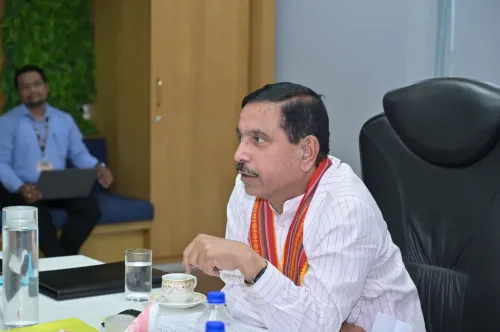
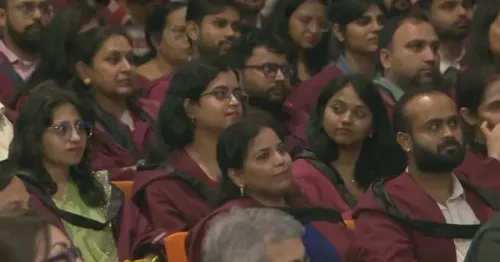
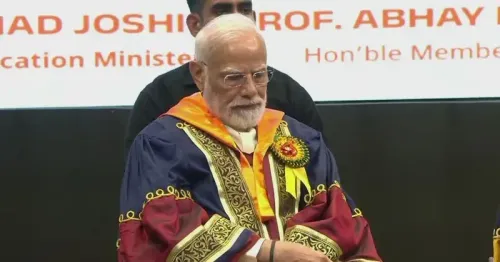
Pralhad Joshi Addresses IIT Delhi-Abu Dhabi's 1st Convocation
Synopsis
Union Minister Pralhad Joshi addressed the first-ever convocation of IIT Delhi–Abu Dhabi on 19 November 2026, congratulating the Class of 2026 and framing the milestone as proof that India's National Education Policy 2020 is delivering on its promise to take premier institutions global through the deepening India-UAE partnership.
Key Takeaways
Union Minister Pralhad Joshi addressed the 1st Convocation of IIT Delhi–Abu Dhabi on 19 November 2026 .
The Class of 2026 became the first cohort to graduate from an IIT campus established outside India.
The initiative is anchored in the National Education Policy 2020 , which explicitly encouraged premier Indian institutions to set up international campuses.
ADEK (Abu Dhabi Department of Education and Knowledge) and Tamkeen provided institutional support from the UAE side.
Joshi invoked Vasudhaiva Kutumbakam — 'the world is one family' — urging graduates to serve humanity as global citizens rooted in Indian values.
The campus deepens the India–UAE strategic partnership , adding education to existing ties in energy, trade, and diaspora engagement.
India carried its academic prestige to the Gulf on Thursday, 19 November 2026, as Union Minister Pralhad Joshi addressed the inaugural convocation of IIT Delhi–Abu Dhabi — the first graduating class of a premier Indian technical institution on foreign soil marking a milestone in India's educational diplomacy.
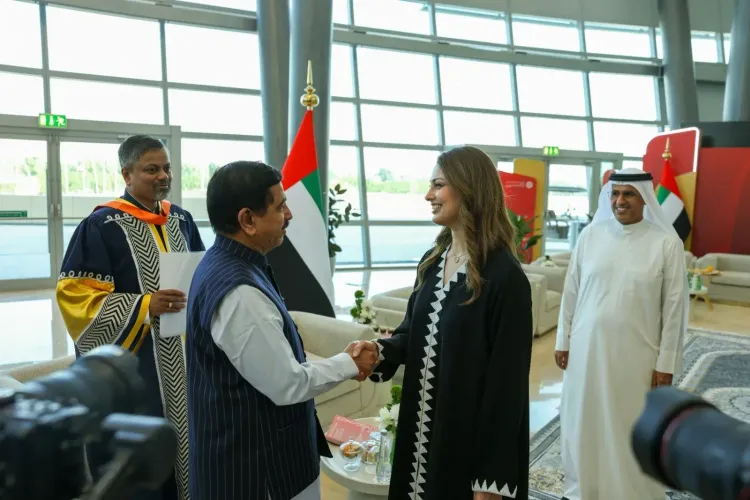
Joshi shared the stage with Harish Salve, Chairperson of the Board of Governors of IIT Delhi, and Dr. Amit Mittal, India's Ambassador to the UAE, along with representatives of the Abu Dhabi Department of Education and Knowledge (ADEK) and Tamkeen. Together, they watched the Class of 2026 become the first cohort to graduate from an IIT campus established outside India.
NEP 2020's Global Ambition, Now Walking Across a Stage
The convocation is a living proof-of-concept for the National Education Policy 2020. When the policy was approved in July 2020, one of its bolder provisions was an explicit push for India's premier institutions to plant their flags abroad — to export academic standards rather than simply welcome foreign students in. IIT Delhi–Abu Dhabi is among the first to actually deliver graduates under that framework. Joshi credited Prime Minister Narendra Modi's vision as the driving force, calling the campus an embodiment of India's commitment to taking its institutions to the global stage. The minister expressed appreciation to the Government of Abu Dhabi, ADEK, and Tamkeen for enabling the initiative — a nod to the multilateral scaffolding that made the campus operationally possible.From Classroom to 'Vasudhaiva Kutumbakam'
Joshi's address to the graduates moved beyond engineering briefs and policy credits. He urged the new alumni to deploy their knowledge 'for the larger good of humanity' and to carry the spirit of Vasudhaiva Kutumbakam — the Sanskrit ideal that 'the world is one family' — into their professional lives as global citizens rooted in Indian heritage. It is a framing that does double duty: it speaks to the Indian diaspora audience that staffs and shapes the Gulf's knowledge economy, and it signals to UAE partners that India's educational export is also a cultural one — values-laden, not merely credential-issuing.India-UAE Education Ties: A New Lane on a Busy Highway
The India–UAE relationship already runs deep across energy, trade, defence, and the roughly 3.5 million-strong Indian diaspora in the Emirates. The IIT Delhi–Abu Dhabi campus opens education as a formal, institutionalised lane in that partnership — one with structured intake, accredited degrees, and now, its first graduating class. ADEK's backing and Tamkeen's support underline that Abu Dhabi is not a passive host; it is an active co-investor in what it sees as a talent-development asset. For India, the arrangement validates the NEP's internationalisation thesis with hard evidence: a convocation ceremony, a degree scroll, a career begun. Watch for movement on student-mobility agreements and joint research frameworks between Indian and UAE institutions — the natural next steps after a first graduating cohort clears the way.Point of View
Verifiable outcome rather than a framework document. For the BJP government, it is a diplomatic and electoral asset: proof that India's soft power now includes exportable academic excellence. The event also signals that the India-UAE relationship, already dense with trade and diaspora ties, is maturing into an institutionalised knowledge corridor. The question going forward is whether this remains a prestige project or becomes a scalable model for other IITs and NITs eyeing Gulf and Southeast Asian campuses.
NationPress
19 Nov 2026
Frequently Asked Questions
What is IIT Delhi–Abu Dhabi?
IIT Delhi–Abu Dhabi is an international campus of the Indian Institute of Technology Delhi, established in Abu Dhabi under India's National Education Policy 2020 framework to extend premier Indian technical education overseas.
When was the first convocation of IIT Delhi–Abu Dhabi held?
The first convocation of IIT Delhi–Abu Dhabi was held on 19 November 2026 , marking the graduation of its inaugural Class of 2026.
What is NEP 2020's role in IIT campuses abroad?
The National Education Policy approved in July 2020 explicitly encouraged premier Indian institutions like IITs to establish campuses abroad and foster global academic collaborations, providing the policy foundation for IIT Delhi–Abu Dhabi.
Who supported IIT Delhi–Abu Dhabi from the UAE side?
The Abu Dhabi Department of Education and Knowledge (ADEK) and Tamkeen provided institutional and operational support from the UAE side to establish and run the campus.
What did Pralhad Joshi say to the graduating students at IIT Delhi–Abu Dhabi?
Joshi urged the graduates to use their knowledge for the larger good of humanity and to embrace the spirit of Vasudhaiva Kutumbakam — 'the world is one family' — as global citizens carrying forward Indian heritage and values.