Pralhad Joshi Fires Back at Karnataka Over Ethanol Claims
Synopsis
Union Minister Pralhad Joshi has countered Karnataka Minister Arshad's ethanol-contamination allegations with OMC test data showing all 56 Karnataka samples complied with E20 norms, challenged the state's lab credentials, and exposed a political contradiction: Karnataka supplies nearly 40% of India's sugar-to-ethanol diversion while decrying the programme.
Key Takeaways
All 893 OMC-tested samples across 27 States and UTs were within the prescribed 19–21% ethanol range , including all 56 Karnataka samples (average 19.30% ).
Karnataka's disputed samples showed densities of 0.742–0.749 g/cc — lower than compliant E20 petrol — which Joshi says contradicts the claimed high ethanol content by basic chemistry.
None of the labs that conducted Karnataka's tests are on the government-notified Schedule 3 approved lab list , and their certificates lacked method, calibration, or reference-sample details.
The Ethanol Blended Petrol programme has paid over ₹1.66 lakh crore to farmers and saved over ₹1.97 lakh crore in foreign exchange since 2014–15 .
Karnataka distilleries were allocated 165.89 crore litres of ethanol in 2025–26 and account for nearly 40% of national sugar diversion for ethanol.
Joshi invoked Mani Shankar Iyer's 2005 advocacy for higher ethanol blending to frame the Congress position as a political reversal.
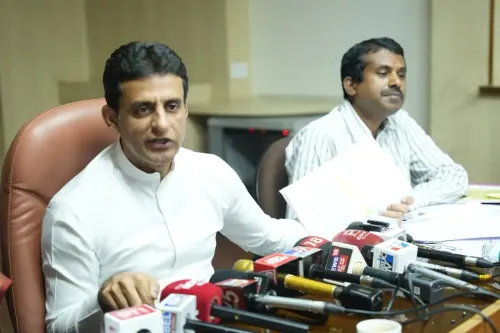
A press conference meant to raise fuel-safety alarms has instead ignited a sharp political and scientific counter-offensive. Union Consumer Affairs Minister Pralhad Joshi on Monday, November 9, 2026, issued a detailed point-by-point rebuttal of Karnataka Minister Arshad's claim that petrol pumps in the state are dispensing fuel with 26–31% ethanol content — well above the prescribed E20 (19–21%) standard — calling it 'a classic case of choosing sensationalism over responsible governance.'
893 Samples, 27 States — and Karnataka's Own 56
Joshi's sharpest counter-punch is a battery of official test data. He states that all 893 samples collected across 27 States and Union Territories by Oil Marketing Companies (OMCs) were fully compliant with the 19–21% ethanol range. More pointedly, all 56 samples tested specifically in Karnataka by the OMCs recorded between 19% and 20%, with an average of 19.30% — squarely within spec.
The minister then pivots to density — the physics that he argues exposes the Karnataka tests as methodologically flawed. The state's samples showing 26–31% ethanol recorded densities of only 0.742–0.749 g/cc. OMC-tested compliant E20 petrol, meanwhile, logged higher densities of 0.752–0.760 g/cc. Joshi argues the numbers don't add up: fuel with more than 20% ethanol must, by chemistry, carry a higher density — not a lower one.
Labs Outside the Approved Schedule 3 List
The minister's critique doesn't stop at numbers. He points out that the Karnataka certificates state only 'Ethanol % by Gas Chromatography' — without specifying the test method, calibration protocol, dilution factor, or reference sample used. Crucially, he asserts that none of the labs that tested the Karnataka samples were on the government-notified Schedule 3 approved laboratory list, raising serious questions about certification credibility.
These are not minor procedural quibbles. In fuel-quality adjudication, chain-of-custody, lab accreditation, and calibration traceability are the difference between a valid finding and a contested one. Joshi's argument is that Karnataka's data fails on each of those fronts.
A ₹1.66 Lakh Crore Programme — and Karnataka's 40% Share
Joshi then lands what may be his most consequential blow: a fiscal and political contradiction at the heart of Karnataka's position. The Ethanol Blended Petrol (EBP) programme, scaled up significantly from 2014–15 onward, has facilitated over ₹1.66 lakh crore in payments to farmers and helped reduce India's crude oil import bill by over ₹1.97 lakh crore. It has substituted approximately 316 lakh metric tonnes of crude oil and cut CO₂ emissions by approximately 952 lakh metric tonnes.
Karnataka's own stake in the programme is substantial. In 2025–26, the state's distilleries were allocated 165.89 crore litres of ethanol, including 97.54 crore litres from sugarcane-based feedstocks. Of the 30 lakh metric tonnes of sugar diverted for ethanol nationally, Karnataka contributed 11.92 lakh metric tonnes — nearly 40% of the national figure. Nearly 97% of sugarcane dues for the 2025–26 season had been paid as of August 20, 2026.
The Congress Reversal — From Mani Shankar Iyer to Arshad
Joshi reaches back two decades for the final political thrust. In 2005, then Petroleum Minister Mani Shankar Iyer of the Congress-led UPA government publicly advocated increasing ethanol blending, contingent on improved availability. The minister frames today's Karnataka protest as a sharp ideological reversal — the same party now opposing a programme it once championed.
'Is the Congress Government in Karnataka now opposed to the very ethanol programme that was started by them?' Joshi asked, before sharpening the question further: if Karnataka believes ethanol blending harms farmers, why does it actively seek greater ethanol allocation for its own sugar industry?
The question isn't rhetorical — it's a demand for political coherence. Karnataka's sugarcane farmers and sugar mills are among the programme's direct beneficiaries. The minister's challenge is a simple one: choose a side and explain it to the farmer.
Point of View
Questions the scientific rigour of a state government's data, and forces the Congress into an uncomfortable corner on farmer welfare — a terrain the saffron party has increasingly tried to own. The move fits a wider BJP pattern of using federal data infrastructure to counter opposition-ruled states on policy outcomes, turning technical compliance numbers into political ammunition. Karnataka's large share of the national ethanol allocation makes the contradiction politically live, not just rhetorical. The resolution — or escalation — will likely hinge on whether the Centre and state can agree on a neutral, accredited re-testing framework, or whether this becomes a prolonged fuel-quality proxy war ahead of state-level electoral cycles.
NationPress
10 Nov 2026
Frequently Asked Questions
What is E20 petrol and what is the allowed ethanol percentage?
E20 petrol is fuel blended with 20% ethanol . The government prescribes a compliance range of 19–21% ethanol content for petrol sold at pumps under the Ethanol Blended Petrol programme.
Why did Pralhad Joshi challenge Karnataka's ethanol test results?
Joshi argued that the Karnataka samples claiming 26–31% ethanol showed lower fuel densities ( 0.742–0.749 g/cc ) than is chemically consistent with high ethanol content, and that the labs used were not on the government's Schedule 3 approved list.
How much has India's ethanol blending programme paid to farmers?
Since 2014–15 , the Ethanol Blended Petrol programme has facilitated over ₹1.66 lakh crore in payments to farmers , primarily through improved sugarcane procurement and timely payment of dues.
What is Karnataka's share in India's ethanol production?
In 2025–26 , Karnataka distilleries were allocated 165.89 crore litres of ethanol and contributed 11.92 lakh metric tonnes out of the national 30 lakh metric tonne sugar diversion — nearly 40% of the national total.
What did Congress's Mani Shankar Iyer say about ethanol blending in 2005?
In 2005 , then Petroleum Minister Mani Shankar Iyer stated that the Congress-led government wanted to increase ethanol blending levels, subject to improvements in ethanol availability — a position Joshi contrasts sharply with Karnataka's current opposition.