Pralhad Joshi: India first G20 nation to hit 50% non-fossil target

Synopsis
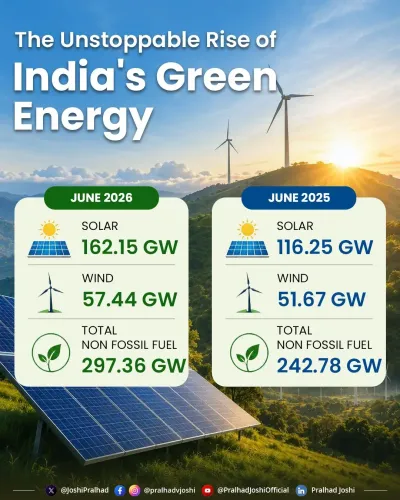
India has achieved its COP21 pledge of 50% cumulative non-fossil installed electricity capacity five years ahead of the 2030 deadline, becoming the only G20 nation to do so. Union Minister Pralhad Joshi announced the milestone and praised Piyush Goyal's address at the Berlin Global Dialogue 2026 on climate justice and Global South solidarity.
Key Takeaways
India has met its COP21 target of 50% non-fossil installed electricity capacity five years before the 2030 deadline.
India is described as the only G20 nation to accomplish this target ahead of schedule.
The target was originally set at 40% in India's 2015 NDC under the Paris Agreement, then raised to 50% under the Panchamrit strategy announced at COP26 in Glasgow in 2021 .
Union Minister Piyush Goyal represented India at the Berlin Global Dialogue 2026 , articulating India's vision for global climate partnership.
India's diplomatic posture centres on climate justice , fair burden-sharing, and shared progress for the Global South .
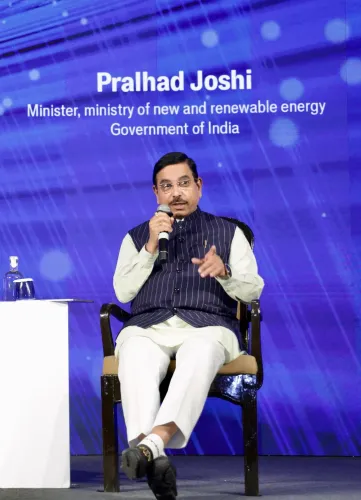
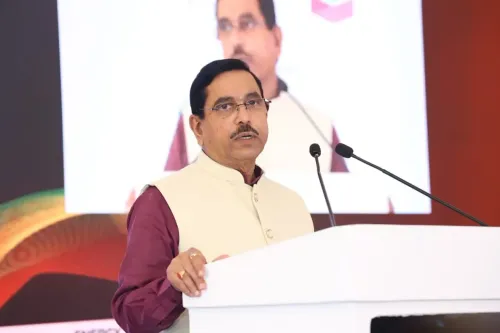
India has crossed a landmark climate threshold five years early — and Union Minister Pralhad Joshi wants the world to take note. On Friday, October 23, 2026, the Minister of New and Renewable Energy took to X to announce that India has achieved its COP21 commitment of 50% cumulative non-fossil installed electricity capacity ahead of the 2030 deadline, making it the only G20 nation to accomplish this target before schedule.
What India actually promised — and what it has now delivered
The journey to this milestone traces back over a decade. When India submitted its Nationally Determined Contribution (NDC) under the Paris Agreement in 2015, the original target was 40% non-fossil fuel electricity capacity by 2030. That ambition was raised significantly at COP26 in Glasgow in 2021, where India unveiled its Panchamrit strategy — a five-point climate pledge that included scaling the non-fossil target to 50% of cumulative electric power capacity by 2030. Hitting that revised, higher bar five years ahead of schedule represents a material leap, not just an accounting exercise.
Minister Joshi framed the achievement in terms of a core principle: 'India believes in sustainable growth without costing the planet.' The formulation is deliberate — it pushes back against the long-standing assumption in global climate diplomacy that rapid economic development and decarbonisation are inherently in tension.
Goyal at the Berlin Global Dialogue 2026
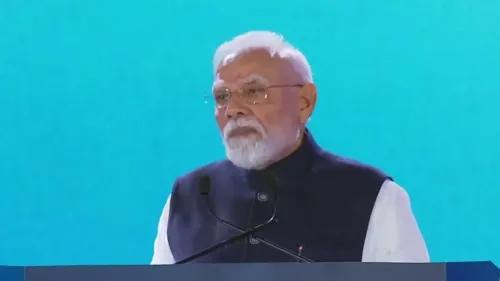
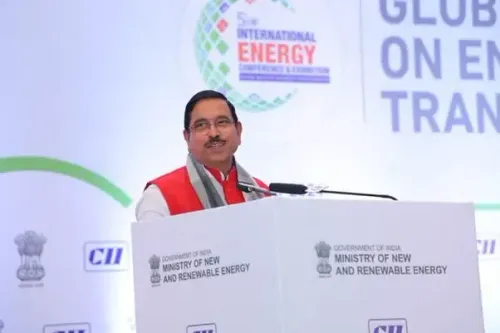
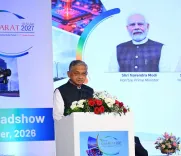
The domestic milestone is being amplified on the international stage. Joshi's post highlighted the role of senior BJP leader and Union Minister Piyush Goyal, who represented India at the Berlin Global Dialogue 2026 and laid out India's vision for a global climate partnership. Goyal's address, according to Joshi, centred on three interlinked themes: climate justice, fairness in burden-sharing, and shared progress for the Global South.
The framing of 'climate justice' and the explicit invocation of the Global South signal a consistent strategic posture India has maintained across multilateral forums — that historical emitters bear a differentiated responsibility, and that developing nations must not be forced to choose between lifting citizens out of poverty and meeting emission targets designed largely by wealthier economies.
India's renewable push in a G20 context
The claim of being the only G20 nation to hit the 50% non-fossil capacity milestone ahead of schedule — if borne out — would place India in a position to lead rather than merely participate in climate negotiations. The G20 grouping, which accounts for roughly 80% of global emissions, has struggled to present a unified front on transition timelines. India's early delivery sharpens its standing as a constructive voice while also giving it greater leverage to push back on prescriptive timelines that do not account for development-stage differences.
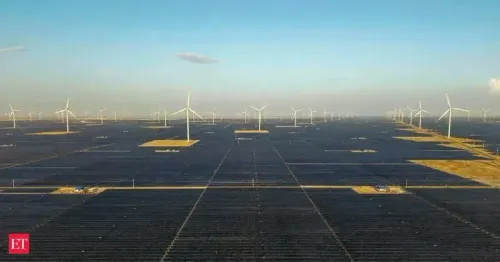
The renewable energy sector — solar in particular — has been the engine of this shift, with large-scale capacity additions driven by competitive tariffs and government-backed procurement programmes. That momentum now has a diplomatic dividend as well.
India arrived at Berlin not with apologies, but with a scorecard. The next question is whether that scorecard translates into binding commitments from the larger emitters to match the pace India has set.
Point of View
Giving New Delhi a concrete performance record to deploy in multilateral climate negotiations dominated by pressure on developing economies. Minister Joshi's post — timed around the Berlin Global Dialogue — is clearly designed to reinforce India's 'constructive but assertive' posture on climate: compliant with commitments, but insistent on differentiated responsibility for the Global South. The pairing of a domestic milestone with Goyal's international platform signals a coordinated messaging strategy ahead of future COP cycles. If the claim of being the sole G20 early-achiever holds up under scrutiny, it materially strengthens India's hand in pushing wealthier emitters toward comparable ambition.
NationPress
23 Oct 2026
Frequently Asked Questions
What is India's COP21 climate commitment on non-fossil electricity?
Under the Paris Agreement signed at COP21 in 2015, India initially committed to 40% non-fossil fuel electricity capacity by 2030. At COP26 in Glasgow in 2021, India raised this to 50% as part of its Panchamrit strategy. Minister Pralhad Joshi announced in October 2026 that this 50% target has been achieved five years ahead of the deadline.
Is India the only G20 country to achieve the 50% non-fossil electricity target early?
According to Union Minister Pralhad Joshi's post on October 23, 2026, India is the only G20 nation to have accomplished the 50% cumulative non-fossil installed electricity capacity target ahead of the 2030 schedule.
What is the Panchamrit strategy India announced at COP26?
India's Panchamrit strategy, announced at COP26 in Glasgow in 2021, is a five-point climate pledge. It includes achieving 50% of cumulative electric power from non-fossil fuel sources by 2030, alongside targets for renewable energy capacity and net-zero emissions.
What did Piyush Goyal say at the Berlin Global Dialogue 2026?
According to Minister Pralhad Joshi, Piyush Goyal articulated India's vision for global climate partnership at the Berlin Global Dialogue 2026, highlighting India's proactive steps on renewable energy and championing climate justice, fairness, and shared progress for the Global South.
What does 'climate justice' mean in India's climate diplomacy?
In India's diplomatic framing, climate justice refers to the principle that historically high-emitting developed nations bear a greater responsibility for climate action, and that developing nations — particularly those of the Global South — should not be forced to sacrifice economic development to meet targets shaped primarily by wealthier countries.