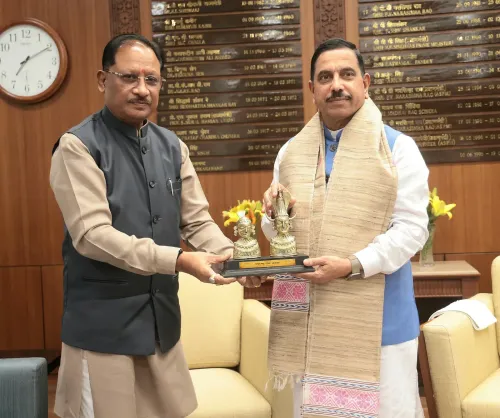
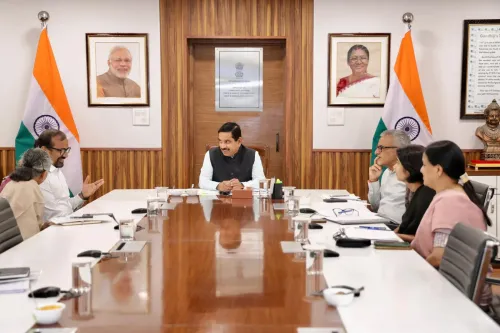
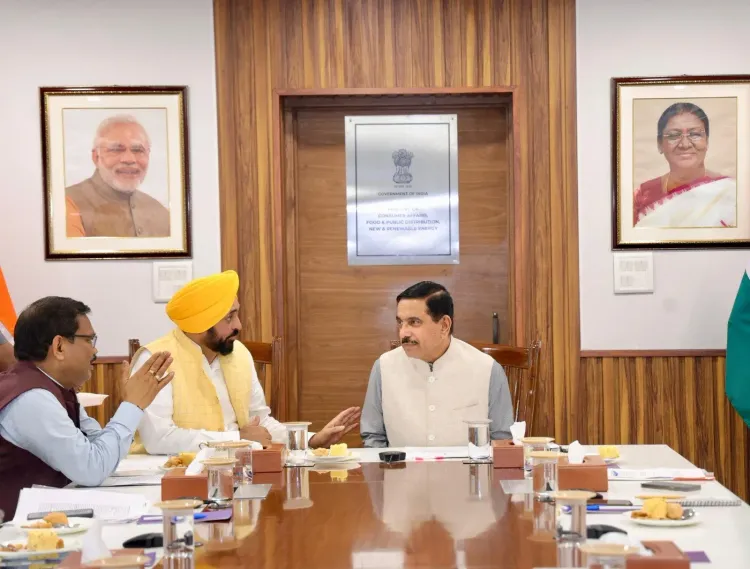
Pralhad Joshi meets CM Bhagwant Mann on Punjab foodgrain management
Synopsis
Union Consumer Affairs Minister Pralhad Joshi met Punjab Chief Minister Bhagwant Mann on August 8 to discuss Central Pool stock liquidation, grain movement, and storage capacity ahead of Kharif Marketing Season 2026-27, underscoring Punjab's pivotal role in India's food security.
Key Takeaways
Union Minister Pralhad Joshi and Punjab CM Bhagwant Mann held a detailed meeting on August 8, 2026 on foodgrain management.
Discussions covered Central Pool stock liquidation , timely movement of rice and wheat, and adequate storage capacity in Punjab.
Advance planning for Kharif Marketing Season 2026–27 paddy procurement was a central agenda item.
Punjab is a leading contributor of wheat and rice to India's Central Pool managed by the Food Corporation of India .
The meeting reflects cross-party federal coordination, with AAP-governed Punjab engaging the BJP-led Union ministry on operational food security.
FCI's storage augmentation in Punjab and actual KMS 2026–27 procurement figures will be the key indicators to watch.
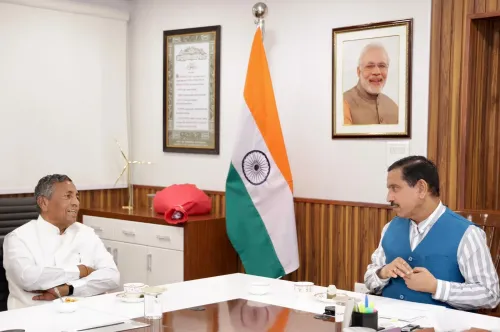
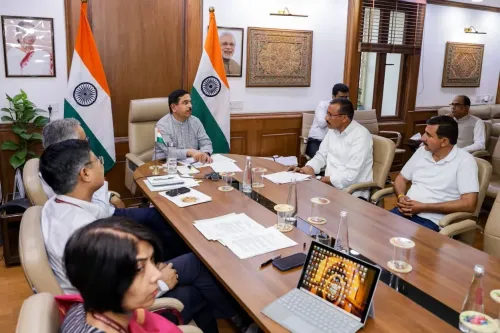
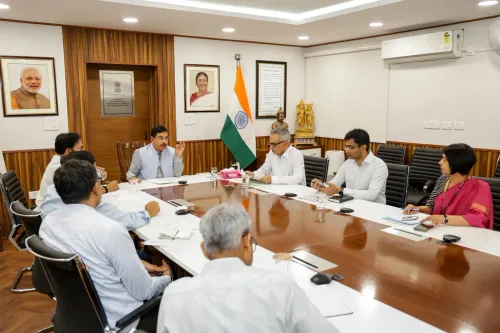
India's food security machinery got a high-level check-up on Saturday, August 8, as Union Consumer Affairs Minister Pralhad Joshi sat down with Punjab Chief Minister Bhagwant Mann to hammer out the operational details of grain procurement, storage, and stock movement in the country's most critical surplus state.
The meeting covered a sweep of pressure points: liquidation of Central Pool stocks, timely movement of rice and wheat out of Punjab, and whether the state has enough godown capacity to absorb the next harvest. At the centre of the agenda was advance planning for Kharif Marketing Season (KMS) 2026–27 — the annual paddy procurement cycle that determines how smoothly millions of farmers get paid and how reliably the public distribution system is stocked across consuming states.
Why Punjab's grain pipeline matters so much
Punjab is not merely a participant in India's food security architecture — it is its load-bearing wall. The state contributes a disproportionately large share of wheat and rice to the Central Pool managed by the Food Corporation of India (FCI), which procures at the Minimum Support Price (MSP) under the National Food Security Act, 2013. When stocks pile up faster than they move out, the state's godowns choke, procurement slows, and farmers bear the cost in delays and logistical bottlenecks.
The challenge is structural and recurring. Buffer stock norms and liquidation policies are reviewed annually by the Department of Food and Public Distribution, but the physical reality — finite storage, variable rail and road evacuation capacity, and the relentless rhythm of two major crop seasons — demands constant coordination between New Delhi and Chandigarh.
AAP-BJP coordination across the federal divide
The optics here are worth noting. Bhagwant Mann leads a state governed by the Aam Aadmi Party, a political rival of the ruling BJP at the Centre. That Mann travelled to meet Joshi signals that on the operational business of feeding the country, party lines yield to procurement calendars. The Decentralised Procurement Scheme, operational since 1997–98, already gives states like Punjab significant agency in handling grain locally — but the Central Pool's fiscal weight means the Union ministry remains the indispensable counterpart.
Joshi stated that 'necessary measures' have been taken to ensure smooth paddy procurement and storage for KMS 2026–27, though specifics of those measures are yet to be detailed publicly.
Watch the actual paddy arrival figures and FCI's storage augmentation progress in Punjab when the kharif harvest begins to roll in — those numbers will tell whether Saturday's meeting translated into ground-level readiness.
Point of View
Smooth procurement in an AAP state also carries a political dividend: demonstrating governance competence on farmer welfare ahead of any electoral cycle. The real test, however, will be whether the 'necessary measures' announced translate into expanded godown capacity and faster stock evacuation when paddy arrivals peak.
NationPress
8 Aug 2026
Frequently Asked Questions
Why did Punjab CM Bhagwant Mann meet Union Minister Pralhad Joshi?
Mann met Joshi on August 8, 2026 to discuss operational coordination on foodgrain management, including Central Pool stock liquidation, rice and wheat movement, and storage capacity ahead of Kharif Marketing Season 2026-27.
What is Kharif Marketing Season (KMS) and why does it matter for Punjab?
KMS is the annual paddy procurement cycle that begins after the kharif harvest. Punjab is one of India's largest paddy contributors to the Central Pool, making timely procurement and storage planning critical for both farmers and the national public distribution system.
What is the Central Pool in India's foodgrain system?
The Central Pool is the stockpile of wheat and rice procured by the Food Corporation of India at MSP from surplus states like Punjab, used to supply the public distribution system across India under the National Food Security Act, 2013.
What is the Decentralised Procurement Scheme?
Operational since 1997-98, it allows states to handle foodgrain procurement and storage locally rather than routing everything through FCI, giving states like Punjab greater agency in managing their own grain supply chains.
What storage challenges does Punjab face in foodgrain management?
Punjab's godowns frequently face space constraints when Central Pool stocks are not evacuated quickly enough, slowing down fresh procurement from farmers and creating a fiscal burden on the central food management system.