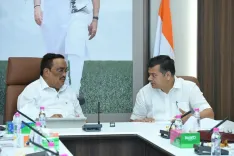
CM Mann's Punjab Govt Caps Private School Fees via Ordinance

Synopsis
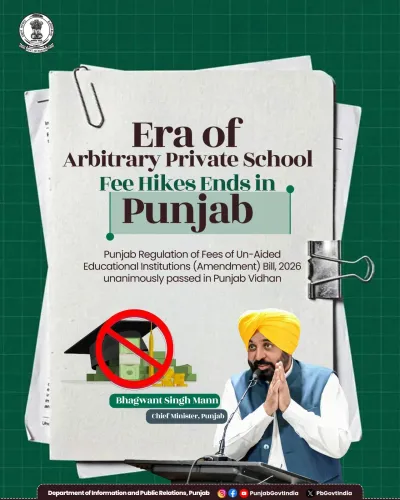
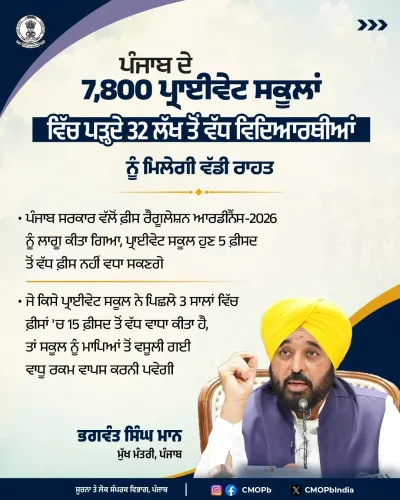
The Punjab government led by CM Bhagwant Mann promulgated the Punjab Regulation of Fees of Unaided Educational Institutions (Amendment) Ordinance, 2026 on 15 July, placing private school fees under a strict regulatory framework and extending relief to over 32 lakh students and their families.
Key Takeaways
The Punjab government promulgated the Punjab Regulation of Fees of Unaided Educational Institutions (Amendment) Ordinance, 2026 on 15 July 2026 .
The ordinance places fee structures of private unaided schools under a strict regulatory framework.
Over 32 lakh students and their families are expected to benefit from the measure.
Chief Minister Bhagwant Mann 's AAP government used the ordinance route to implement the change without waiting for a legislative session.
District-level fee regulatory committees are expected to be constituted to oversee fee approvals going forward.
The ordinance must be ratified by the Punjab Legislative Assembly within the constitutionally stipulated timeframe to remain in force.
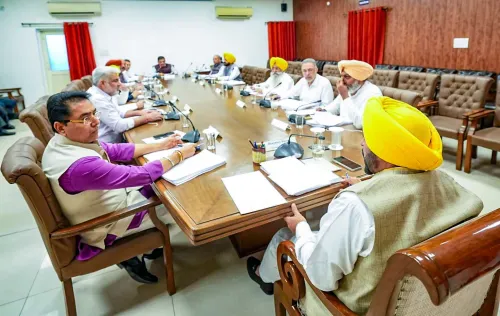
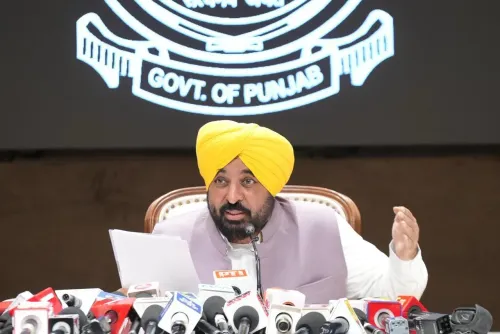
The Chief Minister's Office of Punjab announced on Wednesday, 15 July 2026 that the state government, led by Chief Minister Bhagwant Mann, has promulgated the Punjab Regulation of Fees of Unaided Educational Institutions (Amendment) Ordinance, 2026, bringing private school fee structures under a strict regulatory framework and delivering what it described as 'historic relief' to over 32 lakh students and their families.
Context
The ordinance targets unaided private educational institutions — schools that operate without government grants — which have long drawn complaints from parents over steep, often opaque annual fee hikes. By promulgating an ordinance, the Mann government bypassed the legislative assembly session timeline to effect the change immediately, signalling the urgency it attaches to the measure. The move is framed as direct relief for the families of more than 32 lakh students enrolled in such institutions across Punjab.
Policy Backdrop
Indian states have periodically legislated fee controls for unaided schools to protect middle-income households from unchecked annual increases. Punjab already had the Punjab Regulation of Fees of Unaided Educational Institutions Act on the books; the 2026 amendment ordinance tightens that framework further. The Aam Aadmi Party (AAP) government, which swept to power in Punjab in March 2022 under Bhagwant Mann, has consistently positioned education reform — spanning public school infrastructure upgrades, teacher recruitment, and now private fee regulation — as a central plank of its governance agenda, mirroring approaches adopted by AAP in its earlier tenure in Delhi.
Stakeholders and Impact
Parents of children in private unaided schools stand to benefit most directly, as the regulatory framework is expected to introduce a structured, accountable process for any future fee revisions. School managements, by contrast, may face constraints on the autonomy they previously exercised in setting fees, and industry bodies representing private schools are likely to scrutinise the ordinance's specific provisions closely. The broader middle-income demographic in urban and semi-urban Punjab — which relies heavily on private schooling — is the primary constituency the government is addressing with this intervention.
What's Next
Implementation will hinge on the formation of district-level fee regulatory committees empowered to review and approve fee structures proposed by individual institutions. Legal challenges are a credible near-term risk: associations representing private schools have historically approached the Punjab and Haryana High Court when faced with fee-cap legislation, arguing that excessive state control infringes on the rights of unaided institutions under constitutional provisions. The government will need to defend the ordinance's provisions in any such proceedings. The ordinance will also need to be ratified by the Punjab Legislative Assembly within the constitutionally mandated period to become a permanent statute.
Point of View
And acting swiftly maximises the electoral goodwill it generates. The move fits squarely within AAP's broader education-as-governance brand, which has been central to the party's identity since its Delhi years. However, the real test will come in implementation: past fee-regulation regimes in other states have been diluted by protracted litigation from school management associations, and the Punjab and Haryana High Court has historically been a contested arena for such disputes. If the regulatory committees are constituted swiftly and the law survives legal scrutiny, this could become a template for other AAP-governed or opposition-governed states seeking to differentiate on education policy.
NationPress
13 Oct 2026
Frequently Asked Questions
What is the Punjab Regulation of Fees of Unaided Educational Institutions Amendment Ordinance 2026?
It is an ordinance promulgated by the Punjab government on 15 July 2026 that amends existing law to bring the fee structures of private unaided schools under a strict state regulatory framework, covering institutions that operate without government grants.
How many students benefit from Punjab's private school fee regulation ordinance?
The Punjab government stated that over 32 lakh students and their families will benefit from the ordinance regulating private school fees.
Who promulgated the Punjab school fee regulation ordinance?
The ordinance was promulgated by the Punjab government led by Chief Minister Bhagwant Mann of the Aam Aadmi Party.
Can private schools in Punjab challenge the fee regulation ordinance in court?
Yes, private school associations have historically filed writ petitions before the Punjab and Haryana High Court against fee-cap legislation, arguing it infringes on the constitutional rights of unaided institutions, and similar legal challenges are possible in this case.
What happens after an ordinance is promulgated — does it need assembly approval?
Yes, under the Indian Constitution an ordinance must be placed before and ratified by the state legislative assembly within six weeks of the assembly's next session, failing which it lapses.