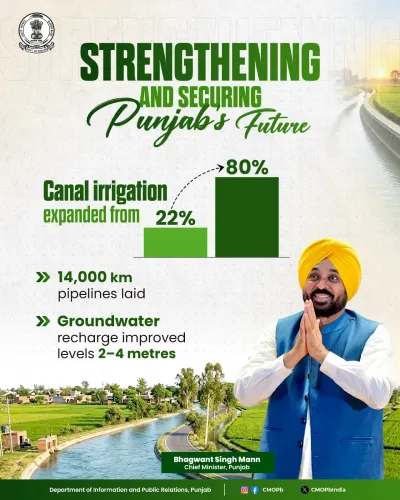
CM Bhagwant Mann: 14,000 km of Underground Pipelines Laid in Punjab

Synopsis
Chief Minister Bhagwant Mann has announced that Punjab has laid 14,000 km of underground irrigation pipelines — equal to the Delhi-to-Canada distance — with a target to add 6,000 km more before the wheat season in the next six months.
Key Takeaways
14,000 km of underground irrigation pipelines have already been laid across Punjab by the state government.
The government compares this length to the distance from Delhi to Canada , underlining the project's scale.
An additional 6,000 km of pipelines is targeted to be completed in the next six months .
The new target is timed specifically to be ready before the wheat crop season , which begins around November.
The programme aims to reduce seepage losses, cut groundwater dependency, and deliver canal water directly to farm fields.
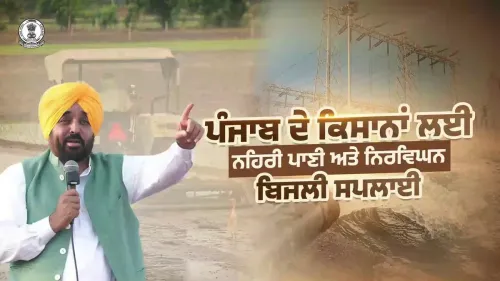
CM Bhagwant Mann made the announcement while addressing the public, linking the infrastructure drive to broader farmer welfare.
Punjab's farmlands are getting a quiet revolution beneath their soil. Addressing a public gathering on Wednesday, October 14, 2026, the Chief Minister's Office of Punjab announced that Chief Minister Bhagwant Mann had declared that 14,000 kilometres of underground irrigation pipelines have already been laid across the state — a stretch the government equates to the distance from Delhi to Canada.
14,000 km in the ground — and 6,000 more to come before wheat season
Speaking directly to the public, CM Mann framed the scale of the effort in a unit anyone can feel: 'ਦਿੱਲੀ ਤੋਂ ਕੈਨੇਡਾ ਦੀ ਦੂਰੀ' ('the distance from Delhi to Canada'). The imagery is deliberate — Punjab's diaspora connection to Canada runs deep, and the comparison puts a bureaucratic kilometre count into a human frame.
The government has now set a target to lay an additional 6,000 km of underground pipelines over the next six months, with the explicit goal of completing them before the wheat crop season begins. That deadline is not an arbitrary one: the rabi wheat sowing window in Punjab opens around November, meaning farmers would need reliable canal water delivery in place before fields are prepared.
Why Punjab's groundwater crisis makes this urgent
Punjab feeds much of India's foodgrain buffer, but the state's aquifers are under severe stress. Decades of dependence on tubewells — cheaper and more controllable than erratic canal supply — have pushed groundwater tables critically low across large parts of the state. Every litre of canal water that reaches a field through a sealed underground pipe instead of an open earthen channel is a litre that doesn't seep away or evaporate: a direct substitution for groundwater extraction.
Successive governments have attempted canal modernisation, but execution has lagged behind ambition. The Mann government's pipeline push is the most numerically ambitious iteration of that long-running effort, anchoring the programme to a hard seasonal deadline rather than an open-ended rollout.
What the next six months will tell us
The 6,000 km addition would bring total underground pipeline coverage in Punjab to 20,000 km — a figure that, if realised, would represent a structural shift in how the state delivers surface water to its farmers. The wheat season serves as a natural accountability clock: either the pipes are in the ground before sowing, or they are not.
With Punjab's assembly budget sessions and agricultural outcome data watched closely across the country, the government has essentially made this infrastructure drive a public promise with a hard expiry date — and farmers across the state will be the first to know if it holds.
Point of View
And tying the next target to the wheat season deadline transforms it from a scheme into a performance test. If the 6,000 km addition is delivered on time, it strengthens the AAP government's argument that it can deliver large-scale rural infrastructure — a key plank ahead of any electoral cycle. The canal-water-to-farm pipeline model also sits within a decade-long national conversation about precision irrigation and aquifer conservation, placing Punjab at the front of a debate that is only growing louder as water scarcity tightens across northern India.
NationPress
14 Oct 2026
Frequently Asked Questions
How many kilometres of underground pipelines has Punjab laid so far?
The Punjab government has laid 14,000 km of underground irrigation pipelines across the state, according to Chief Minister Bhagwant Mann.
What is Punjab's pipeline target before the wheat season?
The government has set a target to lay an additional 6,000 km of underground pipelines within the next six months, before the wheat crop season begins.
Why is Punjab building underground irrigation pipelines?
Underground pipelines reduce water seepage and evaporation losses from open canal channels, helping deliver more canal water directly to farmfields and easing dependence on rapidly depleting groundwater tubewells.
Who announced the Punjab irrigation pipeline project?
Chief Minister Bhagwant Mann made the announcement while addressing the public, with the Chief Minister's Office of Punjab sharing it on October 14, 2026.
How does Punjab's 14,000 km pipeline compare in distance?
The Punjab government itself compared the 14,000 km pipeline length to the distance from Delhi to Canada , to convey the scale of the infrastructure rollout.