Punjab CM Office: 65,481 drug smugglers held in 450 days
Synopsis
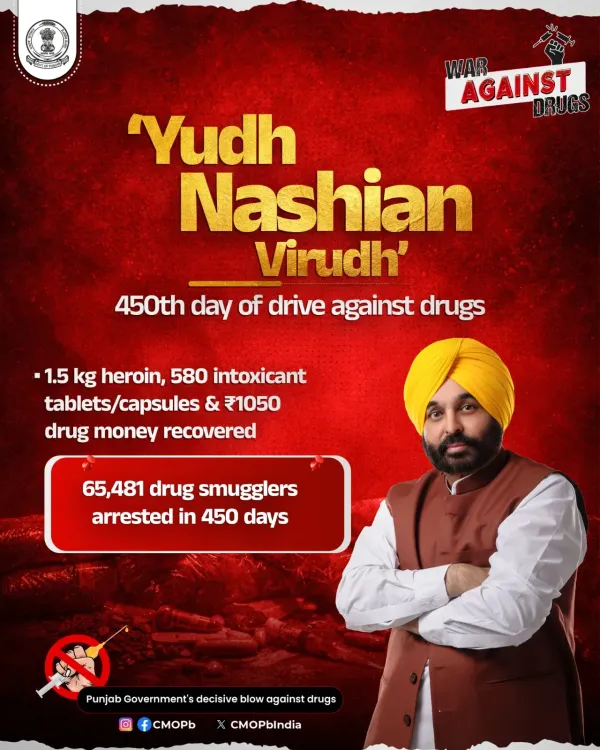
Punjab's Chief Minister's Office reports that the Yudh Nashian Virudh anti-narcotics drive has completed 450 consecutive days, with 65,481 drug smugglers arrested in total. The latest day's haul includes 1.5 kg heroin, 580 intoxicant tablets, and ₹1,050 in drug money recovered from suspects.
Key Takeaways
The Yudh Nashian Virudh ('War Against Drugs') drive by Punjab Police has now run for 450 consecutive days without interruption.
A total of 65,481 drug smugglers have been arrested since the campaign began, averaging roughly 145 arrests per day .
The 26 May 2026 operational update recorded recovery of 1.5 kg heroin , 580 intoxicant tablets/capsules , and ₹1,050 in drug money .
All arrests are registered under the Narcotic Drugs and Psychotropic Substances (NDPS) Act, 1985 .
Punjab's shared border with Pakistan and proximity to the Golden Crescent production zone make it India's most exposed state to heroin trafficking.
The Chief Minister's Office issues daily enforcement updates, using cumulative statistics as a public accountability mechanism.
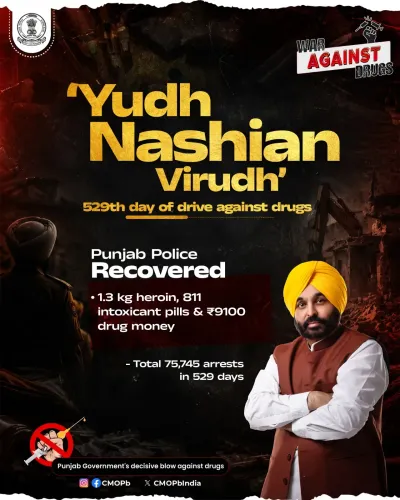
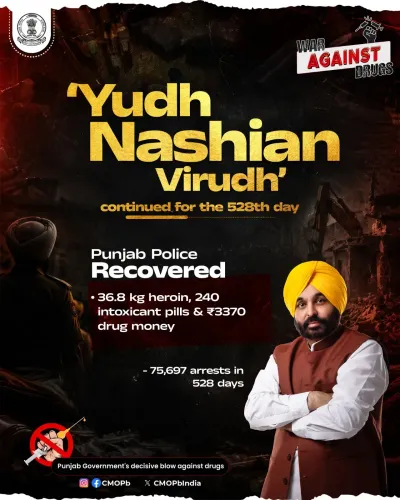
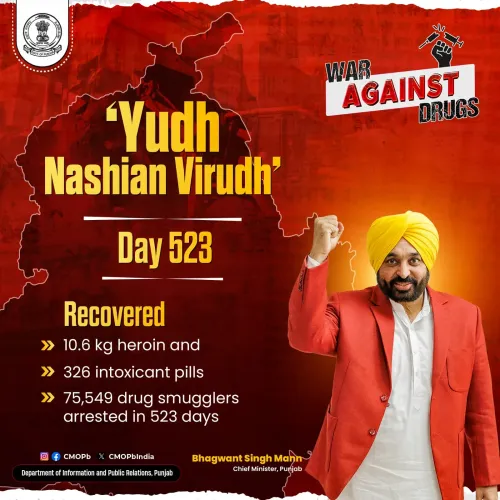
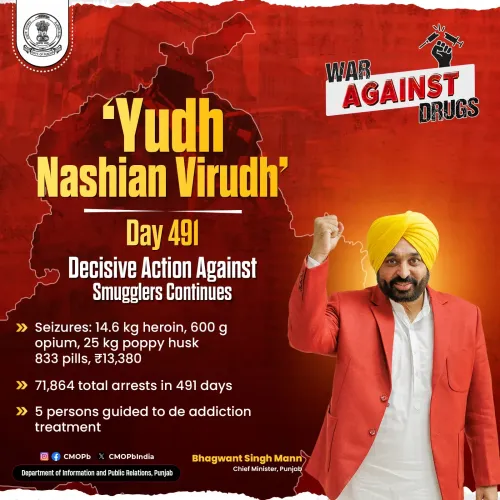
The Chief Minister's Office of Punjab announced on Tuesday, 26 May 2026 that the state's sustained anti-narcotics drive, Yudh Nashian Virudh ('War Against Drugs'), has entered its 450th consecutive day of operations, with police teams recovering 1.5 kg heroin, 580 intoxicant tablets and capsules, and ₹1,050 in drug money in the latest round of action. The cumulative arrest count under the drive has reached 65,481 drug smugglers since the campaign's launch.
Context
The CMO's post states that police teams 'have continued its drive against drugs Yudh Nashian Virudh for 450th day,' marking an unbroken streak of daily enforcement activity. The single-day haul — 1.5 kg heroin, 580 tablets/capsules, and ₹1,050 recovered from suspects' possession — reflects the granular, ground-level nature of the operation, which targets not only large consignments but also street-level distribution networks. The milestone figure of 65,481 total arrests in 450 days averages to roughly 145 arrests per day across Punjab's districts.
Policy Backdrop
The Yudh Nashian Virudh campaign is a flagship law-enforcement commitment of the current Punjab government, which made combating the state's drug crisis a central plank of its 2022 electoral mandate. All arrests and seizures are carried out under the Narcotic Drugs and Psychotropic Substances (NDPS) Act, 1985, the central legislation governing drug offences in India. Punjab's border with Pakistan has historically made it a primary entry corridor for heroin originating from the Golden Crescent — the Afghanistan-Iran-Pakistan drug-production belt — giving the state a structurally acute narcotics challenge compared with most other Indian states.
Previous state administrations between 2015 and 2021 had also launched periodic anti-narcotics drives, but the current campaign distinguishes itself through its emphasis on continuity: daily operational updates from the CMO serve as both an accountability mechanism and a public-communication tool, keeping the issue in the news cycle and signalling sustained political will.
Stakeholders and Impact
Punjab's youth population and residents of border districts — particularly in Amritsar, Gurdaspur, Ferozepur, and Tarn Taran — are the primary beneficiaries of successful enforcement, given historically high rates of drug dependency in these zones. Families of those arrested, as well as accused individuals awaiting trial under the NDPS Act, form a secondary stakeholder group with significant legal and social exposure. The Punjab Police, which coordinates daily raids across multiple districts, bears the operational burden of maintaining the pace of arrests and seizures.
Civil-society groups and de-addiction advocates have consistently argued that enforcement alone is insufficient and must be paired with rehabilitation infrastructure. The state has, in parallel, announced de-addiction centre expansions, though the CMO's daily updates focus primarily on enforcement metrics.
What's Next
The 500-day milestone, expected in mid-July 2026, is likely to be marked as a significant threshold by the CMO, potentially accompanied by a broader review of the campaign's impact on drug supply chains. Observers will watch for any formal involvement of central agencies such as the Narcotics Control Bureau (NCB) or Border Security Force (BSF), whose mandates overlap with state police operations along the India-Pakistan border. Parallel announcements on community rehabilitation programmes and de-addiction centres would indicate whether the government is shifting emphasis from purely punitive to a dual enforcement-and-recovery model.
Point of View
With cumulative arrest figures serving as a scoreboard of governance delivery. At 65,481 arrests over 450 days, the scale of the drive is substantial by any measure, but the emphasis on arrest tallies raises a standard question in drug-policy circles: whether supply-side enforcement alone translates into reduced consumption or merely cycles suspects through the legal system. The focus on border districts and heroin — linked directly to the Golden Crescent supply chain — positions the campaign within a national-security frame as much as a public-health one, potentially strengthening the case for greater central-agency coordination. The approaching 500-day mark will test whether the government broadens its messaging to include rehabilitation outcomes alongside seizure and arrest numbers.
NationPress
22 Sept 2026
Frequently Asked Questions
What is Yudh Nashian Virudh?
Yudh Nashian Virudh (meaning 'War Against Drugs') is an ongoing anti-narcotics enforcement drive run by Punjab Police under the direction of the Chief Minister's Office of Punjab , targeting drug smuggling, distribution, and possession across the state.
How many drug smugglers have been arrested in Punjab's anti-drug drive?
As of 26 May 2026 , a total of 65,481 drug smugglers have been arrested under the Yudh Nashian Virudh campaign since its launch, over a period of 450 days .
What drugs were seized in the latest Punjab anti-narcotics operation?
In the 450th-day update, police recovered 1.5 kg heroin , 580 intoxicant tablets and capsules , and ₹1,050 in drug money from suspects' possession.
Why is Punjab particularly affected by drug trafficking?
Punjab shares a long international border with Pakistan , making it a primary entry point for heroin sourced from the Golden Crescent (Afghanistan-Iran-Pakistan), which has historically contributed to high rates of drug smuggling and consumption in the state.
Under which law are drug smugglers arrested in Punjab?
Arrests made under the Yudh Nashian Virudh drive are registered under the Narcotic Drugs and Psychotropic Substances (NDPS) Act, 1985 , the central Indian legislation governing drug offences.