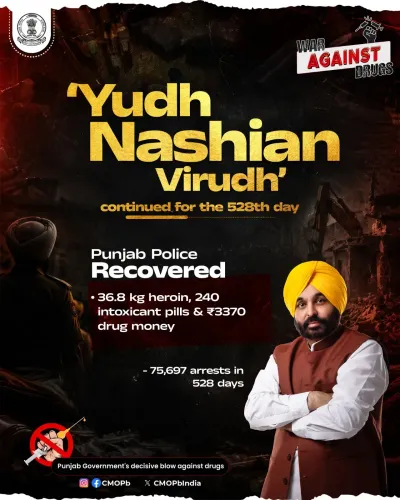
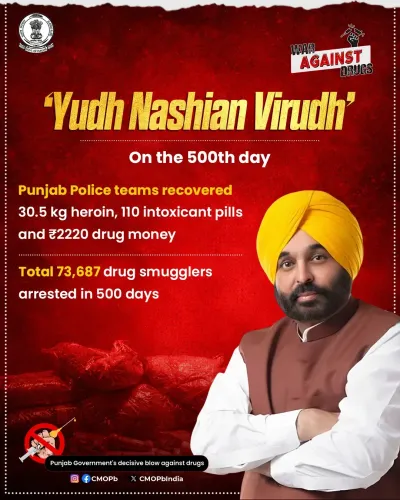
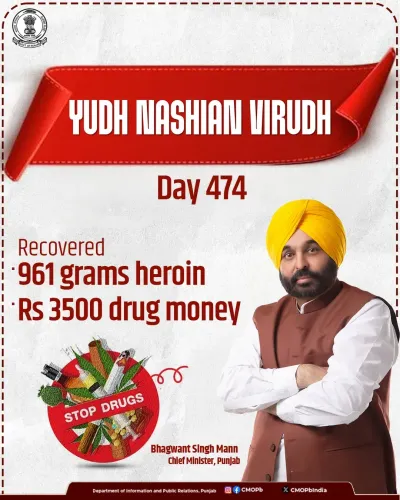
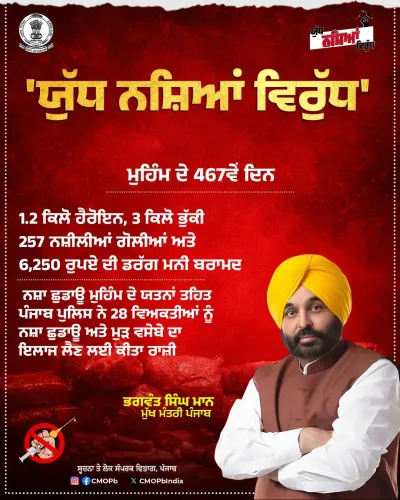
Punjab CM Office: 65,530 Drug Smugglers Arrested in 452 Days
Synopsis
Punjab's Chief Minister's Office reports that the 'Yudh Nashian Virudh' anti-drug campaign reached its 452nd consecutive day on 28 May 2026, with police seizing 3.5 kg heroin and ₹64,500 in drug money. Total arrests since the drive began now stand at 65,530.
Key Takeaways
The 'Yudh Nashian Virudh' campaign completed its 452nd consecutive day of operations on 28 May 2026 .
Punjab Police seized 3.5 kg of heroin and ₹64,500 in drug money in the day's operations.
Cumulative arrests under the campaign have reached 65,530 drug smugglers over 452 days.
The campaign was launched by the AAP government under Chief Minister Bhagwant Mann after coming to power in March 2022 .
Punjab's border with Pakistan makes it a historically significant corridor for cross-border heroin trafficking.
The daily reporting format by the CMO serves as a public accountability mechanism for the ongoing enforcement drive.
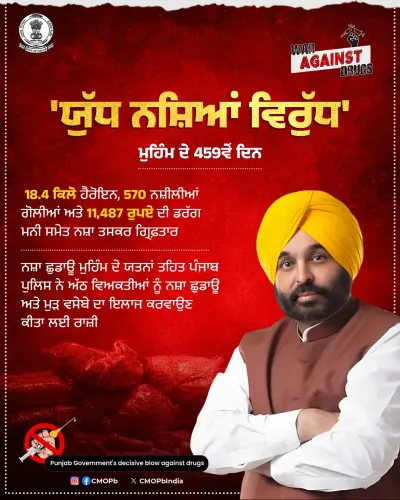
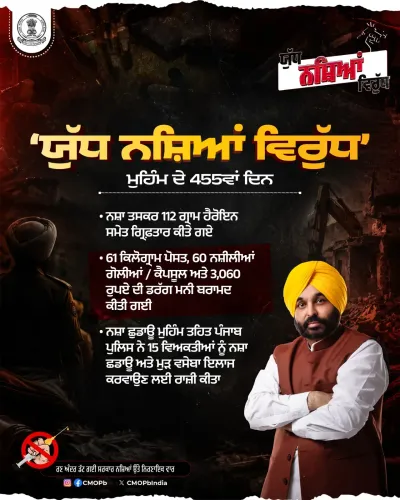
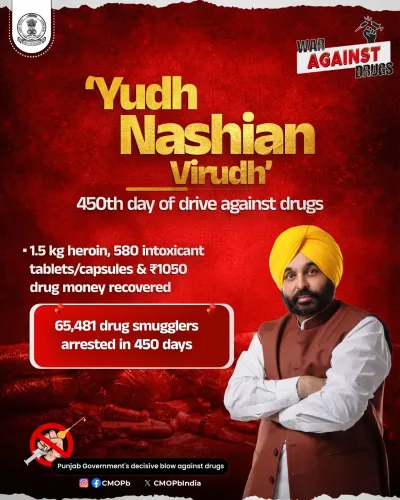
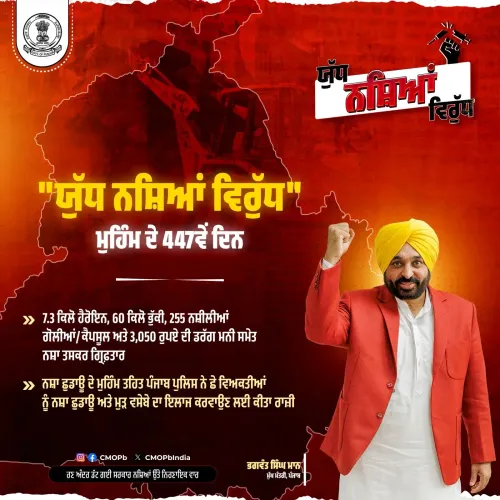
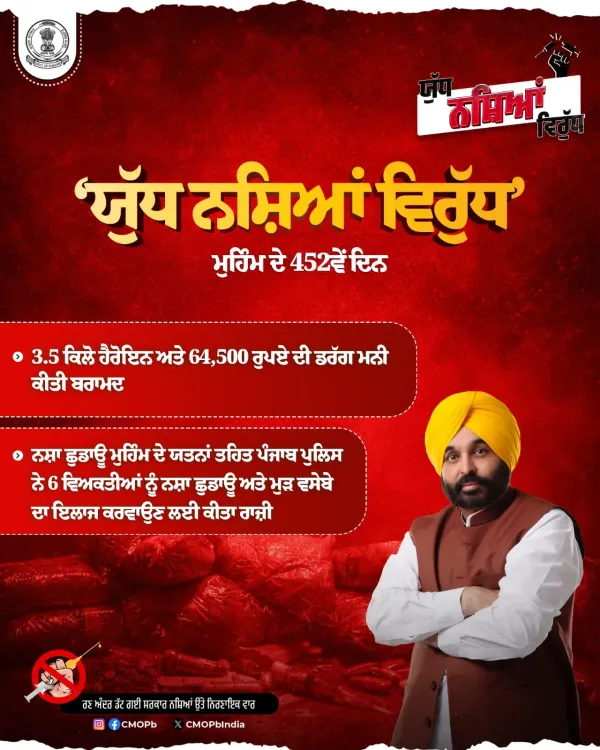
The Chief Minister's Office of Punjab on Thursday, 28 May 2026, reported that police teams continued the anti-narcotics campaign 'Yudh Nashian Virudh' into its 452nd consecutive day, arresting fresh drug smugglers and seizing 3.5 kg of heroin along with ₹64,500 in drug money. The cumulative tally of drug traffickers arrested since the campaign began has now reached 65,530.
Context
The post, shared from the official CMO Punjab handle, states in both Punjabi and English: 'ਪੁਲਿਸ ਦੀਆਂ ਟੀਮਾਂ ਨੇ ਮੁਹਿੰਮ ਯੁੱਧ ਨਸ਼ਿਆਂ ਵਿਰੁੱਧ ਨੂੰ 452ਵੇਂ ਦਿਨ ਵੀ ਜਾਰੀ ਰੱਖਦਿਆਂ...' ('Police teams have continued the drive Yudh Nashian Virudh for the 452nd day...'). The daily public reporting format is a deliberate communication strategy, signalling that operational pressure against narcotics networks is unrelenting and measurable.
Punjab Police teams are the primary operational arm of the campaign, conducting raids, making arrests, and logging seizures that are then consolidated and announced through the Chief Minister's Office. The day's haul — 3.5 kg heroin and drug proceeds of ₹64,500 — adds to a cumulative record the government has been building since the drive's inception.
Policy Backdrop
When the Aam Aadmi Party government led by Chief Minister Bhagwant Mann came to power in March 2022, eradicating the drug menace was positioned as one of its foremost administrative commitments. The campaign 'Yudh Nashian Virudh' — translating to 'War Against Drugs' — was launched as the flagship enforcement response to that pledge, combining daily police action with high-visibility public communication.
Punjab shares a long border with Pakistan and has historically been one of the most affected Indian states in terms of cross-border heroin trafficking. Successive state governments have launched enforcement drives, but the current administration's approach of logging and publishing daily arrest and seizure figures marks a distinctive accountability mechanism. Earlier anti-narcotics operations in the state were carried out during the 2015–2017 period under the previous Shiromani Akali Dal–BJP coalition government.
Stakeholders and Impact
The campaign's primary stated beneficiaries are Punjab's youth, who have disproportionately borne the social and health consequences of widespread opiate abuse in the state. Civil society groups and families of those affected by addiction have long demanded sustained enforcement paired with rehabilitation infrastructure.
Drug traffickers and peddlers operating along the Punjab–Pakistan border corridor represent the target population of the drive. With 65,530 arrests logged over 452 days, the scale of the enforcement sweep suggests a broad net that encompasses both high-value smugglers and street-level peddlers. Analysts and opposition voices have at times questioned whether the arrest-centric approach is matched by equivalent investment in de-addiction and rehabilitation services.
What's Next
The Chief Minister's Office is expected to continue its daily reporting cadence, with each update adding to the cumulative arrest and seizure figures. Observers will watch whether the government pairs the enforcement narrative with announcements on expanding de-addiction centres, amending state excise and narcotics laws, or seeking enhanced coordination with central border-control agencies.
Any significant single-day seizure — particularly of large heroin consignments linked to cross-border networks — or the arrest of a high-profile trafficker would likely elevate the campaign's visibility further. The broader test for the 'Yudh Nashian Virudh' drive remains whether sustained arrest numbers translate into measurable declines in drug availability and abuse rates across Punjab.
Point of View
530 arrests in 452 days is a substantial headline number, but the arrest-centric metric leaves open the harder question of whether supply and demand for narcotics in the state have materially declined. The absence of parallel data on rehabilitation outcomes or drug availability indices means the campaign's full impact remains difficult to assess independently. Sustaining public confidence will increasingly require the government to move the narrative from arrest tallies to demonstrable social outcomes.
NationPress
20 Sept 2026
Frequently Asked Questions
What is the 'Yudh Nashian Virudh' campaign in Punjab?
'Yudh Nashian Virudh' means 'War Against Drugs' and is the flagship anti-narcotics enforcement drive launched by the AAP government in Punjab under Chief Minister Bhagwant Mann after it came to power in March 2022. It involves daily police raids, arrests of drug smugglers and peddlers, and seizure of narcotics and drug money across the state.
How many drug smugglers have been arrested in Punjab's anti-drug campaign so far?
As of day 452 of the campaign on 28 May 2026, a total of 65,530 drug smugglers have been arrested under the 'Yudh Nashian Virudh' drive, according to the Chief Minister's Office of Punjab.
How much heroin was seized by Punjab Police on 28 May 2026?
Punjab Police seized 3.5 kg of heroin and ₹64,500 in drug money from drug smugglers on the 452nd day of the 'Yudh Nashian Virudh' campaign, as reported by the CMO Punjab.
Why is Punjab particularly affected by drug trafficking?
Punjab shares a long border with Pakistan, which has historically made it a key corridor for cross-border heroin trafficking. The state has faced high rates of opiate abuse, prompting successive governments to launch enforcement campaigns targeting smuggling networks.
Who is leading the anti-drug campaign in Punjab?
The campaign is led under the overall direction of Chief Minister Bhagwant Mann and the AAP state government, with Punjab Police as the primary operational force conducting daily raids, arrests, and seizures reported through the Chief Minister's Office.