Punjab CM Office: 7,300 maternity cases covered under MMSY
Synopsis
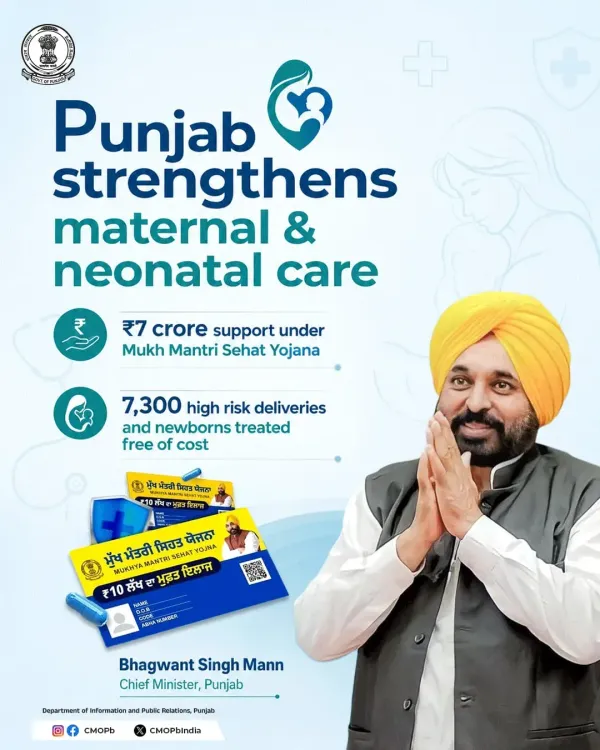
The Chief Minister's Office of Punjab says the Mukh Mantri Sehat Yojana has covered 7,300 high-risk maternity and neonatal cases worth ₹7.04 crore as of May 25, 2026, providing cashless care to vulnerable families under the state's flagship health insurance programme.
Key Takeaways
7,300 maternity and neonatal care cases have been treated under the Mukh Mantri Sehat Yojana as of May 25, 2026 .
Total scheme expenditure on this category stands at ₹7.04 crore , according to official data from the State Health Agency (SHA) .
The scheme focuses specifically on high-risk and complicated deliveries and critical newborn care , removing financial barriers for families.
MMSY provides cashless coverage for secondary and tertiary care and operates alongside the central PM-JAY framework with additional state-specific benefits.
The announcement was made by the Chief Minister's Office of Punjab on May 26, 2026 via its official handle.
The Chief Minister's Office of Punjab announced on Tuesday, May 26, 2026 that the state's flagship health insurance programme, the Mukh Mantri Sehat Yojana (MMSY), has covered 7,300 maternity and neonatal care cases at a total expenditure of ₹7.04 crore, according to official data from the State Health Agency (SHA) as of May 25, 2026.
Context
The CMO Punjab post states that the scheme is 'ensuring that complicated deliveries and critical newborn care are accessible to families without financial burden.' The State Health Agency, the nodal body responsible for implementing MMSY and empanelling hospitals, provided the case count and expenditure figures cited in the announcement. The data covers high-risk maternal and neonatal cases — a category that typically includes complicated deliveries requiring specialist intervention and newborns needing intensive care.
Punjab's announcement places the cumulative case load at 7,300 and total scheme spending on this category at ₹7.04 crore as of the date of reporting. These figures represent the state government's own official data and have been shared through the Chief Minister's Office's verified social media handle.
Policy Backdrop
The Mukh Mantri Sehat Yojana is a Punjab government health insurance scheme providing cashless coverage for secondary and tertiary care treatments to eligible families. It operates alongside the central government's Pradhan Mantri Jan Arogya Yojana (PM-JAY) framework, with state-specific benefits layered on top to address gaps in coverage — particularly for complicated deliveries and critical newborn care.
This approach mirrors a broader national pattern: Indian states have progressively expanded health insurance for high-risk maternal and neonatal cases as part of efforts to bring down the Maternal Mortality Ratio (MMR) and Infant Mortality Rate (IMR). The National Health Mission, launched in 2005, provided the foundational federal-state architecture for such insurance and infrastructure measures. Punjab's targeted financial protection under MMSY reflects continued investment in that framework.
Stakeholders and Impact
The primary beneficiaries of this coverage are expectant mothers, newborns, and low-income families who would otherwise face significant out-of-pocket expenditure for complicated deliveries or neonatal intensive care. Cashless access at empanelled hospitals removes the financial barrier that often delays or prevents families from seeking specialist care in time-critical obstetric and neonatal emergencies.
At an average of roughly ₹9,644 per case (derived from the official figures), the scheme's per-case expenditure reflects the cost intensity of high-risk maternal and neonatal interventions relative to routine deliveries. For families below or near the poverty line, this protection can be the difference between seeking timely care and foregoing it entirely.
What's Next
Utilisation trends and budget utilisation reports in the next quarterly health review will be closely watched to assess whether the pace of coverage is accelerating. Any state budget announcements on expanding the network of empanelled facilities or raising the scheme's benefit ceiling will indicate the government's commitment to scaling this coverage further.
With Punjab continuing to report progress on MMSY's maternal and neonatal component, the state's ability to sustain and grow this expenditure — and to translate case coverage into measurable improvements in MMR and IMR — will be the key metric by which the programme's long-term impact is judged.
Point of View
The CMO is positioning the scheme within a data-accountability narrative increasingly common in state health governance. The focus on high-risk maternal and neonatal cases — rather than routine deliveries — also suggests a strategic prioritisation of outcomes most visible in MMR and IMR statistics, the two metrics by which state health systems are most publicly benchmarked. Whether the pace of 7,300 cases translates into statistically significant movement in Punjab's health indices will be the real test of the programme's depth.
NationPress
10 Oct 2026
Frequently Asked Questions
What is the Mukh Mantri Sehat Yojana in Punjab?
The Mukh Mantri Sehat Yojana (MMSY) is a Punjab government health insurance scheme that provides cashless coverage for secondary and tertiary medical treatments to eligible families, including complicated deliveries and critical newborn care, operating alongside the central PM-JAY framework.
How many maternity cases have been covered under MMSY so far?
According to official data from the State Health Agency, 7,300 maternity and neonatal care cases had been treated under MMSY as of May 25, 2026 , with a total expenditure of ₹7.04 crore .
Who is eligible for maternity benefits under the Mukh Mantri Sehat Yojana?
The scheme targets families facing high-risk and complicated deliveries and critical newborn care situations, with a focus on ensuring that low-income families are not burdened by out-of-pocket expenses for specialist interventions.
What is the State Health Agency Punjab?
The State Health Agency (SHA) is the nodal body under the Punjab health department responsible for implementing the Mukh Mantri Sehat Yojana, empanelling hospitals, and maintaining data on scheme utilisation and expenditure.
How does Punjab's MMSY relate to PM-JAY?
MMSY operates alongside the central government's Pradhan Mantri Jan Arogya Yojana (PM-JAY), adding state-specific benefits — particularly for complicated deliveries and critical neonatal care — that go beyond what the central scheme covers.