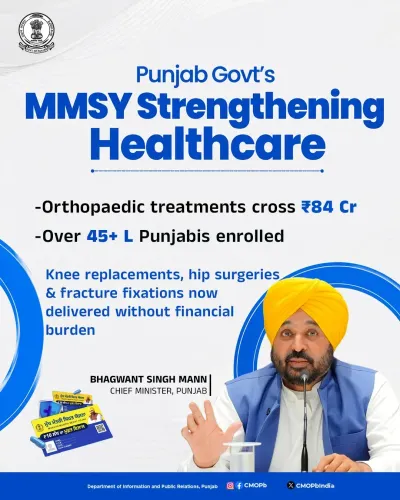
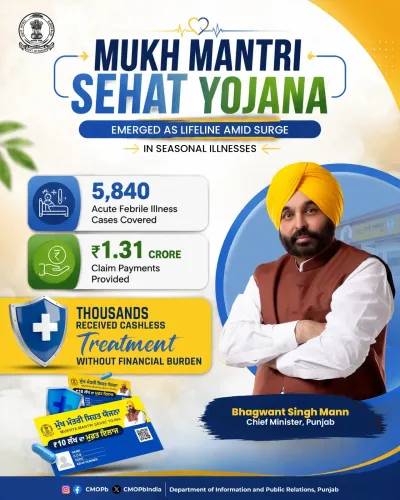
CM Mann's Mukhya Mantri Sehat Yojana Covers 2.4 Lakh Patients
Synopsis
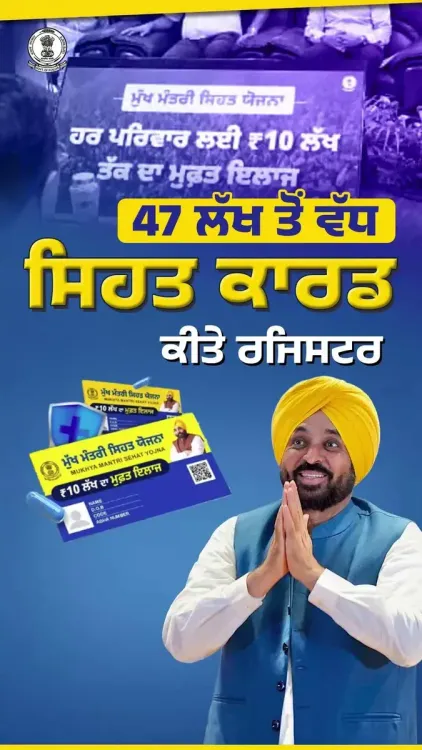
The Chief Minister's Office of Punjab says the Mukhya Mantri Sehat Yojana has delivered cashless treatment to 2,42,917 patients across 4,79,602 procedures, with total spending reaching approximately Rs 852 crore under CM Bhagwant Mann's government.
Key Takeaways
The Mukhya Mantri Sehat Yojana , launched by the Bhagwant Mann -led Punjab government, has been highlighted as a major health initiative.
2,42,917 patients have received cashless treatment under the scheme so far.
A total of 4,79,602 cashless treatments have been provided, indicating multiple procedures per beneficiary on average.
The total cost of treatments delivered under the scheme stands at approximately Rs 852 crore .
The scheme supplements the national Ayushman Bharat framework with state-funded cashless secondary and tertiary care.
Future scrutiny will focus on Punjab's health budget allocations and an official outcome evaluation of the programme.
The Chief Minister's Office of Punjab announced on Saturday, 11 July 2026 that the Mukhya Mantri Sehat Yojana, launched under the leadership of Chief Minister Bhagwant Mann, has emerged as a significant initiative in the delivery of healthcare services across the state.
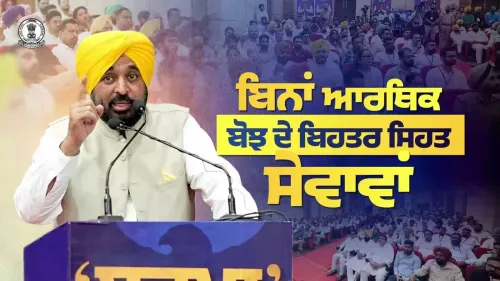
According to the official post, 2,42,917 patients have been provided 4,79,602 cashless treatments under the scheme, with the total expenditure amounting to approximately Rs 852 crore. The Punjabi-language post described the scheme as 'ਸਿਹਤ ਸੇਵਾਵਾਂ ਦੇ ਖੇਤਰ ਵਿੱਚ ਇੱਕ ਅਹਿਮ ਪਹਿਲਕਦਮੀ' — 'an important initiative in the field of health services.'
Context
The Mukhya Mantri Sehat Yojana is a state-funded cashless treatment programme introduced by the Aam Aadmi Party government in Punjab after it came to power in March 2022. The scheme targets patients requiring secondary and tertiary care at empanelled hospitals, offering treatment without out-of-pocket payments at the point of service.
The announcement underscores the Mann government's push to make healthcare access a visible policy deliverable, with the scheme's cumulative figures now being placed on record through official channels.
Policy Backdrop
The scheme draws conceptual lineage from the AAP government's Delhi Mohalla Clinic model, which began in 2015 and demonstrated the party's intent to prioritise free or subsidised primary care as a political and governance commitment.
At the national level, the Ayushman Bharat Pradhan Mantri Jan Arogya Yojana (AB-PMJAY) provides cashless hospitalisation cover of up to Rs 5 lakh per family per year. Punjab's state-funded scheme supplements this framework, a pattern seen in several opposition-governed states that have chosen to extend coverage beyond the central programme's limits.
This approach reflects a broader trend among state governments to layer their own health entitlements on top of the central architecture, particularly to address segments of the population not covered under AB-PMJAY or to fund procedures outside its package list.
Stakeholders and Impact
The primary beneficiaries are Punjab's public hospital users and patients who would otherwise bear the cost of secondary and tertiary procedures privately. The figure of 2,42,917 patients receiving 4,79,602 cashless treatments suggests that a significant share of beneficiaries underwent multiple procedures under the scheme.
Empanelled hospitals — both public and private — are also key stakeholders, as the scheme channels government reimbursements to facilities that agree to treat patients at pre-agreed rates. The Rs 852 crore total expenditure figure signals the scale of fiscal commitment the state has made to sustaining the programme.
What's Next
Attention will now turn to Punjab's forthcoming budget allocations for the health sector and whether the government releases a formal evaluation of the scheme's outcomes, including data on empanelled hospital numbers, average treatment costs per patient, and district-wise coverage.
Any expansion of the scheme's package list or beneficiary eligibility criteria would be a key indicator of the government's intent to deepen its health coverage commitments ahead of future electoral cycles.
Point of View
Positioning the Mukhya Mantri Sehat Yojana as a flagship welfare achievement of the Mann government. The Rs 852 crore expenditure figure, if sustained, represents a substantial fiscal bet on health as a political differentiator in Punjab. The AAP's pattern of replicating and expanding on its Delhi health model in Punjab follows a playbook of visible, citizen-facing delivery that the party has used to build electoral credibility. How the state finances this commitment alongside other welfare promises will be the critical test as Punjab's fiscal pressures mount.
NationPress
10 Oct 2026
Frequently Asked Questions
What is the Mukhya Mantri Sehat Yojana in Punjab?
The Mukhya Mantri Sehat Yojana is a state-funded cashless treatment scheme launched by the Bhagwant Mann-led Punjab government to provide secondary and tertiary healthcare to residents at empanelled hospitals without out-of-pocket payments.
How many patients have benefited from the Mukhya Mantri Sehat Yojana?
According to the Chief Minister's Office of Punjab, 2,42,917 patients have received cashless treatment under the scheme, with 4,79,602 total procedures conducted.
How much has Punjab spent on the Mukhya Mantri Sehat Yojana?
The total cost of treatments provided under the Mukhya Mantri Sehat Yojana is approximately Rs 852 crore, as stated by the CMO Punjab on 11 July 2026.
Is the Mukhya Mantri Sehat Yojana different from Ayushman Bharat?
Yes. While Ayushman Bharat is a central government scheme providing up to Rs 5 lakh cashless cover per family, the Mukhya Mantri Sehat Yojana is a state-funded programme that supplements central coverage, a model adopted by several opposition-governed states.
What is Bhagwant Mann's health policy in Punjab?
Chief Minister Bhagwant Mann's government has focused on expanding free and cashless healthcare access through schemes like the Mukhya Mantri Sehat Yojana, drawing on the AAP's earlier Mohalla Clinic model from Delhi.