Punjab CMO: MMSY Orthopaedic Spend Crosses Rs 84 Crore
Synopsis
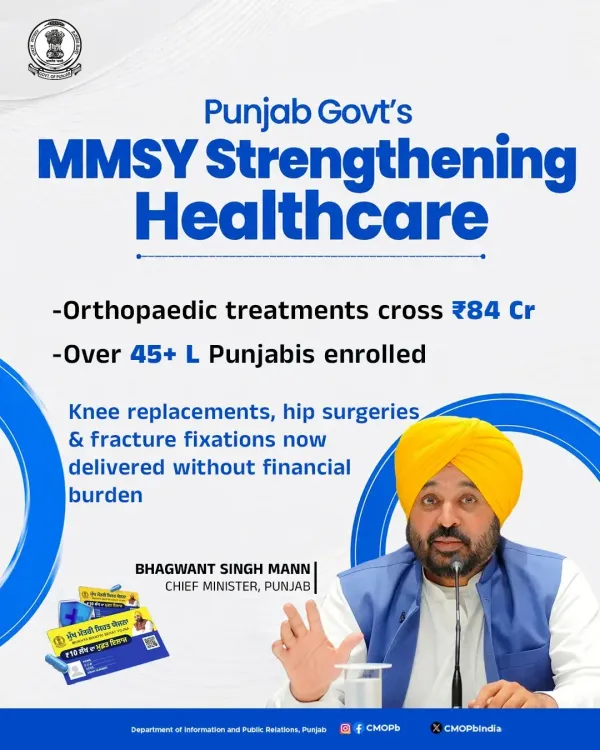
The Chief Minister's Office of Punjab said orthopaedic treatments under the Bhagwant Mann government's Mukh Mantri Sehat Yojana have crossed Rs 84 crore. Knee replacements lead utilisation, followed by hip surgeries and fracture fixations with plates and nails, increasingly performed cashless at district and tertiary hospitals across the state.
Key Takeaways
Orthopaedic claims under MMSY have crossed Rs 84 crore , per the Punjab CMO.
Knee replacements form the largest share of procedures, followed by hip surgeries.
Fracture fixation using plates, nails and implants is a significant category.
Procedures are increasingly delivered cashless in district and tertiary hospitals.
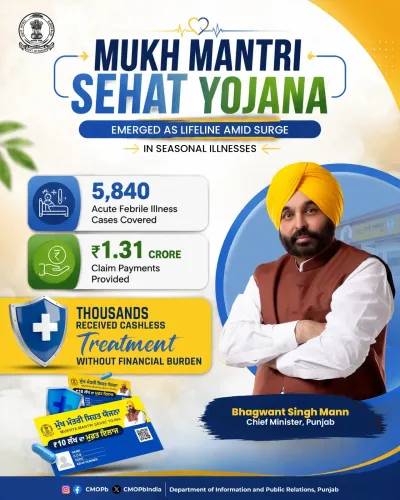
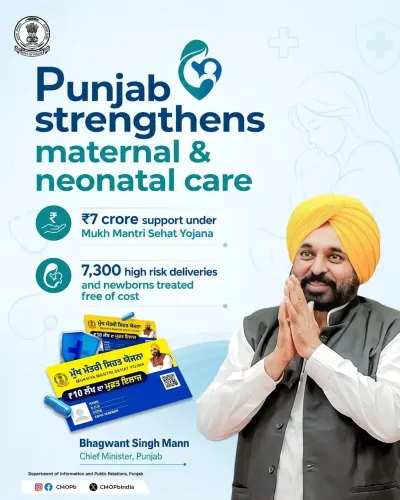
MMSY, launched in July 2022, offers up to Rs 5 lakh cover per family.
Disclosure comes from the office of CM Bhagwant Mann on 3 June 2026.
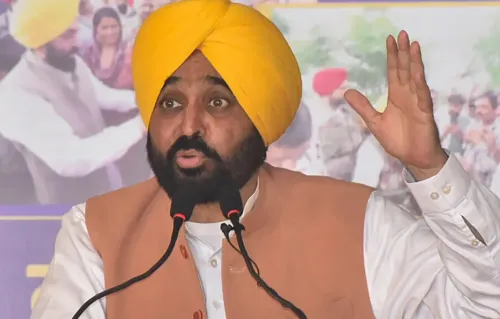
The Chief Minister's Office of Punjab on 3 June 2026 said that orthopaedic treatments availed under the state's flagship Mukh Mantri Sehat Yojana (MMSY) have crossed Rs 84 crore, citing a sustained rise in demand for bone and joint care across the state. The disclosure, made via the official handle of Chief Minister Bhagwant Mann, points to knee replacements as the single largest category of procedures reimbursed under the cashless scheme.
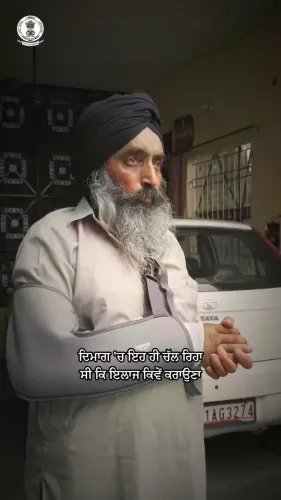
According to the post, 'knee replacements account for the highest share of procedures under the scheme, followed by hip surgeries and a large number of fracture fixation cases involving plates, nails and other implants.' These interventions, the office added, 'are increasingly being performed in district and tertiary care hospitals under cashless treatment coverage.'
Context
The Mukh Mantri Sehat Yojana is Punjab's state-funded health assurance programme, designed to extend cashless secondary and tertiary care to families through a network of empanelled public and private hospitals. The latest utilisation update is part of a series of periodic disclosures from the Government of Punjab tracking how the scheme is being used on the ground.
Orthopaedic interventions — particularly joint replacements — are among the most expensive elective procedures in Indian healthcare, with package costs typically running into lakhs of rupees per patient. The Rs 84-crore cumulative outgo signals both the volume of beneficiaries availing such procedures and the relative weight of bone-and-joint care in the scheme's overall claims basket.
Policy backdrop
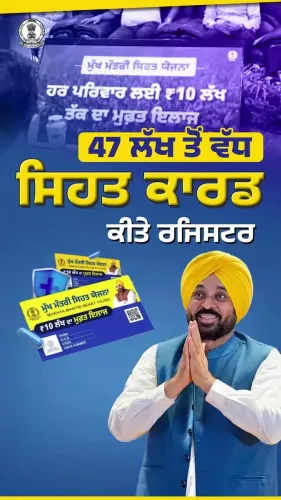
MMSY was launched in July 2022 by the Bhagwant Mann-led Aam Aadmi Party government, offering cashless coverage of up to Rs 5 lakh per family per year. It built on the earlier Punjab Government Employees Health Insurance Scheme and was positioned as a state-level complement to the central Ayushman Bharat PM-JAY programme.
The scheme's empanelment net includes district hospitals, tertiary public facilities and private providers, with the stated aim of reducing out-of-pocket expenditure on high-cost procedures. Joint replacements, cardiac care and oncology have historically been among the top cost drivers in similar state programmes elsewhere.
Stakeholders and impact
The primary beneficiaries are orthopaedic patients — many of them elderly residents in rural and semi-urban Punjab — for whom joint pain, arthritis and post-fracture complications have traditionally meant either catastrophic medical bills or deferred treatment. By routing these procedures through district hospitals under cashless coverage, the state is also nudging tertiary-grade orthopaedic capacity beyond the metropolitan teaching hospitals.
For empanelled facilities, the scheme provides assured patient volumes and standardised package payments for implants and surgical procedures. The mention of 'plates, nails and other implants' in the post underscores that trauma care — a heavy burden in a state with high road-accident incidence — is now being increasingly absorbed by the public insurance pool rather than left to private out-of-pocket spending.
The broader pattern across Indian states has been a steady widening of government health insurance to cover expensive orthopaedic work. Comparable utilisation profiles have been seen in Rajasthan's Chiranjeevi Yojana and Andhra Pradesh's Dr YSR Aarogyasri, where joint surgeries consistently feature among leading expenditure heads.
What's next
Attention will now turn to subsequent quarterly utilisation reports from the Punjab Health Department and to any fresh budget signals on MMSY funding ceilings, package rates and hospital empanelment. As demand for elective orthopaedic care grows with an ageing population, the sustainability of cashless coverage at current package rates will be a key test of the scheme's design.
If district hospitals continue to absorb a rising share of joint replacements and fracture-fixation surgeries, MMSY could mark a measurable shift in how tertiary orthopaedic care is delivered outside Punjab's largest urban centres.
Point of View
Especially orthopaedics. By foregrounding knee and hip procedures, the Punjab government is signalling that MMSY is not merely a catastrophic-illness backstop but a routine financing vehicle for an ageing population. The real test, as with Rajasthan and Andhra Pradesh's parallel schemes, will be whether package rates and hospital empanelment can keep pace with rising demand without squeezing provider participation.
NationPress
18 Oct 2026
Frequently Asked Questions
What is the Mukh Mantri Sehat Yojana in Punjab?
It is Punjab's state health assurance scheme offering cashless secondary and tertiary care through empanelled hospitals. Launched in July 2022 under CM Bhagwant Mann, it provides coverage of up to Rs 5 lakh per family per year.
How much has been spent on orthopaedic care under MMSY?
According to the Chief Minister's Office of Punjab, orthopaedic treatments under MMSY have crossed Rs 84 crore. The figure was shared in an official post on 3 June 2026.
Which orthopaedic procedures are most used under MMSY?
Knee replacements account for the highest share of procedures, followed by hip surgeries. Fracture fixation cases using plates, nails and other implants also form a large category.
Are MMSY orthopaedic surgeries available at district hospitals?
Yes. The CMO said these interventions are increasingly being performed at district and tertiary care hospitals under cashless treatment coverage, expanding access beyond major urban centres.
Is MMSY different from Ayushman Bharat PM-JAY?
MMSY is a Punjab state scheme distinct from the central Ayushman Bharat PM-JAY, although both provide cashless hospitalisation cover. MMSY is administered by the Government of Punjab through its own empanelment and package framework.