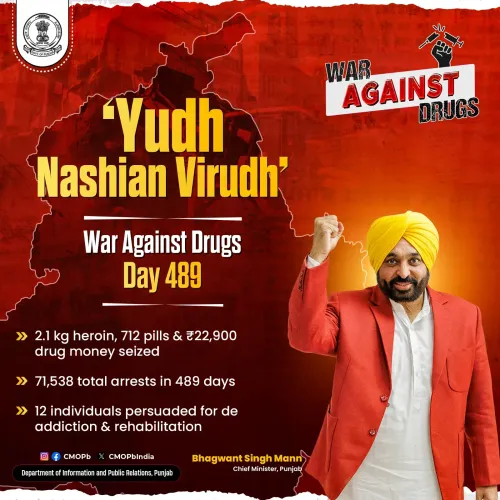
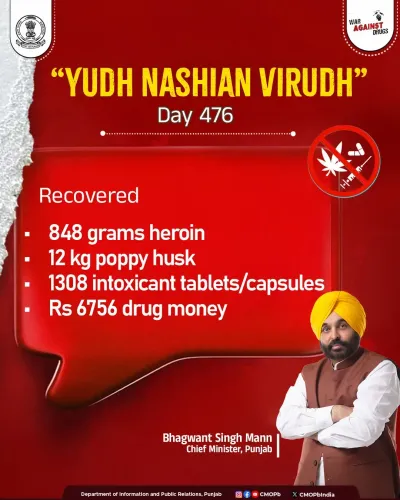
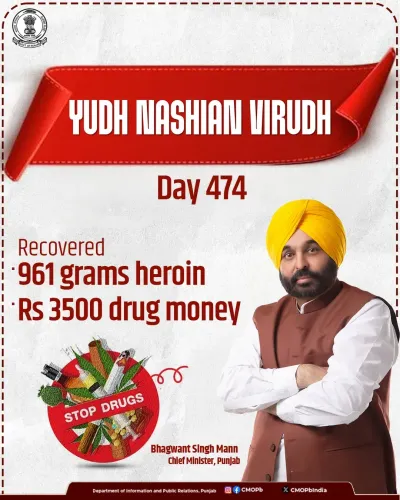
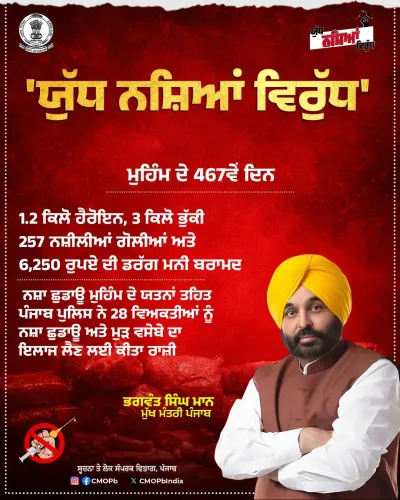
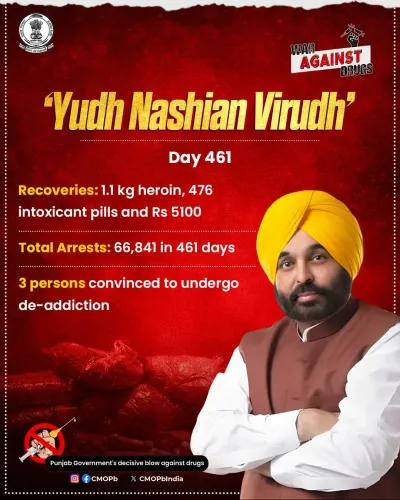
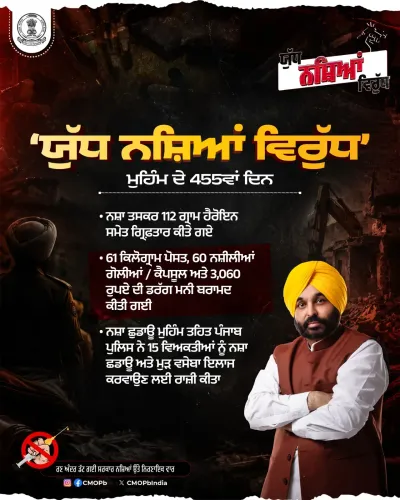
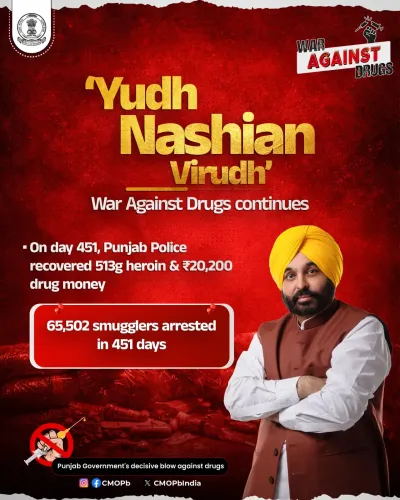
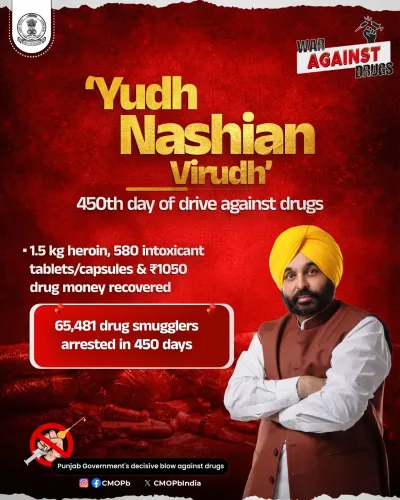
Punjab Police arrests 71,864 smugglers in 491-day anti-drug drive
Synopsis
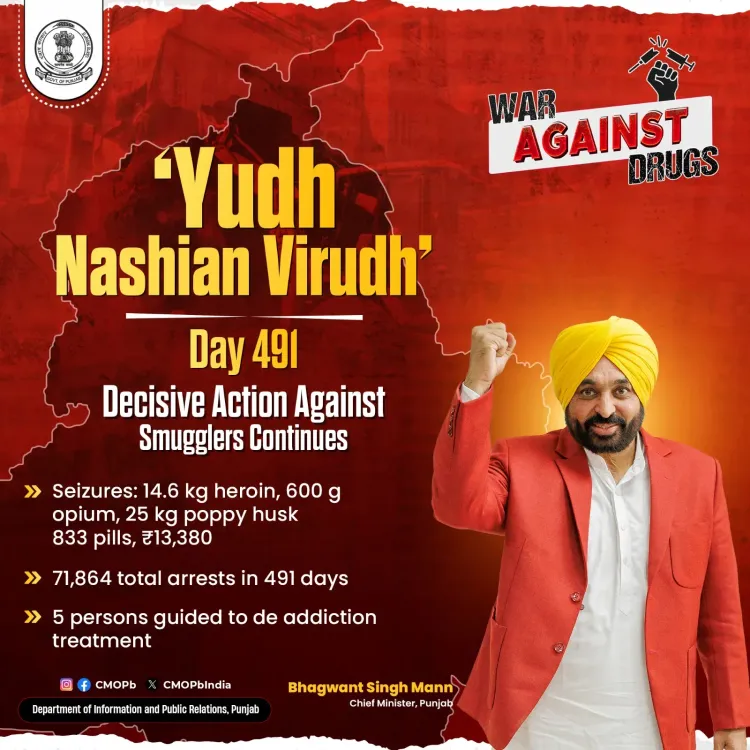
Punjab Police marked the 491st day of the Yudh Nashian Virudh anti-drug campaign on 6 July 2026, seizing 14.6 kg heroin and arresting fresh drug smugglers, pushing the cumulative arrest count to 71,864. Five persons were also referred for de-addiction treatment.
Key Takeaways
Day 491 of the Yudh Nashian Virudh campaign was reported by the Chief Minister's Office of Punjab on 6 July 2026 .
Punjab Police seized 14.6 kg heroin , 600 grams opium , 25 kg poppy husk , and 833 intoxicant pills in the latest operations. ₹13,380 in drug money was also recovered from arrested smugglers.
Total drug smugglers arrested since the drive began has reached 71,864 .
Five persons were convinced to voluntarily enter de-addiction and rehabilitation treatment as part of the campaign's outreach arm.
The campaign combines daily enforcement with rehabilitation referrals under the AAP government led by CM Bhagwant Mann .
The Chief Minister's Office of Punjab announced on Monday, 6 July 2026 that Punjab Police has continued its anti-narcotics campaign Yudh Nashian Virudh ('War Against Drugs') into its 491st consecutive day, with fresh arrests of drug smugglers and significant seizures of contraband across the state.
In the latest operational update, police teams recovered 14.6 kg heroin, 600 grams opium, 25 kg poppy husk, 833 intoxicant pills, and ₹13,380 in drug money from arrested smugglers. The cumulative tally of drug smugglers arrested since the drive began has now reached 71,864.
Context
Punjab has long grappled with a severe narcotics crisis, driven in large part by cross-border heroin flows linked to its proximity to the India-Pakistan border and the diversion of pharmaceutical opioids into illicit supply chains. The scale of the problem has made anti-drug enforcement a central political and governance priority for successive state governments.
The Yudh Nashian Virudh campaign is the current Aam Aadmi Party government's flagship response to this challenge. Under Chief Minister Bhagwant Mann, who took office in March 2022, the drive combines aggressive enforcement — arrests, seizures, and dismantling of supply networks — with de-addiction and rehabilitation outreach.
Policy Backdrop
The AAP government relaunched a structured anti-narcotics push upon assuming power, building on earlier state-level operations while adding a distinctive feature: daily public reporting of cumulative statistics through the Chief Minister's Office social media channels. This transparency-by-numbers approach is designed to signal sustained political will and operational momentum.
The daily update format ensures that enforcement milestones — arrests, seizure weights, drug money recovered — are placed directly in the public domain, making the campaign's progress visible and trackable. The 491-day continuous run underscores the administration's intent to frame this as a long-term structural effort rather than a periodic crackdown.
Stakeholders and Impact
Punjab's youth, border communities, and families affected by addiction are the primary stakeholders in this campaign. The human cost of the drug crisis — lost productivity, fractured families, and health emergencies — has been documented across districts, making enforcement and rehabilitation equally critical levers.
Alongside the enforcement numbers, the CMO's update noted that police have convinced five persons to voluntarily undergo de-addiction and rehabilitation treatment as part of the campaign's outreach component. While modest in isolation, the de-addiction referrals represent the campaign's attempt to address demand alongside supply.
What's Next
Attention will now turn to the release of Punjab Police's next quarterly narcotics report, which is expected to provide a more granular breakdown of seizure trends, geographic hotspots, and rehabilitation outcomes. Any announcements regarding expanded funding or new infrastructure for government-run de-addiction centres will be closely watched by health and social welfare advocates.
With the cumulative arrest count approaching 72,000, the administration faces growing scrutiny over whether enforcement numbers translate into measurable reductions in drug availability and addiction rates on the ground — the harder metric that will ultimately define the campaign's legacy.
Point of View
864 arrests in 491 days is a significant enforcement milestone, but analysts will note that arrest tallies alone do not capture whether drug availability or addiction prevalence is actually declining. The modest de-addiction referral numbers — five persons on a single day — highlight the persistent gap between enforcement scale and rehabilitation capacity, a tension that the administration will need to address more visibly. As the campaign heads toward its 500th day, the pressure to demonstrate outcome-based results, not just activity metrics, will intensify.
NationPress
6 Jul 2026
Frequently Asked Questions
What is Yudh Nashian Virudh?
Yudh Nashian Virudh ('War Against Drugs') is Punjab's ongoing state-wide anti-narcotics campaign launched by the Aam Aadmi Party government under Chief Minister Bhagwant Mann, combining enforcement operations against drug smugglers with de-addiction and rehabilitation outreach.
How many drug smugglers have been arrested in Punjab's anti-drug drive?
As of day 491 of the campaign, reported on 6 July 2026, the total number of drug smugglers arrested under Yudh Nashian Virudh has reached 71,864 .
What drugs were seized by Punjab Police on day 491?
Punjab Police seized 14.6 kg heroin , 600 grams opium , 25 kg poppy husk , and 833 intoxicant pills , along with ₹13,380 in drug money, on the 491st day of the drive.
What is Punjab doing for drug de-addiction?
As part of the Yudh Nashian Virudh campaign, Punjab Police actively convinces arrested or identified individuals to voluntarily undergo de-addiction and rehabilitation treatment. On day 491, five persons were referred for such treatment.
Why is Punjab particularly affected by drug trafficking?
Punjab's proximity to the India-Pakistan border makes it a key corridor for cross-border heroin flows. Domestic pharmaceutical diversion also contributes to the state's narcotics problem, which has affected large sections of its youth population.