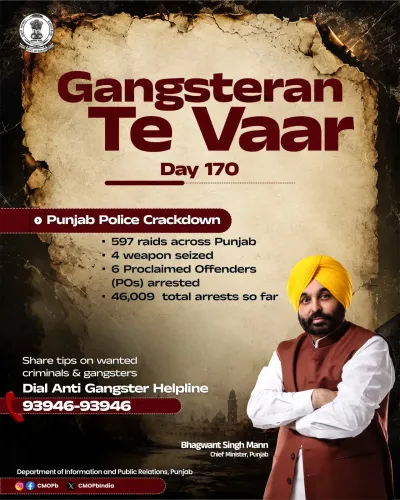
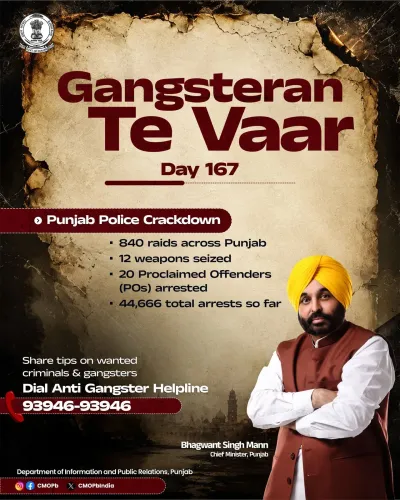
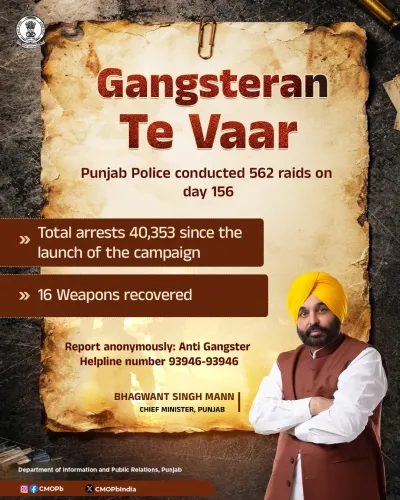
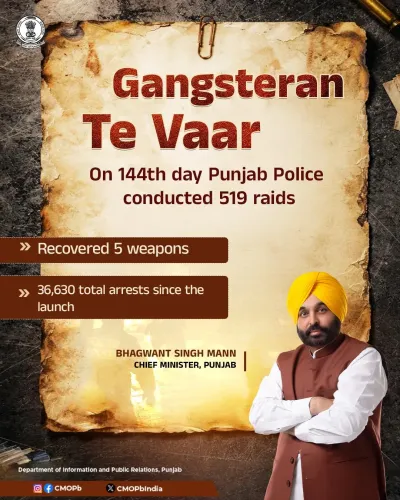
Punjab Police Conducts 776 Raids on Day 184 of Gangsteran Te Vaar
Synopsis
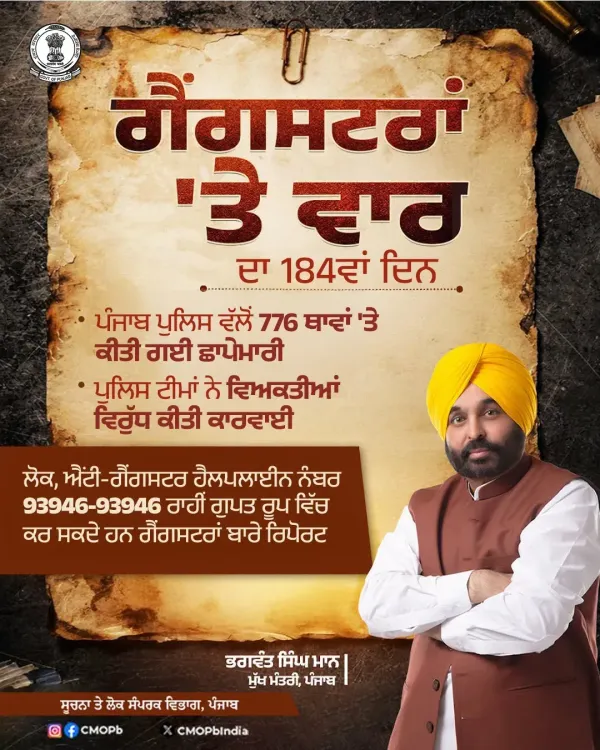
On the 184th day of Punjab's 'Gangsteran Te Vaar' campaign, police conducted 776 coordinated raids on gangster-linked locations statewide, seizing five weapons and pushing cumulative arrests to 52,174, the Chief Minister's Office announced on 24 July 2026.
Key Takeaways
776 raids were conducted simultaneously across Punjab on 24 July 2026 , the 184th day of the Gangsteran Te Vaar campaign.
All targeted locations had been pre-identified and mapped as linked to associates of gangsters.
Police seized five weapons during the operation alongside multiple arrests.
Cumulative arrests since the campaign's launch now stand at 52,174 .
The campaign was initiated by Chief Minister Bhagwant Mann 's AAP government, which took office in March 2022 on a platform of dismantling gangster networks.
The operation targets associate ecosystems — safe houses, logistics, and support networks — rather than only named gangsters.
The Chief Minister's Office of Punjab announced on Friday, 24 July 2026 that Punjab Police conducted 776 simultaneous raids across the state on the 184th day of the ongoing Gangsteran Te Vaar ('War on Gangsters') campaign, targeting identified and mapped locations linked to associates of gangsters.
What Happened
Police teams fanned out across Punjab, hitting 776 pre-identified locations linked to gangster networks in a single coordinated operation. The raids resulted in arrests of multiple individuals along with the seizure of five weapons. With these latest arrests, the campaign's cumulative tally has reached 52,174 arrests since its launch.
The CMO's post stated: 'Punjab Police conducted 776 raids at identified and mapped locations linked to associates of gangsters across the state. Police teams arrested individuals with five weapons, taking the total arrests to 52,174 since the launch of the campaign.'
Context
Bhagwant Mann's Aam Aadmi Party government came to power in March 2022 with an explicit mandate to dismantle drug networks and gangster culture — longstanding blights on Punjab's social fabric. The Gangsteran Te Vaar campaign was launched as the primary enforcement instrument of that pledge.
Punjab has historically grappled with organised gangs involved in extortion, contract killings, and drug trafficking, with violence frequently spilling into public spaces. Successive governments have relied on sustained police drives as the principal response, and the current administration has continued and intensified that approach.
Policy Backdrop
The campaign's operational model — identifying, mapping, and then raiding associate networks rather than only pursuing named gangsters — reflects a broader intelligence-led policing strategy. By targeting the support ecosystem of organised crime, the approach aims to cut off logistics, safe houses, and weapons supply chains.
The scale of the operation, with raids conducted at 776 locations in a single day, signals a deliberate emphasis on simultaneous pressure rather than sequential action, designed to prevent tip-offs and network regrouping.
Stakeholders and Impact
Residents of Punjab — particularly in districts historically troubled by gang activity — are the primary intended beneficiaries of the crackdown. The cumulative arrest figure of 52,174 over 184 days represents a significant volume of enforcement activity, though independent assessment of its impact on ground-level crime rates remains ongoing.
Organised crime networks operating across state borders, as well as those with links to drug trafficking corridors, face sustained disruption. Civil liberties observers have periodically called for transparency on charge-sheet rates and conviction outcomes to evaluate the campaign's long-term effectiveness.
What's Next
The government is expected to continue issuing periodic updates on total seizures, weapons recovered, and charge-sheet progress. Analysts will watch whether the high arrest volumes translate into sustained reductions in extortion and violent crime statistics across Punjab. The campaign's trajectory also carries political weight for the AAP government as it approaches its mid-term phase.
Point of View
Reinforcing the AAP government's core law-and-order brand ahead of future electoral cycles. The shift to mapping and raiding associate networks — rather than only pursuing named gangsters — marks a doctrinal evolution in Punjab's anti-organised-crime playbook, moving from reactive policing to proactive disruption of criminal ecosystems. However, the sheer volume of arrests raises questions that the government has yet to fully address publicly: what proportion result in charge-sheets and convictions, and how durably is organised crime being weakened versus temporarily disrupted. The campaign's long-term credibility will hinge on those downstream metrics as much as on the headline arrest count.
NationPress
25 Jul 2026
Frequently Asked Questions
What is the Gangsteran Te Vaar campaign in Punjab?
'Gangsteran Te Vaar' — meaning 'War on Gangsters' — is an ongoing Punjab Police operation launched under Chief Minister Bhagwant Mann's AAP government to dismantle organised crime networks through coordinated raids, arrests, and weapons seizures across the state.
How many total arrests have been made in the Gangsteran Te Vaar campaign?
As of 24 July 2026 — the 184th day of the campaign — total arrests have reached 52,174 , according to the Chief Minister's Office of Punjab.
How many raids did Punjab Police conduct on 24 July 2026?
Punjab Police conducted 776 raids on 24 July 2026 at pre-identified and mapped locations linked to associates of gangsters across the state.
Why is Punjab Police targeting gangster associates and not just gangsters?
By mapping and raiding the support networks of gangsters — including safe houses, logistics, and weapons supply chains — the campaign aims to disrupt the broader criminal ecosystem, making it harder for organised gangs to operate even if key figures evade immediate arrest.
When did the Bhagwant Mann government launch its anti-gangster drive in Punjab?
The AAP government under Bhagwant Mann took office in March 2022 with an explicit commitment to dismantling gangster and drug networks, and subsequently launched the 'Gangsteran Te Vaar' campaign as its primary enforcement initiative.