Punjab Police Conduct 597 Raids on Day 170 of Gangsteran Te Vaar

Synopsis
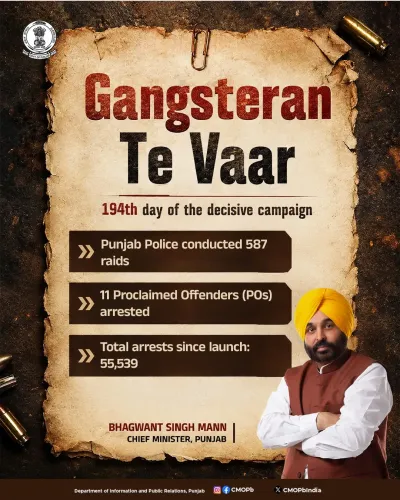
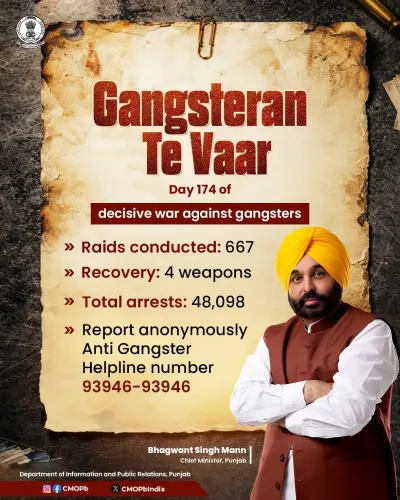
Punjab Police conducted 597 raids on Day 170 of the 'Gangsteran Te Vaar' campaign, arresting individuals with four weapons and six Proclaimed Offenders. Cumulative arrests since the campaign's launch have reached 46,009, with preventive action taken against 250 more persons on the same day.
Key Takeaways
597 raids were conducted on Day 170 of the Gangsteran Te Vaar campaign at locations linked to gangster associates across Punjab .
Cumulative arrests since the campaign's launch have reached 46,009 , with four weapons seized on Day 170 alone.
Preventive action was taken against 250 persons on July 9, 2026 .
Six Proclaimed Offenders (POs) — individuals evading court warrants — were arrested during the day's operations.
The campaign, launched by the AAP government in Punjab , targets gangsters, their associates, and mapped locations across the state.
The Chief Minister's Office of Punjab announced on Thursday, July 9, 2026, that the state's sustained anti-gangster drive — 'Gangsteran Te Vaar' — has entered its 170th day, with Punjab Police conducting 597 raids at identified and mapped locations linked to associates of gangsters across the state.
The CMO's post stated that on Day 170, police teams arrested individuals along with four weapons, pushing the campaign's cumulative arrest tally to 46,009 since its launch. In addition, preventive action was taken against 250 persons on the same day, and six Proclaimed Offenders (POs) were apprehended during the operation.
Context
Gangsteran Te Vaar — loosely translated as 'Strike Against Gangsters' — is a statewide enforcement drive by Punjab Police targeting organised criminal networks, their associates, and mapped hideouts across the state. The campaign involves coordinated raids, arrests, and preventive detentions aimed at dismantling the operational infrastructure of gangster syndicates.
The operation has now sustained daily enforcement activity for nearly six months, with the state government regularly publishing day-wise updates to signal institutional commitment to the drive.
Policy Backdrop
The Aam Aadmi Party government, which assumed office in Punjab in 2022, came to power with an explicit mandate to strengthen law and order and confront organised crime head-on. The launch of Gangsteran Te Vaar is part of that broader governance agenda.
Punjab has long contended with organised criminal gangs involved in extortion, contract killings, and narcotics trafficking. Successive state administrations have deployed extended police operations combining raids, arrests of Proclaimed Offenders, and preventive measures to disrupt these syndicates — but the current campaign's duration and publicly reported scale mark a notable escalation in enforcement tempo.
Stakeholders and Impact
For ordinary Punjab residents — particularly in districts historically affected by gang violence and extortion — the sustained campaign signals continued administrative pressure on criminal networks. The arrest of Proclaimed Offenders, individuals who have evaded court summons or warrants, is seen as a marker of the operation's reach into entrenched criminal ecosystems.
The regular seizure of weapons alongside arrests is also significant in a state where illegal firearms have historically been a key enabler of organised crime. Each weapon recovered is framed by authorities as a direct reduction in the operational capacity of active gangs.
What's Next
With the campaign now past its 170-day mark and cumulative arrests crossing 46,000, attention will turn to whether the state government pairs enforcement numbers with updated crime-rate data for Punjab — a metric that would allow independent assessment of the drive's on-ground impact.
Analysts and civil society groups are also watching for any follow-up legislative measures to strengthen provisions against organised crime, which could give the campaign a more durable institutional foundation beyond policing action alone.
Point of View
Quantifiable commitment rather than a one-time crackdown. Crossing 46,000 cumulative arrests is a significant political milestone for the AAP government, which staked its 2022 mandate partly on taming Punjab's entrenched gang problem. However, the true test of the campaign's effectiveness lies not in arrest tallies but in whether crime indicators — extortion rates, contract killings, narcotics flows — show measurable decline. The government's next challenge will be converting enforcement momentum into verifiable, data-backed improvements in public safety.
NationPress
8 Oct 2026
Frequently Asked Questions
What is the Gangsteran Te Vaar campaign in Punjab?
'Gangsteran Te Vaar' is a statewide anti-gangster operation by Punjab Police targeting organised criminal networks, their associates, and mapped hideouts. It involves coordinated raids, arrests, and preventive detentions to dismantle gang infrastructure across the state.
How many arrests have been made in the Gangsteran Te Vaar campaign?
As of Day 170 of the campaign on July 9, 2026, cumulative arrests under Gangsteran Te Vaar have reached 46,009 since the operation's launch.
What happened on Day 170 of Gangsteran Te Vaar?
On Day 170, Punjab Police conducted 597 raids, arrested individuals with four weapons, apprehended six Proclaimed Offenders, and took preventive action against 250 persons.
Who is running the Gangsteran Te Vaar operation?
Punjab Police is conducting the operation under the broader law-and-order mandate of the Aam Aadmi Party government, which came to power in Punjab in 2022.
What are Proclaimed Offenders in the context of Punjab Police operations?
Proclaimed Offenders are individuals who have evaded court summons or warrants and are formally declared as such by a court. Their arrest is considered a marker of an operation's reach into entrenched criminal networks.