Trump's Working Families Tax Cuts Mark One Year, Expand Child Tax Credit

Synopsis
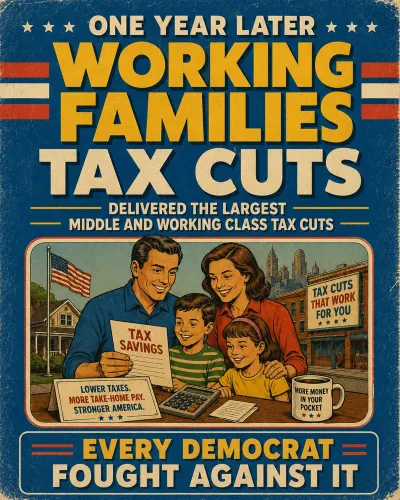
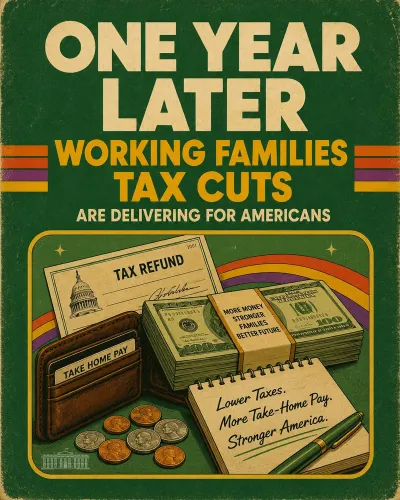
The White House marked one year of President Trump's Working Families Tax Cuts on July 9, 2026, highlighting the permanent doubling and expansion of the Child Tax Credit as sustained financial relief for American families with children.
Key Takeaways
The White House announced the one-year anniversary of President Trump 's Working Families Tax Cuts on July 9, 2026 .
The legislation permanently doubles and expands the Child Tax Credit , moving beyond the temporary provisions of the 2017 Tax Cuts and Jobs Act .
The original TCJA of 2017 had doubled the Child Tax Credit to $2,000 per qualifying child , but those provisions were set to expire after 2025 .
American families with children are the stated primary beneficiaries of the expanded credit.
The permanent expansion reflects a longstanding Republican priority to make individual TCJA tax cuts durable rather than temporary.
The White House announced on Thursday, July 9, 2026, that President Donald Trump's Working Families Tax Cuts legislation has completed one year since enactment, with the administration highlighting permanent expansion of the Child Tax Credit as a central benefit for American families.
Context
The White House stated that the law is 'delivering HUGE relief to American families by permanently doubling and expanding the Child Tax Credit.' The post marks a one-year milestone for the legislation, framing it as a lasting financial benefit rather than a temporary measure.
The Child Tax Credit is a federal tax provision that reduces the tax burden on families for each qualifying child. Its expansion has been a recurring legislative priority for Republican administrations and lawmakers over the past decade.
Policy Backdrop
The roots of the current expansion trace back to the Tax Cuts and Jobs Act (TCJA) of 2017, which President Trump signed during his first term. That law doubled the Child Tax Credit to $2,000 per qualifying child, though most of its individual provisions were set to expire after 2025.
The Working Families Tax Cuts legislation, as described by the White House, appears to address that scheduled sunset by making the expanded credit permanent rather than allowing it to lapse. This aligns with a broader Republican legislative goal of converting temporary TCJA provisions into durable policy.
The move to permanently expand the credit represents a significant shift from the original TCJA structure, where the doubled credit was a time-limited measure subject to future congressional reauthorisation.
Stakeholders and Impact
American families with children are the primary beneficiaries identified by the White House. A permanently expanded Child Tax Credit reduces annual federal tax liability for eligible households, providing predictable relief that families can factor into long-term financial planning.
For lower- and middle-income households, the credit's refundability provisions — which determine how much of the credit can be claimed beyond what is owed in taxes — are particularly consequential. The White House's announcement does not specify changes to income thresholds or refundability parameters beyond the doubling and expansion language.
What's Next
With the administration marking the first anniversary of the legislation, attention will likely shift to implementation details and any regulatory guidance from the Internal Revenue Service on how the expanded credit applies to the 2026 tax year and beyond.
Congressional oversight of the law's fiscal impact, including its effect on federal revenue projections, is expected to remain a point of debate between Republican supporters and Democratic critics of the broader tax framework. The permanence of the expansion also sets a baseline for any future legislative negotiations on family tax policy.
Point of View
The administration draws a sharp contrast with the time-limited structure of the 2017 TCJA, attempting to neutralise a longstanding Democratic critique that Republican tax cuts are temporary and tilted toward corporations. The focus on the Child Tax Credit is strategically calibrated — it is among the most broadly popular elements of any tax package, cutting across income groups and party lines. Whether the fiscal cost of permanence becomes a liability in future budget negotiations remains the key political question.
NationPress
8 Oct 2026
Frequently Asked Questions
What is the Working Families Tax Cuts law signed by Trump?
The Working Families Tax Cuts is legislation announced by the White House as permanently doubling and expanding the Child Tax Credit for American families. It builds on the framework established by the 2017 Tax Cuts and Jobs Act.
How much is the Child Tax Credit after Trump's expansion?
The White House states the Child Tax Credit has been permanently doubled and expanded under the Working Families Tax Cuts. The original 2017 TCJA set the credit at $2,000 per qualifying child; the current law's exact per-child figure has not been specified in the official announcement.
When did Trump's Working Families Tax Cuts become law?
Based on the White House's July 9, 2026 announcement marking 'one year later,' the legislation appears to have been enacted around July 2025. An exact enactment date has not been confirmed in the official post.
Who benefits from the expanded Child Tax Credit in 2026?
American families with qualifying children are the primary beneficiaries. The credit reduces federal tax liability per child, with the greatest impact on low- and middle-income households depending on refundability provisions.
What was the Child Tax Credit before Trump's 2025 tax law?
The 2017 Tax Cuts and Jobs Act doubled the Child Tax Credit to $2,000 per qualifying child, but those provisions were scheduled to expire after 2025. The Working Families Tax Cuts legislation is presented as making the expanded credit permanent.