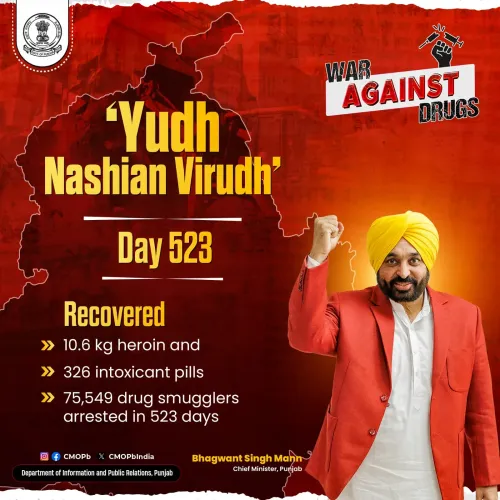
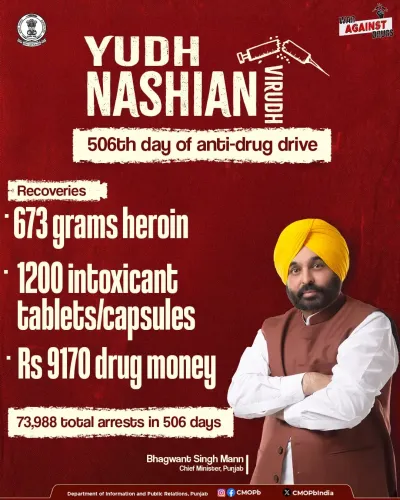
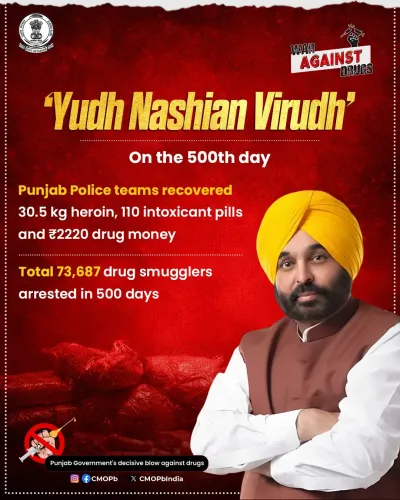
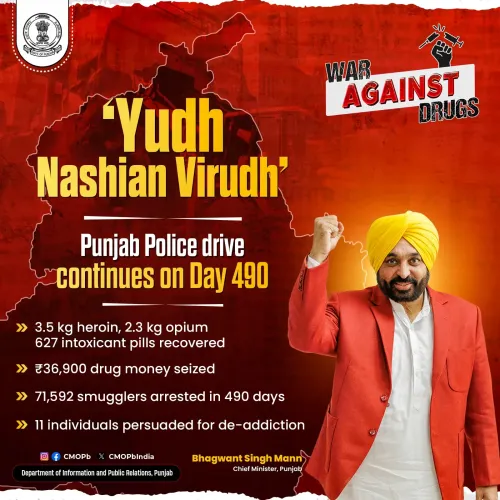
Punjab Police Hits Day 603 of Yudh Nashian Virudh, Arrests Cross 88,086
Synopsis
Punjab Police continued the 'Yudh Nashian Virudh' anti-drug campaign on its 603rd day, seizing 11.7 kg heroin and 1,028 pills, pushing cumulative arrests to 88,086 while referring 29 more persons to de-addiction treatment.
Key Takeaways
Day 603 of the Yudh Nashian Virudh campaign was confirmed by the Chief Minister's Office of Punjab on October 25, 2026 .
Punjab Police recovered 11.7 kg of heroin , 1,028 intoxicant pills , and Rs 5,200 in drug money in a single day's operations.
Cumulative drug smuggler arrests since the campaign's 2022 launch have reached 88,086 .
29 individuals were convinced to voluntarily enter de-addiction and rehabilitation on day 603.
The campaign runs a twin mandate: supply-side enforcement through arrests and demand-side reduction through rehabilitation referrals.
Punjab's proximity to drug trafficking corridors has made sustained enforcement a long-standing governance priority across multiple administrations.
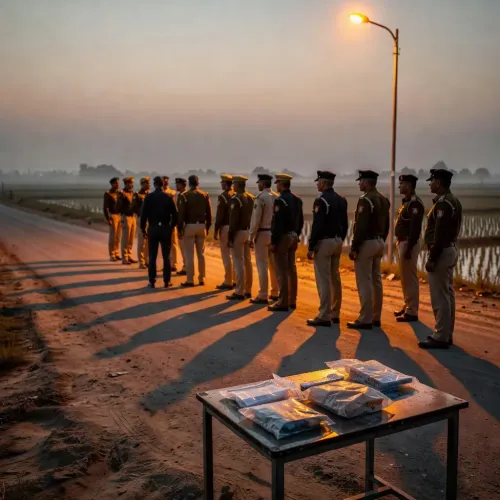
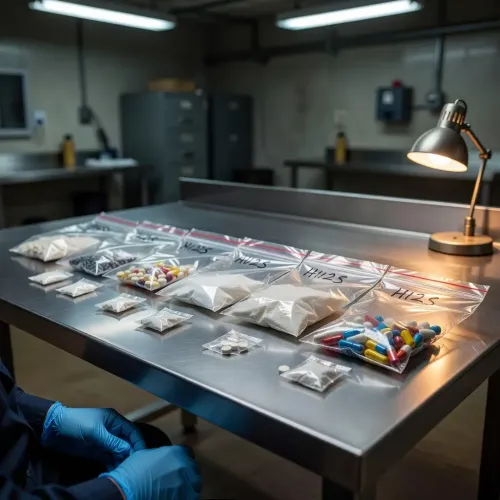
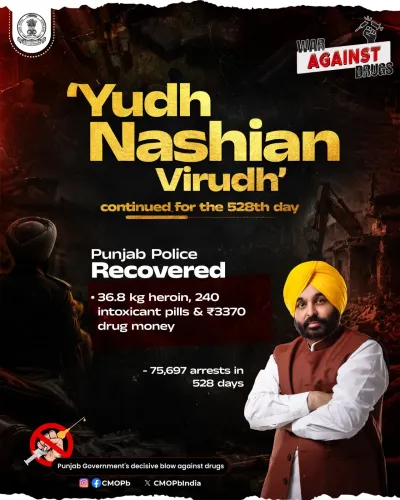
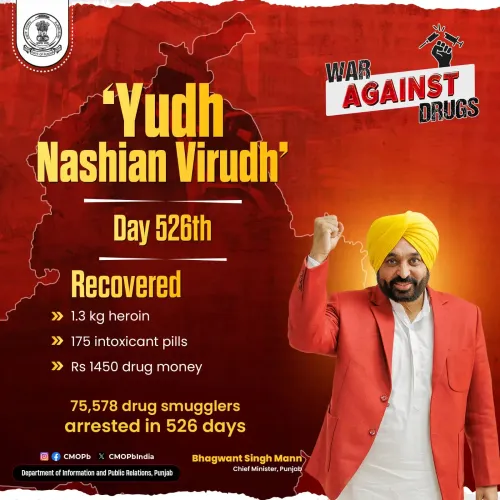
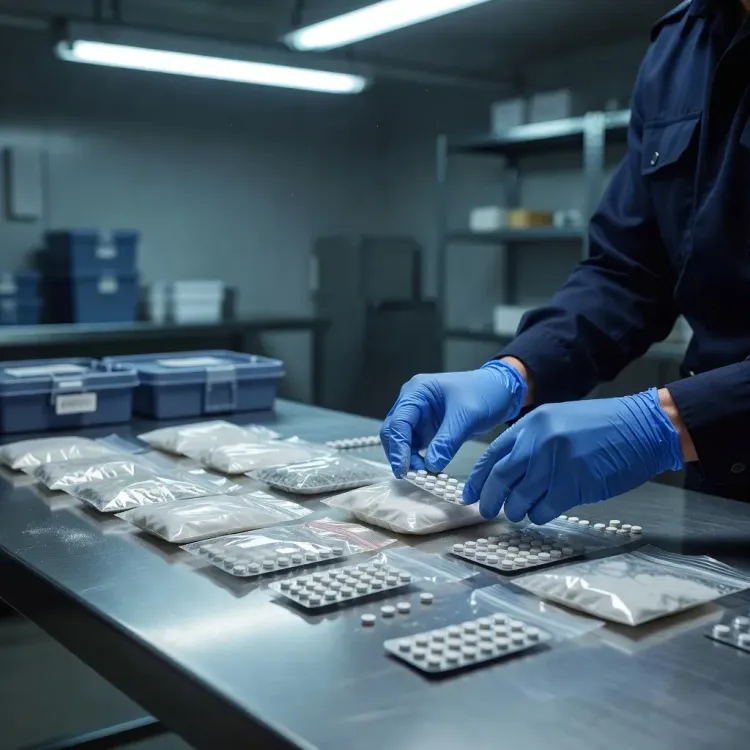
Six hundred and three days in, and Punjab's war on drugs shows no sign of standing down. The Chief Minister's Office of Punjab confirmed on Sunday, October 25, 2026 that Punjab Police has sustained its anti-narcotics campaign Yudh Nashian Virudh ('War Against Drugs') into its 603rd consecutive day — seizing 11.7 kg of heroin, 1,028 intoxicant pills, and Rs 5,200 in drug money from smugglers arrested in the latest operations.
603 Days, 88,086 Arrests — and the Count Climbs
The cumulative arrest tally now stands at 88,086 drug smugglers since the campaign was launched in 2022 — a number that underscores the sheer scale of enforcement the state has mounted. Each daily update from the CMO adds another data point to what has become one of the longest unbroken anti-narcotics drives by any Indian state police force in recent memory. The consistent daily tempo matters: it signals institutional resolve rather than a surge-and-retreat pattern that often defines such campaigns.
The Rehabilitation Arm: 29 More Referred to De-addiction
Alongside the arrests, 29 individuals were persuaded by Punjab Police personnel to voluntarily enter de-addiction and rehabilitation treatment on day 603 — a figure that quietly anchors the campaign's second pillar. Yudh Nashian Virudh has always carried a twin mandate: disrupt the supply chain through arrests, and shrink demand by pulling users toward treatment. Punjab has wrestled with drug abuse for decades, and successive state administrations have learned that enforcement alone cannot untangle a crisis embedded this deep in communities.
Why Punjab's Dual-Track Model Matters
The campaign's design — police as both enforcer and counsellor — reflects a hard lesson drawn from years of failed single-dimensional crackdowns. Officers are not just filing FIRs; they are, in effect, case-managing vulnerable individuals toward government rehabilitation infrastructure. The daily de-addiction referral count, often overlooked in favour of the dramatic seizure numbers, is arguably the more durable metric of success. Heroin recovered today can be replaced; a person redirected to treatment represents a potential permanent exit from the cycle.
For the families of Punjab's youth — the demographic most exposed to trafficking networks that have historically run through the state's border geography — each day's bulletin is both a ledger of harm and a signal that the state apparatus remains active. With the total arrest figure closing in on 90,000, the next milestone is already in sight.
Point of View
Seizures, and de-addiction referrals functions as governance signalling: it keeps the issue on Punjab's political agenda while building a cumulative accountability record. The dual enforcement-plus-rehabilitation model, if the referral numbers translate into actual treatment completions, could set a replicable template for other border states grappling with trafficking networks. The real test, however, will come when the headline arrest tally is measured against ground-level recidivism and supply availability data — metrics the daily bulletins do not yet capture.
NationPress
26 Oct 2026
Frequently Asked Questions
What is the Yudh Nashian Virudh campaign in Punjab?
Yudh Nashian Virudh — meaning 'War Against Drugs' — is a sustained anti-narcotics drive launched by the Punjab government in 2022. It combines daily police enforcement operations to arrest drug smugglers with outreach efforts to refer drug users to de-addiction and rehabilitation centres.
How many drug smugglers have been arrested under Yudh Nashian Virudh so far?
As of day 603 of the campaign (October 25, 2026), the total number of drug smugglers arrested has reached 88,086, according to the Chief Minister's Office of Punjab.
What was recovered by Punjab Police on day 603 of the anti-drug drive?
On the 603rd day of the campaign, Punjab Police seized 11.7 kg of heroin, 1,028 intoxicant pills, and Rs 5,200 in drug money from arrested smugglers.
How does Punjab Police handle drug users under this campaign?
Alongside arrests of smugglers, Punjab Police personnel actively counsel drug users to voluntarily enter de-addiction and rehabilitation treatment. On day 603, 29 persons were convinced to undergo such treatment.
Which government authority posts daily updates on the Yudh Nashian Virudh campaign?
The Chief Minister's Office of Punjab posts daily updates on the campaign's progress — including arrest counts, contraband seized, and de-addiction referrals — on its official X (formerly Twitter) account, @CMOPbIndia.