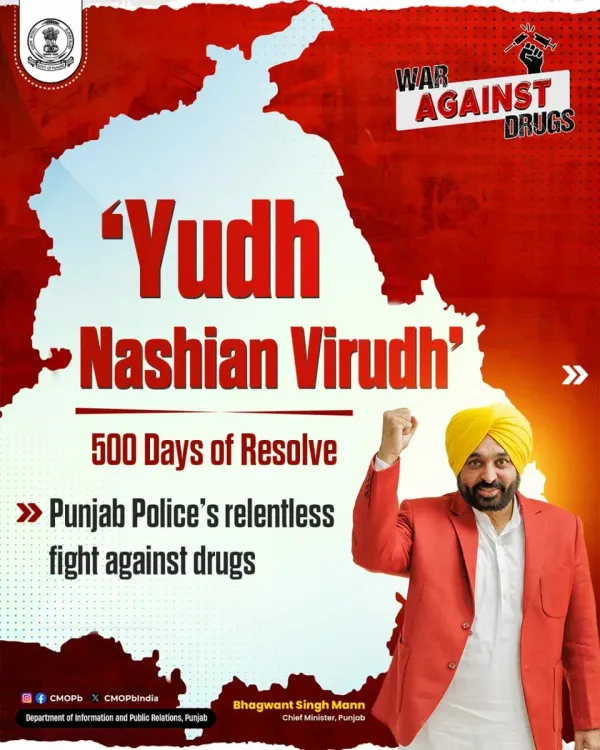
Punjab Police logs 52,432 FIRs in 500 days of Yudh Nashian Virudh
Synopsis
Punjab Police's Yudh Nashian Virudh campaign, launched on 1 March 2025 under CM Bhagwant Mann, has in 500 days filed 52,432 FIRs, arrested over 68,850 drug traffickers, confiscated ₹319 crore in assets, and mobilised 1.25 lakh Village Defence Committee members across Punjab.
Key Takeaways
52,432 FIRs registered under the NDPS Act in 500 days of the Yudh Nashian Virudh campaign.
More than 68,850 drug traffickers apprehended since the campaign launched on 1 March 2025 .
Properties worth ₹319 crore belonging to drug traffickers attached or confiscated.
Over 24,000 Village Defence Committees with more than 1.25 lakh members are coordinating with Punjab Police.
The campaign combines strict enforcement, community participation and preventive education under the directions of Chief Minister Bhagwant Mann .
Punjab's border geography makes it a critical transit zone; the campaign targets both supply networks and grassroots demand.
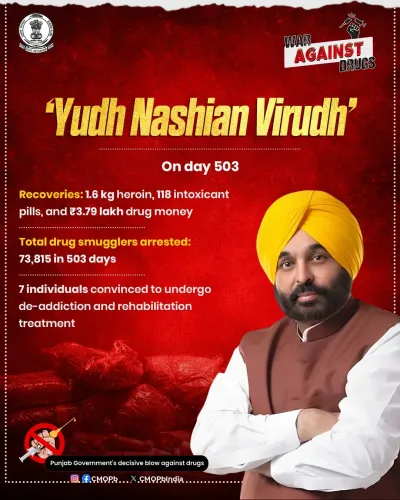
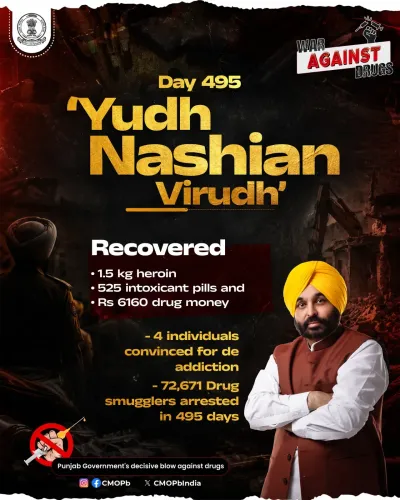
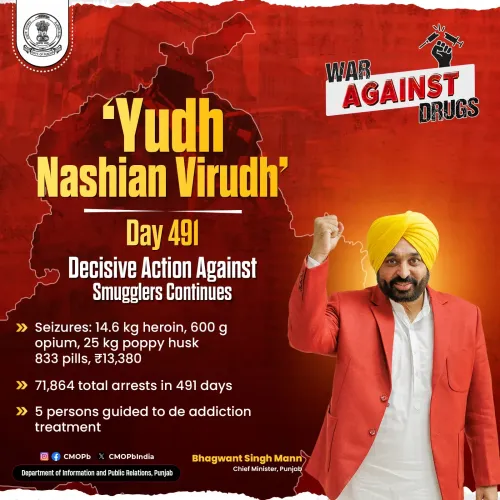
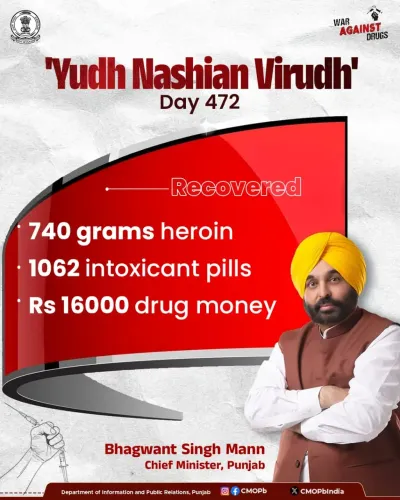
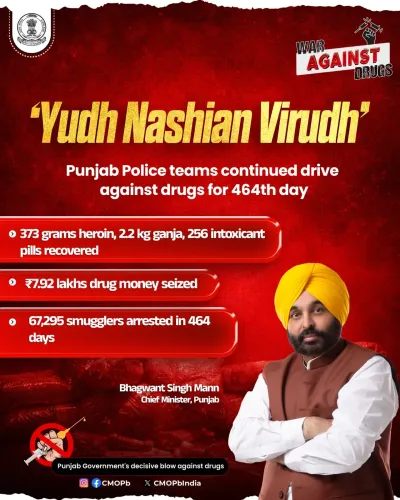
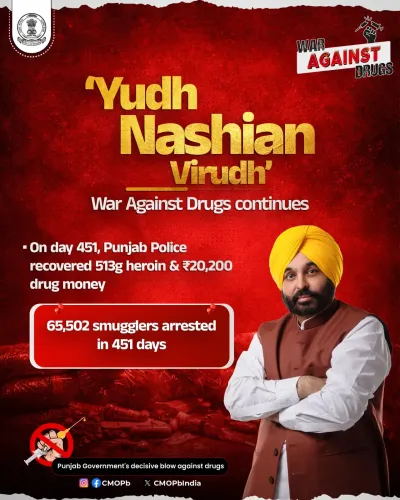
The Chief Minister's Office of Punjab announced on Monday, 20 July 2026 that Punjab Police's flagship anti-drug campaign, Yudh Nashian Virudh (Yudh Nashian Virudh — 'War Against Drugs'), has crossed the 500-day mark since its launch on 1 March 2025, registering 52,432 FIRs under the NDPS Act and apprehending more than 68,850 drug traffickers.
Context
Launched under the directions of Chief Minister Bhagwant Mann, the campaign has pursued what the CMO describes as a 'three-pronged strategy' of strict enforcement, community participation and preventive education. In its first 500 days, properties worth ₹319 crore belonging to drug traffickers were attached or confiscated under the provisions of the Narcotic Drugs and Psychotropic Substances Act, 1985 — India's principal legislation governing drug offences and asset forfeiture.
The CMO's post states that Punjab Police is also working in close coordination with over 24,000 Village Defence Committees, comprising more than 1.25 lakh members, embedding community vigilance at the grassroots level.
Policy Backdrop
Punjab has long been identified as a major transit and consumption zone for opiates and synthetic drugs entering from the India-Pakistan border. Successive state administrations since the mid-2010s have periodically announced special anti-narcotics cells and awareness drives, often citing elevated drug-related case data from national crime records.
The Aam Aadmi Party government led by Chief Minister Bhagwant Mann, in power since March 2022, has positioned the anti-drug drive as a centrepiece of its law-and-order agenda. The NDPS Act empowers authorities to attach properties linked to narcotics proceeds, and the ₹319 crore in confiscated assets signals an emphasis on targeting the economic infrastructure of the drug trade rather than street-level enforcement alone.
Stakeholders and Impact
The campaign's reach extends well beyond police stations. The mobilisation of over 1.25 lakh Village Defence Committee members across 24,000-plus committees means that border villages and rural communities — historically the most exposed to narcotics trafficking routes — are now active participants in surveillance and reporting.
Law enforcement agencies, including potential coordination with central bodies such as the Narcotics Control Bureau, stand to benefit from the intelligence generated at the community level. For rural families, the preventive education component of the campaign targets demand reduction alongside the supply-side crackdown.
What's Next
The milestone of 500 days is likely to be followed by fresh quarterly crime statistics from Punjab Police that will test whether FIR registrations and arrest numbers translate into sustained reductions in drug availability and consumption. Analysts will also watch for any announced joint operations with central paramilitary forces along the Punjab-Pakistan border, which remains the primary entry point for contraband narcotics into the state.
As the campaign moves past its first 500 days, the durability of community-level structures such as the Village Defence Committees will determine whether Yudh Nashian Virudh marks a structural shift in Punjab's approach to drug control or remains a high-intensity enforcement surge.
Point of View
Central to its 2022 election campaign, is being delivered with measurable outcomes. The emphasis on asset confiscation (₹319 crore) alongside arrest numbers reflects a deliberate shift toward disrupting the financial architecture of drug networks, a more sophisticated metric than FIR counts alone. The Village Defence Committee model, if sustained, could institutionalise community policing in border districts in a way that outlasts any single administration. However, the true test will come when independent crime statistics are published — translating enforcement activity into verifiable reductions in drug prevalence remains the harder, longer arc.
NationPress
21 Jul 2026
Frequently Asked Questions
What is Yudh Nashian Virudh?
Yudh Nashian Virudh, meaning 'War Against Drugs', is Punjab Police's flagship anti-narcotics campaign launched on 1 March 2025 under the directions of Chief Minister Bhagwant Mann, combining enforcement, community vigilance and preventive education.
How many FIRs has Punjab Police registered under the NDPS Act in the Yudh Nashian Virudh campaign?
Punjab Police has registered 52,432 FIRs under the Narcotic Drugs and Psychotropic Substances Act since the campaign began on 1 March 2025.
How much property has been confiscated from drug traffickers in Punjab?
Properties worth ₹319 crore belonging to drug traffickers have been attached or confiscated during the Yudh Nashian Virudh campaign.
What are Village Defence Committees in Punjab's anti-drug drive?
Village Defence Committees are community-level bodies coordinating with Punjab Police; over 24,000 such committees with more than 1.25 lakh members are active under the Yudh Nashian Virudh campaign.
How many drug traffickers have been arrested in Punjab since March 2025?
More than 68,850 drug traffickers have been apprehended by Punjab Police in the 500 days since the Yudh Nashian Virudh campaign was launched on 1 March 2025.