Punjab Police Marks 499 Days of 'Yudh Nashian Virudh' Drive
Synopsis
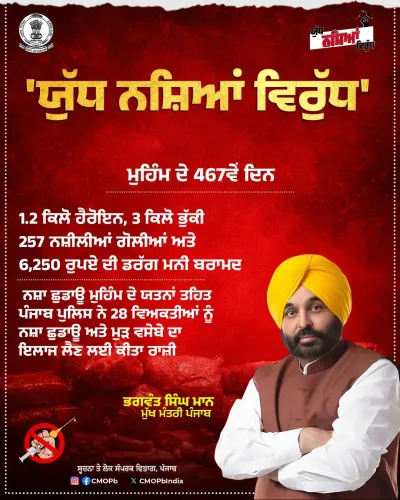
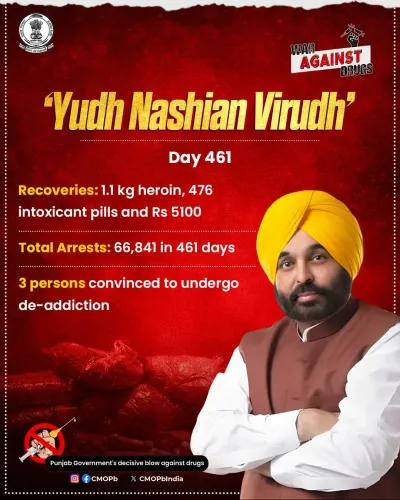
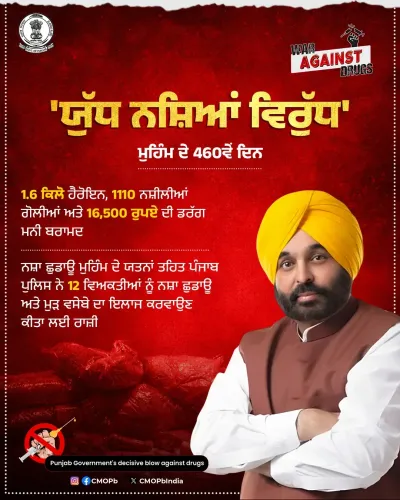
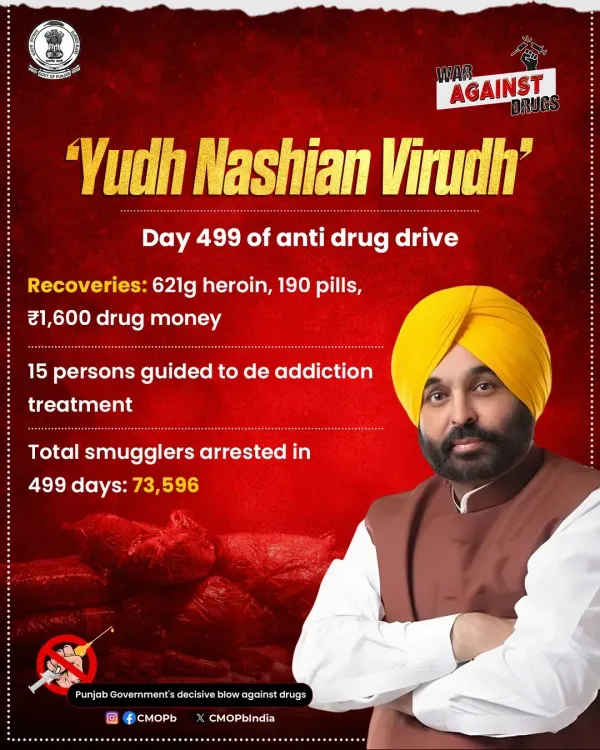
Punjab Police completed 499 days of the 'Yudh Nashian Virudh' anti-drug campaign on 14 July 2026, recovering 621 grams of heroin and arresting more smugglers, taking the campaign total to 73,596 arrests. Fifteen persons were also referred for de-addiction treatment on the day.
Key Takeaways
499 consecutive days of the 'Yudh Nashian Virudh' campaign completed as of 14 July 2026 .
621 grams of heroin and 190 intoxicant pills recovered on day 499, along with ₹1,600 in drug money .
Cumulative drug smuggler arrests since the campaign's launch have reached 73,596 .
15 persons were referred for voluntary de-addiction and rehabilitation treatment on the day.
The campaign was launched in 2022 by the Bhagwant Mann government as a dual enforcement-and-rehabilitation drive.
The 500th day milestone is imminent and expected to prompt a consolidated review of campaign statistics.
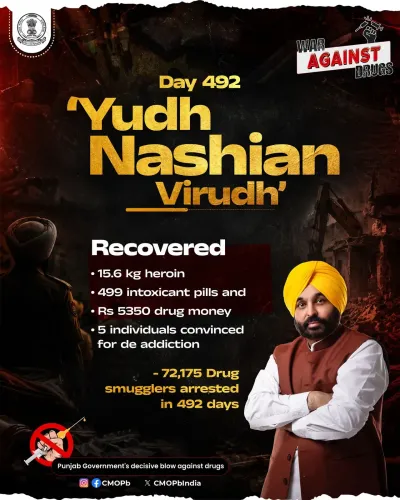
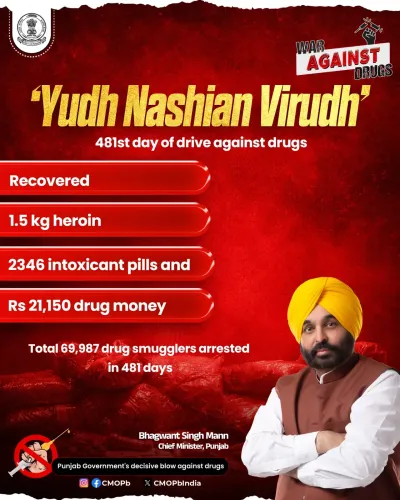
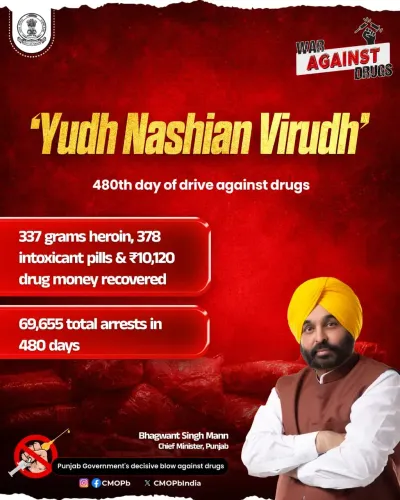
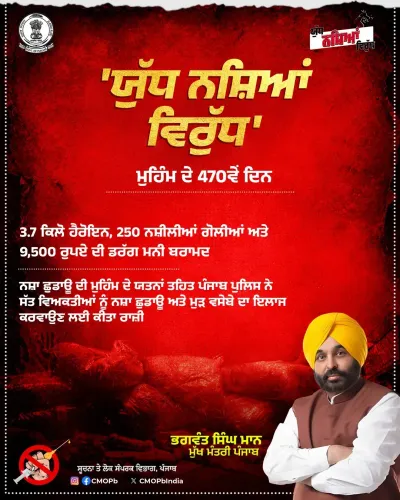
The Chief Minister's Office of Punjab announced on Tuesday, 14 July 2026 that Punjab Police has completed 499 consecutive days of its sustained anti-narcotics campaign 'Yudh Nashian Virudh', with fresh arrests of drug smugglers and recoveries of heroin, intoxicant pills, and drug money reported on the day.
According to the official update, police teams on day 499 recovered 621 grams of heroin, 190 intoxicant pills, and ₹1,600 in drug money from the possession of arrested individuals. The cumulative tally of drug smugglers arrested since the campaign's launch has now reached 73,596. Separately, 15 persons were convinced on the day to voluntarily undergo de-addiction and rehabilitation treatment.
Context
The Yudh Nashian Virudh (meaning 'War Against Drugs') campaign was launched by the Punjab government in 2022 under Chief Minister Bhagwant Mann as a high-visibility, dual-track initiative combining enforcement crackdowns with demand-reduction through rehabilitation referrals. Daily public updates via the CMO's official channels have been a defining feature of the campaign, designed to signal sustained political will rather than episodic action.
Punjab's proximity to the Golden Crescent — the Afghanistan-Pakistan-Iran drug-production corridor — has historically made the state a transit and consumption hotspot for heroin and synthetic narcotics. The current campaign is the most sustained enforcement effort in the state's recent history in terms of unbroken daily operational reporting.
Policy Backdrop
Successive Punjab governments have alternated between large-scale enforcement drives and rehabilitation-focused policies, often criticised for lacking continuity. The Mann administration's approach deliberately fuses both tracks: Punjab Police conducts raids and seizures while simultaneously referring addicts to government-run de-addiction centres, aiming to reduce both supply and demand simultaneously.
The daily public accounting of arrests, seizures, and rehabilitation cases is itself a governance tool — creating a publicly verifiable record that holds enforcement agencies to account and signals to border communities that the campaign is not seasonal. The 499-day milestone places the drive on the cusp of a significant marker, with the 500th day expected to draw particular political and administrative attention.
Stakeholders and Impact
The campaign's primary beneficiaries are Punjab's youth, rural families, and border communities in districts such as Amritsar, Tarn Taran, Gurdaspur, and Ferozepur that have borne the heaviest burden of drug abuse. With over 73,596 smugglers arrested across 499 days, the scale of enforcement is significant, though analysts note that supply-side pressure alone is insufficient without parallel rehabilitation infrastructure.
The de-addiction component — tracking daily referrals of individuals to treatment — reflects an acknowledgement that punitive action must be paired with recovery pathways. The 15 persons referred for rehabilitation on day 499 are part of a larger cumulative outreach figure that the CMO has reported throughout the campaign's duration.
What's Next
With the campaign reaching its 500th day imminently, the Punjab government is expected to release consolidated seizure and rehabilitation statistics marking the milestone. Observers will watch whether the occasion is accompanied by any new legislative or budgetary measures in the Punjab Assembly to strengthen the de-addiction network or enhance inter-state and cross-border enforcement coordination. The consistency of daily reporting will itself be a test of whether the campaign retains momentum beyond symbolic milestones.
Point of View
596 arrests in 499 days is a headline-grabbing cumulative figure, but the more consequential metric is whether de-addiction referrals are translating into sustained recoveries, a number that remains harder to verify publicly. The dual-track model of enforcement plus rehabilitation is textbook demand-supply policy, yet Punjab's history of cyclical drug crises suggests that structural solutions — border management, socioeconomic opportunity, and healthcare capacity — will ultimately determine whether this campaign's gains outlast its political moment. The approaching 500-day mark will be a natural inflection point for the government to make a broader case for the campaign's legacy.
NationPress
14 Jul 2026
Frequently Asked Questions
What is 'Yudh Nashian Virudh' in Punjab?
'Yudh Nashian Virudh' is an ongoing anti-narcotics campaign launched by the Punjab government in 2022, combining daily police enforcement raids against drug smugglers with de-addiction and rehabilitation referrals for addicts.
How many drug smugglers have been arrested in Punjab's anti-drug campaign?
As of day 499 of the campaign on 14 July 2026, a total of 73,596 drug smugglers have been arrested under the 'Yudh Nashian Virudh' drive.
How much heroin was seized by Punjab Police on 14 July 2026?
Punjab Police recovered 621 grams of heroin on the 499th day of the 'Yudh Nashian Virudh' campaign, along with 190 intoxicant pills and ₹1,600 in drug money.
What is Bhagwant Mann doing about drugs in Punjab?
Chief Minister Bhagwant Mann's government launched and has sustained the 'Yudh Nashian Virudh' campaign since 2022, directing Punjab Police to conduct daily enforcement operations while simultaneously running de-addiction outreach to refer individuals to rehabilitation centres.
Why does Punjab have a drug problem?
Punjab's location near the Golden Crescent — the Afghanistan-Pakistan-Iran drug production corridor — has historically made it a transit and consumption hub for heroin and synthetic drugs, a challenge that successive state governments have addressed through varying combinations of enforcement and rehabilitation.