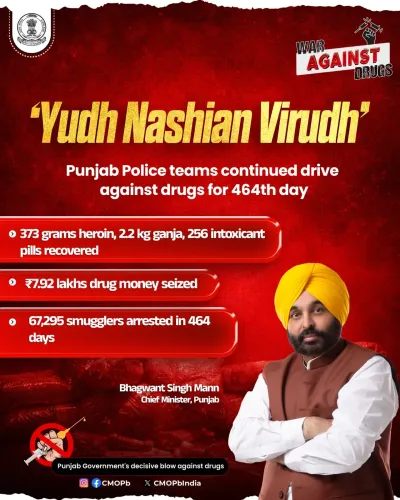
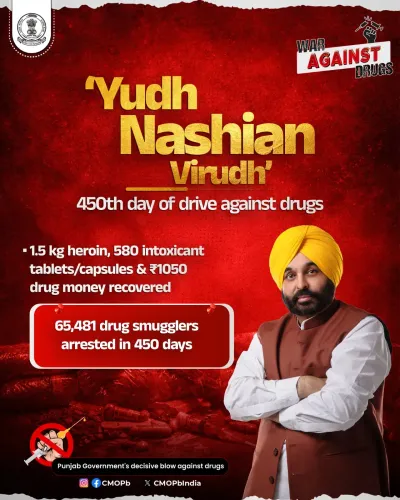
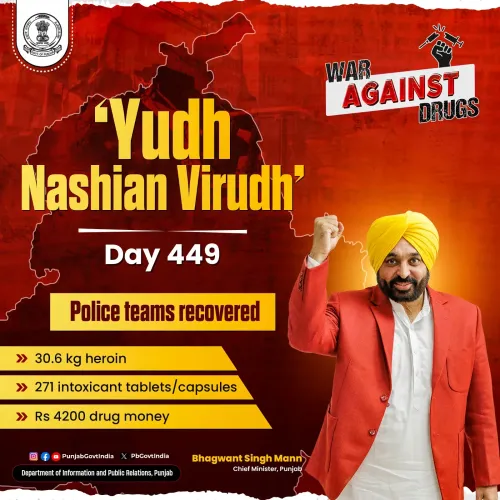
Punjab's 'Yudh Nashian Virudh' hits 16 months: 70,871 arrested
Synopsis
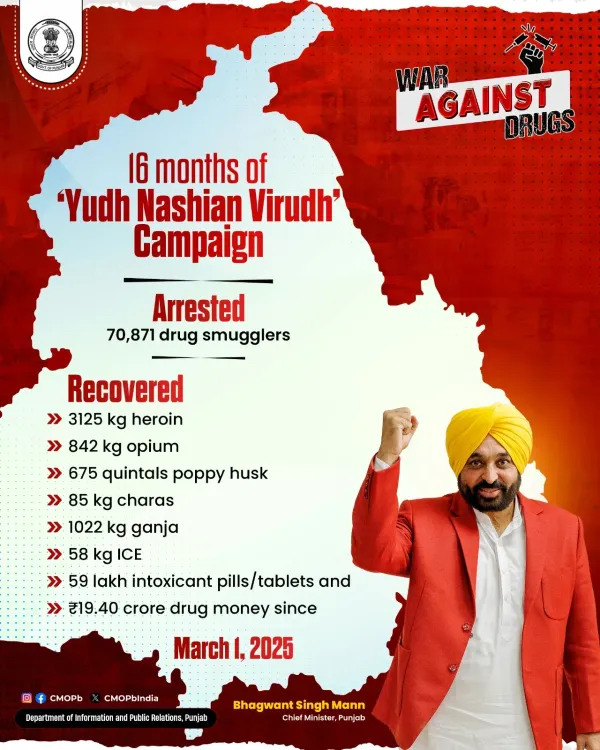
Punjab's 'Yudh Nashian Virudh' anti-drug campaign has completed 16 months with 50,656 FIRs, 70,871 arrests, and seizures including 3,125 kg heroin and ₹19.40 crore drug money, the Chief Minister's Office announced on July 2, 2026.
Key Takeaways
50,656 FIRs registered and 70,871 drug smugglers arrested since the campaign began.
3,125 kg heroin recovered since March 1, 2025 , the single largest category of seizure by weight and value.
Other seizures include 842 kg opium , 675 quintals poppy husk , 1,022 kg ganja , 58 kg ICE , and 59 lakh intoxicant pills/tablets . ₹19.40 crore in drug money seized or recovered during the 16-month campaign.
The campaign, 'Yudh Nashian Virudh' , was launched on the directions of Chief Minister Bhagwant Mann of the Aam Aadmi Party .
Punjab's border with Pakistan makes it a key entry point for narcotics via the Golden Crescent route.
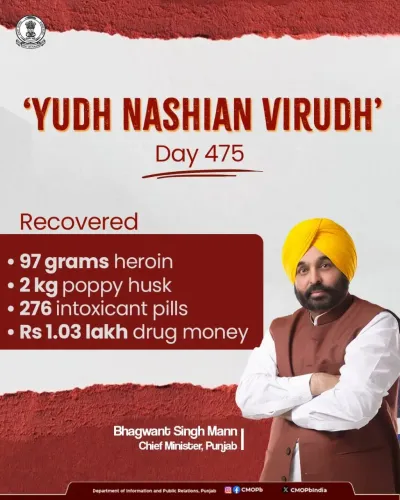
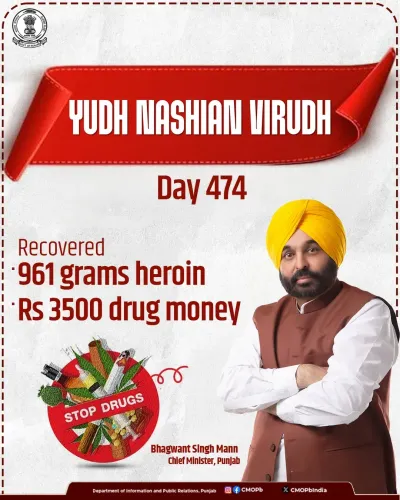
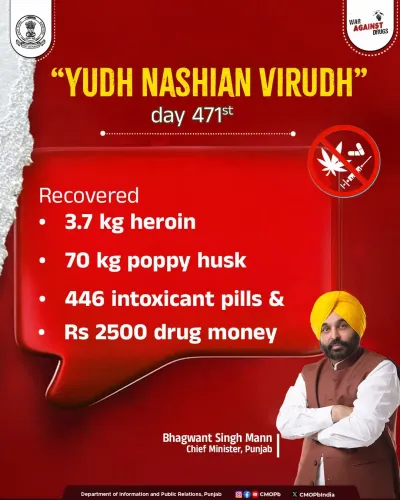
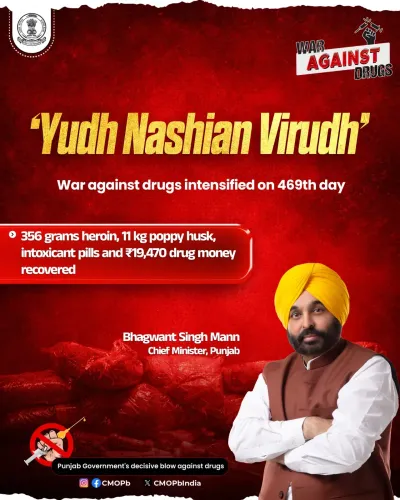
The Chief Minister's Office of Punjab announced on Thursday, July 2, 2026, that the state's ongoing anti-drug campaign 'Yudh Nashian Virudh' — launched on the directions of Chief Minister Bhagwant Mann — has completed 16 months, with Punjab Police registering 50,656 FIRs and arresting 70,871 drug smugglers since the drive's inception.
What the numbers say
The headline seizure figure is 3,125 kg of heroin recovered since March 1, 2025, the date cited by the CMO for measuring the latest phase of the campaign. Alongside heroin, police have seized 842 kg opium, 675 quintals poppy husk, 85 kg charas, 1,022 kg ganja, and 58 kg ICE (crystal methamphetamine). Authorities also confiscated 59 lakh intoxicant pills and tablets and froze or recovered ₹19.40 crore in drug money.
Context
Punjab sits along the India-Pakistan border, making it a primary entry corridor for narcotics flowing in from the Golden Crescent — the opium-producing belt spanning Afghanistan, Iran and Pakistan. Heroin and synthetic drugs have posed a chronic public-health and law-enforcement challenge in the state for over a decade, with addiction prevalence documented in successive government surveys.
'Yudh Nashian Virudh' (meaning 'War Against Drugs') was conceived as a multi-pronged operation targeting smuggling networks, street-level dealers and supply chains simultaneously. The campaign operates through special police units and coordinates with border security agencies to intercept cross-border consignments.
Policy backdrop
Chief Minister Bhagwant Mann, who took office in March 2022 as the Aam Aadmi Party's first Punjab chief minister, declared a statewide crackdown on drug syndicates as a signature governance commitment. Previous administrations — the Shiromani Akali Dal-BJP government (2012–2017) and the Congress government (2017–2022) — had each launched anti-narcotics drives and set up special courts under the Narcotic Drugs and Psychotropic Substances (NDPS) Act, underscoring how drug enforcement has been a persistent political priority across party lines in the state.
The current drive's emphasis on quantitative reporting — FIR counts, arrest tallies, seizure weights, and drug money recovered — continues a well-established pattern of using measurable metrics to signal governance performance on the narcotics front.
Stakeholders and impact
Punjab's youth and border-district villagers are the primary stakeholders in any sustained anti-drug effort, given that addiction rates in these communities have historically been among the highest in the country. For Punjab Police, the scale of arrests and seizures represents significant operational pressure on investigation, prosecution and detention infrastructure. Civil-society groups and de-addiction advocates have consistently called for parallel investment in rehabilitation alongside enforcement.
What's next
Attention will now turn to conviction rates in NDPS cases filed under the campaign, which are widely regarded as a more durable indicator of the drive's long-term deterrent effect than arrest or seizure numbers alone. Any announcements regarding new de-addiction or rehabilitation facilities — potentially tabled in the next Punjab Legislative Assembly session — will be closely watched by health and welfare advocates. The CMO's continued high-frequency public reporting on the campaign suggests it will remain a central plank of the Mann government's political messaging ahead of the next electoral cycle.
Point of View
Which means arrest and seizure tallies, while striking, will face scrutiny against conviction rates and rehabilitation outcomes. The campaign fits a broader pattern of AAP-governed states using high-visibility enforcement drives to distinguish their governance brand from predecessors. The real test will be whether supply-side pressure translates into measurable declines in addiction prevalence, a metric that is slower to move and harder to headline.
NationPress
2 Jul 2026
Frequently Asked Questions
What is 'Yudh Nashian Virudh' in Punjab?
'Yudh Nashian Virudh' means 'War Against Drugs' in Punjabi and is an anti-narcotics campaign launched by the Punjab government under Chief Minister Bhagwant Mann targeting drug smugglers, dealers and supply networks across the state.
How many drug smugglers have been arrested in Punjab's anti-drug drive?
As of July 2, 2026, Punjab Police has arrested 70,871 drug smugglers and registered 50,656 FIRs since the campaign's inception, with the latest phase measured from March 1, 2025.
How much heroin has Punjab Police seized in 2025-2026?
Punjab Police has seized 3,125 kg of heroin since March 1, 2025, as part of the ongoing 'Yudh Nashian Virudh' campaign, along with large quantities of opium, poppy husk, ganja, ICE and intoxicant pills.
Why is Punjab particularly affected by drug trafficking?
Punjab shares a border with Pakistan and lies along the 'Golden Crescent' narcotics corridor — spanning Afghanistan, Iran and Pakistan — making it a primary entry point for heroin and synthetic drugs into India.
What is Bhagwant Mann's role in Punjab's anti-drug campaign?
Chief Minister Bhagwant Mann of the Aam Aadmi Party, in office since March 2022, personally directed the 'Yudh Nashian Virudh' campaign and has made anti-narcotics enforcement a central plank of his government's governance agenda.