Puri Announces Two Elevated Corridors for Varanasi
Synopsis
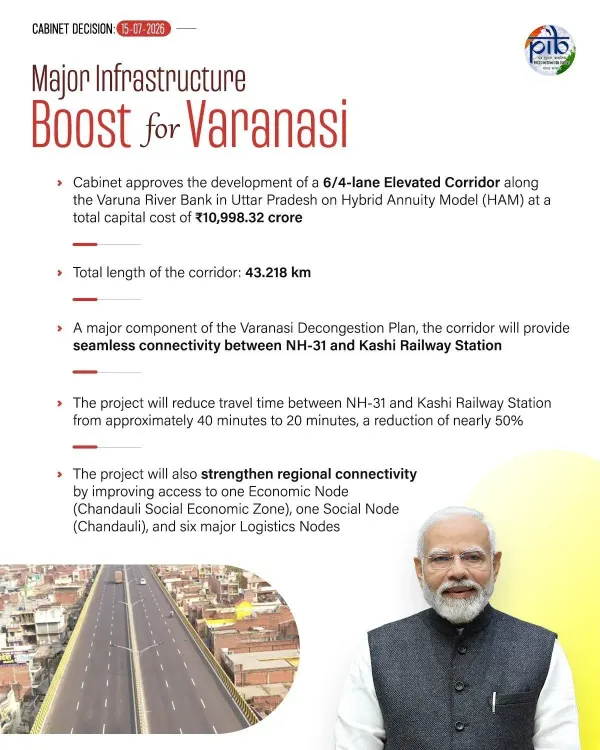
The Union Cabinet has approved two elevated road corridors in Varanasi — a 43.218-km link from NH-31 to Kashi Railway Station and a 46.039-km greenfield corridor from NH-19 to the Ring Road under HAM — aimed at easing urban congestion and boosting Purvanchal's economic connectivity.
Key Takeaways
The Union Cabinet approved two elevated road corridors in Varanasi on 15 July 2026 .
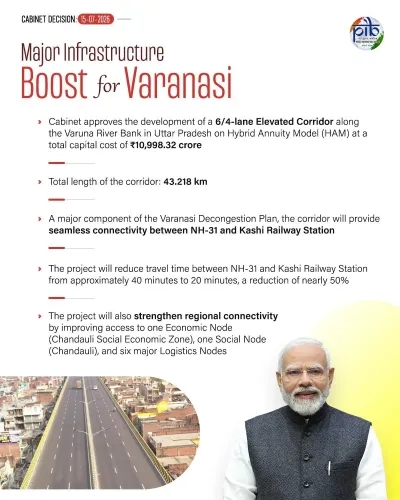
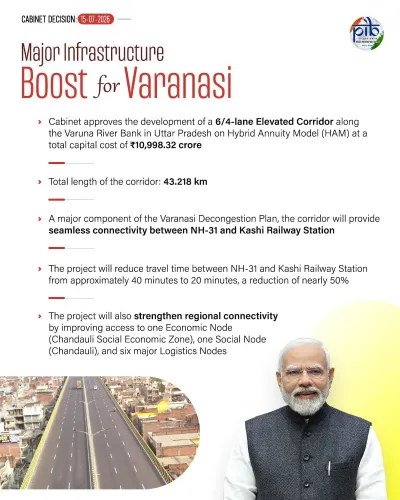
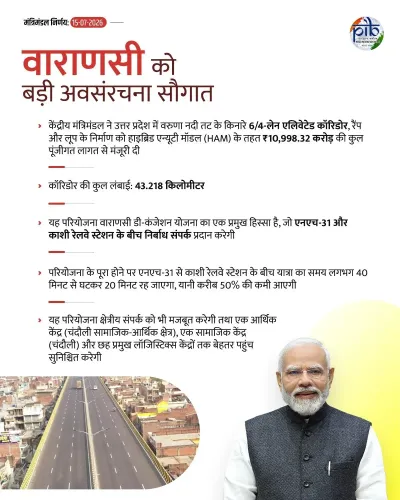
A 43.218-km six/four-lane elevated corridor will connect NH-31 to Kashi Railway Station .
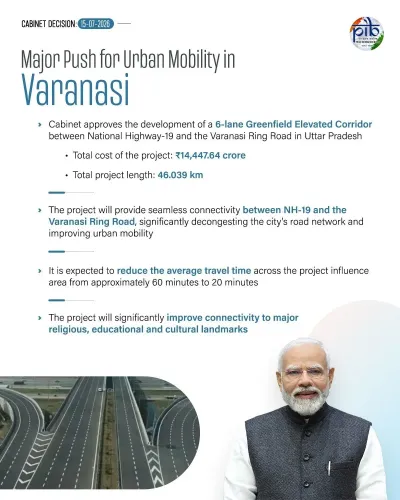
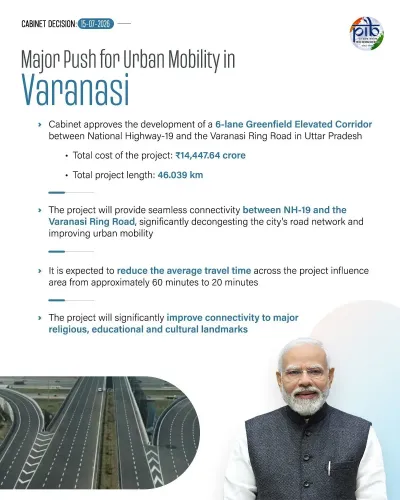
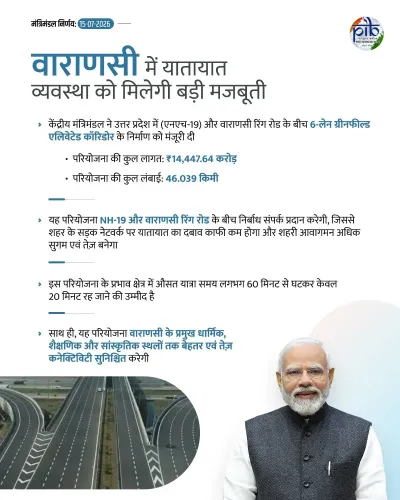
A 46.039-km six-lane greenfield elevated corridor will link NH-19 to the Varanasi Ring Road .
The greenfield corridor will be developed under the Hybrid Annuity Model (HAM) , with the government funding up to 40 per cent of costs during construction.
The projects are intended to ease urban congestion in Varanasi and accelerate economic development across the Purvanchal region.
Implementation will be overseen by the Ministry of Road Transport and Highways and NHAI , pending tendering and land acquisition.
Union Petroleum Minister Hardeep Singh Puri on Wednesday, 15 July 2026 announced that the Union Cabinet had approved two major elevated road corridors for Varanasi, promising to accelerate urban mobility and economic development across the Purvanchal region of eastern Uttar Pradesh.
Posting in Hindi on X, Puri stated that the cabinet had given its nod to a 43.218-km six/four-lane elevated corridor connecting NH-31 to Kashi Railway Station in Varanasi, alongside a 46.039-km six-lane greenfield elevated corridor linking NH-19 with the Varanasi Ring Road. The second project will be developed under the Hybrid Annuity Model (HAM), a public-private partnership framework under which the government typically funds up to 40 per cent of project costs during the construction phase.
Context
Puri described the decisions as giving 'new momentum' (nayi gati) to Kashi's development journey. The twin approvals were announced under the hashtag #CabinetDecisions, signalling they form part of a broader package of decisions cleared by the cabinet. Varanasi, one of India's oldest cities, has been a sustained focus of central government infrastructure investment over the past decade.
The city holds special political significance as the parliamentary constituency of Prime Minister Narendra Modi. The Kashi Vishwanath Dham corridor, inaugurated in 2018, was among the earlier landmark redevelopment projects in the city, modernising temple precincts and pilgrim facilities. These two new road corridors represent the next layer of large-scale urban infrastructure being added to that foundation.
Policy Backdrop
The Varanasi Ring Road concept received in-principle approval around 2017 as part of efforts to decongest the historic city core, and the new greenfield corridor linking NH-19 to that ring road deepens that original vision. The National Infrastructure Pipeline, launched in 2019, had earmarked multiple elevated road and highway projects for eastern Uttar Pradesh, and today's cabinet approvals reflect continued execution of that pipeline.
The Ministry of Road Transport and Highways oversees such national highway projects, with implementation typically handled by the National Highways Authority of India (NHAI). The choice of HAM for the greenfield corridor is consistent with the government's broader strategy of leveraging private capital for highway construction while retaining public ownership of the asset.
Stakeholders and Impact
Varanasi commuters stand to benefit most immediately: the elevated alignment of both corridors is designed to ease chronic surface-level congestion in a city whose dense medieval street network was not built for modern traffic volumes. The direct connection between NH-31 and Kashi Railway Station is expected to improve last-mile connectivity for the millions of pilgrims and tourists who arrive by rail each year.
For Purvanchal — the broader eastern Uttar Pradesh belt that includes districts such as Azamgarh, Ghazipur, and Jaunpur — improved road access to Varanasi's rail and highway nodes could meaningfully reduce logistics costs and open new market linkages for agricultural and small-scale industrial producers in the region. Puri noted that the projects would give 'new momentum to the economic and infrastructure development of Purvanchal.'
What's Next
Cabinet approval marks the start of a multi-stage process. NHAI will need to issue tenders, complete detailed project reports, and advance land acquisition before construction can begin. The HAM project for the NH-19 to Ring Road corridor will additionally require selection of a private concessionaire through a competitive bidding process.
Progress on both corridors will be closely watched in upcoming budget sessions and NHAI project-award data. If executed on schedule, the two elevated corridors could substantially reshape how goods and people move through one of India's most historically significant — and most congested — cities.
Point of View
Now extending from the Kashi Vishwanath Dham redevelopment to large-scale highway engineering. The use of HAM for the greenfield corridor signals continued confidence in the public-private partnership model for capital-intensive road projects, even as land acquisition timelines remain the perennial risk factor. Politically, the announcement allows the BJP to demonstrate tangible infrastructure delivery in eastern Uttar Pradesh ahead of future electoral cycles in a state that carries enormous parliamentary weight. Whether the projects translate into on-ground progress will depend on NHAI's execution pace and the state government's ability to clear land quickly.
NationPress
15 Jul 2026
Frequently Asked Questions
What are the two elevated corridors approved for Varanasi?
The Union Cabinet approved a 43.218-km six/four-lane elevated corridor connecting NH-31 to Kashi Railway Station , and a 46.039-km six-lane greenfield elevated corridor linking NH-19 to the Varanasi Ring Road .
What is the Hybrid Annuity Model used for the Varanasi corridor?
The Hybrid Annuity Model (HAM) is a public-private partnership framework for highway projects under which the government funds up to 40 per cent of the project cost during the construction phase, with a private concessionaire building and maintaining the road.
Why does Varanasi receive so much central infrastructure funding?
Varanasi is the parliamentary constituency of Prime Minister Narendra Modi and has been a sustained focus of central government investment, beginning with projects like the Kashi Vishwanath Dham corridor and continuing through the National Infrastructure Pipeline .
How will the new corridors benefit Purvanchal?
Improved road links connecting Varanasi's rail and national highway nodes are expected to reduce logistics costs and open new market access for businesses and agricultural producers across eastern Uttar Pradesh districts such as Azamgarh , Ghazipur , and Jaunpur .
When will construction on the Varanasi elevated corridors begin?
Cabinet approval is the first step; NHAI must still issue tenders, complete detailed project reports, and advance land acquisition before construction can start. The HAM corridor additionally requires selection of a private concessionaire through competitive bidding.