Rahul Gandhi Warns Officials on Student Protest Crackdowns
Synopsis
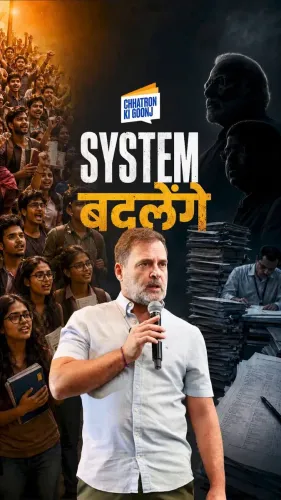
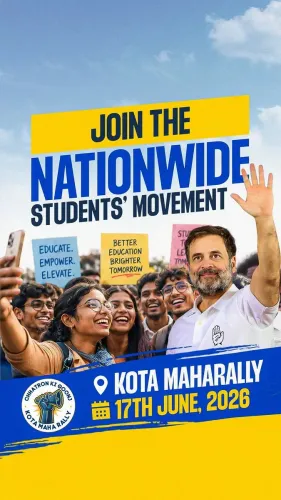
Congress leader Rahul Gandhi on 20 July 2026 warned police officers and government officials against blindly following orders to attack student protesters, invoking Article 19 and declaring the Constitution their true master. He said power is not permanent and accountability will follow.
Key Takeaways
Congress leader Rahul Gandhi posted a bilingual Hindi-English warning on 20 July 2026 directed at police and government officials.
Gandhi invoked Article 19 of the Constitution of India , which guarantees the right to peaceful assembly, calling peaceful protest a 'sacred and fundamental right.' He stated that officials 'blindly following orders to attack India's innocent students' should remember: 'The Constitution is your master.' The post carried an explicit accountability warning: 'Power is not permanent.
Accountability will follow.' The statement echoes the political and legal debates triggered by the 2019 police action at Jamia Millia Islamia during Citizenship Amendment Act protests.
Parliamentary motions and court petitions on campus policing norms are expected to follow if the underlying protests continue.
Congress leader and Leader of the Opposition Rahul Gandhi on Monday, 20 July 2026, issued a sharp warning to police officers and government officials, invoking constitutional supremacy after reported attacks on student protesters across India. Gandhi posted in both Hindi and English, declaring that peaceful protest is a fundamental right and that accountability will follow those who blindly follow orders to use force against students.
Context
Gandhi's post, addressed directly to law enforcement and government employees, stated in Hindi: 'संविधान ही आपका मालिक है' ('The Constitution is your master') and warned that 'power is not permanent' and 'accountability will follow.' The bilingual message was a deliberate signal to a wide audience, combining the formal register of a constitutional argument with the urgency of a political warning.
The post did not name a specific campus, city, or incident, but the language — 'innocent students,' 'blindly following orders,' 'attack' — strongly implies an active or recent episode of police action against student demonstrators somewhere in India.
Policy Backdrop
Article 19 of the Constitution of India, adopted in 1950, guarantees every citizen the right to assemble peaceably and without arms. This provision has been the cornerstone of legal challenges against police action on campuses for decades. Courts have repeatedly held that the state must demonstrate proportionality when dispersing assemblies.
The most prominent recent precedent in public memory is the 2019 police action at Jamia Millia Islamia and other universities during protests against the Citizenship Amendment Act, which drew widespread condemnation from civil society, bar associations, and opposition parties. Those events set off years of litigation and parliamentary debate over campus policing norms. Gandhi's current language echoes the framing opposition leaders used during that period.
Opposition statements on student protests have become a recurring feature of Indian political discourse, particularly when education policy, citizenship law, or social-justice issues animate campus movements. The invocation of constitutional supremacy over administrative orders is a well-established rhetorical and legal strategy by civil-liberties advocates.
Stakeholders and Impact
University students and their unions are the immediate constituency Gandhi is speaking to, signalling Congress's solidarity and implicitly promising future legislative or judicial action. Police officers and government officials are the direct addressees of the warning, which carries an implicit threat of post-power accountability — a reference to the possibility that a future government could investigate orders given today.
The post also speaks to a broader audience of civil-liberties organisations, lawyers, and constitutional scholars who monitor the state's use of force during demonstrations. By framing the Constitution as the 'master' of every official, Gandhi is also positioning the Congress party as the custodian of foundational rights ahead of any electoral contest.
What's Next
Parliamentary observers will watch for privilege motions or adjournment notices in Lok Sabha when it next sits, seeking a statement from the government on the incidents Gandhi appears to be referencing. Petitions before the Supreme Court or relevant High Courts seeking guidelines on campus policing — a trend that accelerated after 2019 — are also likely if the underlying protests continue or escalate.
Gandhi's explicit promise that 'accountability will follow' suggests Congress intends to keep this issue alive in the public domain, potentially building a legislative record that could be used in future proceedings or election campaigns. The degree to which the ruling dispensation responds — or declines to respond — will shape the next phase of this political exchange.
Point of View
But its directness here — naming officials rather than governments — marks an escalation in tone. By framing the Constitution as the ultimate employer of every state functionary, Gandhi is also staking out the legal high ground ahead of any judicial proceedings that may arise from the incidents in question. The bilingual format ensures the message reaches both English-speaking urban audiences and Hindi-belt constituencies simultaneously, maximising political reach.
NationPress
21 Jul 2026
Frequently Asked Questions
What did Rahul Gandhi say about student protests on 20 July 2026?
Rahul Gandhi warned police officers and government officials that peaceful protest is a fundamental right and that those blindly following orders to attack innocent students must remember the Constitution is their master and accountability will follow.
Which constitutional article protects peaceful protest in India?
Article 19 of the Constitution of India, adopted in 1950, protects the right to assemble peaceably and without arms. Gandhi's statement directly invoked this provision.
Has Rahul Gandhi spoken about student protests and police action before?
Yes. Gandhi and the Congress party have consistently spoken out against police action on campuses, most prominently during the 2019 protests at Jamia Millia Islamia against the Citizenship Amendment Act.
What does 'accountability will follow' mean in Rahul Gandhi's post?
The phrase implies that officials who use force against students under current government orders could face investigations or legal consequences if a different administration comes to power, and potentially through court proceedings even sooner.
What is Rahul Gandhi's current political position?
Rahul Gandhi is the Leader of the Opposition in the Lok Sabha and a Member of Parliament from Rae Bareli, representing the Indian National Congress.