Indian Railways Invests Rs 648 Crore in Gujarat and Bihar Projects

Synopsis
Indian Railways is taking significant steps to enhance connectivity and operational efficiency with a total investment of Rs 647.58 crore in two major projects in Gujarat and Bihar. These developments are set to alleviate congestion and improve seamless train operations.
Key Takeaways
Indian Railways invests Rs 647.58 crore in infrastructure.
Key projects include a Rail Over Rail flyover in Gujarat.
A new rail bypass at Bhagalpur in Bihar.
Projects aimed at enhancing connectivity and efficiency.
Focus on decongesting rail network to meet rising demand.
New Delhi, March 24 (NationPress) On Tuesday, Indian Railways approved two significant infrastructure initiatives in Gujarat and Bihar, with a combined investment of Rs 647.58 crore. These projects aim to bolster connectivity, alleviate congestion, and enhance operational efficiency along key routes.
As per the Railway Ministry, the initiatives encompass the construction of a Rail Over Rail (RoR) flyover at Kosamba, Gujarat, and a new rail bypass at Bhagalpur, Bihar.
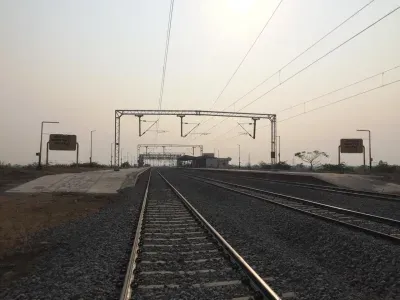
In Gujarat, a project worth Rs 344.38 crore has been authorized to create a Rail Over Rail flyover that will ensure seamless connectivity for the Kosamba-Umrapada gauge conversion segment, covering 9.20 km under the Western Railway. This section is part of the Mumbai-Vadodara main line, which is presently undergoing gauge conversion.
The ministry highlighted that due to the alignment of the Dedicated Freight Corridor, direct connection of the gauge-converted line with the main line cannot be established via a surface crossing.
Upon completion, the RoR structure will remove surface crossings, facilitating smooth integration with the main line and guaranteeing safer and uninterrupted train operations.
In parallel, Bihar has been allocated Rs 303.20 crore for constructing a 13.38 km bypass at Bhagalpur under the Eastern Railway. This bypass will link Gonudham Halt on the Barahat–Bhagalpur route with Sabour on the Bhagalpur-Sahibganj stretch.
The ministry anticipates that this project will significantly reduce congestion at Bhagalpur junction, which is currently operating at over 125% capacity on the Barahat–Bhagalpur section.
Currently, trains are required to reverse their engines at Bhagalpur, leading to delays and inefficiencies. The new bypass is expected to enhance operational fluidity and improve the punctuality of train services, according to the government.
Furthermore, the ministry emphasized that these projects are integral to its larger strategy aimed at expanding capacity and decongesting the rail network to accommodate the rising demands of passengers and freight, while also enhancing safety and efficiency.
Point of View
The approval of these significant infrastructure projects by Indian Railways is a strategic move to address the growing demands for improved connectivity and efficiency within the rail network, reflecting a commitment to enhancing public transport infrastructure.
NationPress
22 Sept 2026
Frequently Asked Questions
What is the total investment for the projects?
The total investment for the projects in Gujarat and Bihar is Rs 647.58 crore.
What is the purpose of the Rail Over Rail flyover?
The Rail Over Rail flyover aims to provide seamless connectivity and eliminate surface crossings, ensuring safer train operations.
How will the Bhagalpur bypass affect train operations?
The Bhagalpur bypass will reduce congestion and improve the punctuality of train services by eliminating the need for engine reversal.
Why is the bypass at Bhagalpur necessary?
The bypass at Bhagalpur is essential to ease congestion caused by the junction operating at over 125% capacity.
When will the projects be completed?
The specific completion dates for the projects have not been disclosed yet.