Rajasthan CM Bhajanlal pushes grid upgrades and battery storage
Synopsis
The Chief Minister's Office of Rajasthan announced on 19 August 2026 that CM Bhajanlal Sharma's government is pursuing parallel upgrades to the state's power transmission network and battery energy storage capacity, aiming to resolve longstanding grid constraints that limit the state's renewable energy potential.
Key Takeaways
The Chief Minister's Office of Rajasthan announced on 19 August 2026 that the state is working to strengthen its power transmission infrastructure.
Battery energy storage capacity development is being pursued simultaneously, addressing the intermittency challenge of solar and wind generation.
The announcement is linked to CM Bhajanlal Sharma under the campaign hashtag #आपणो_अग्रणी_राजस्थान ('Our Leading Rajasthan').
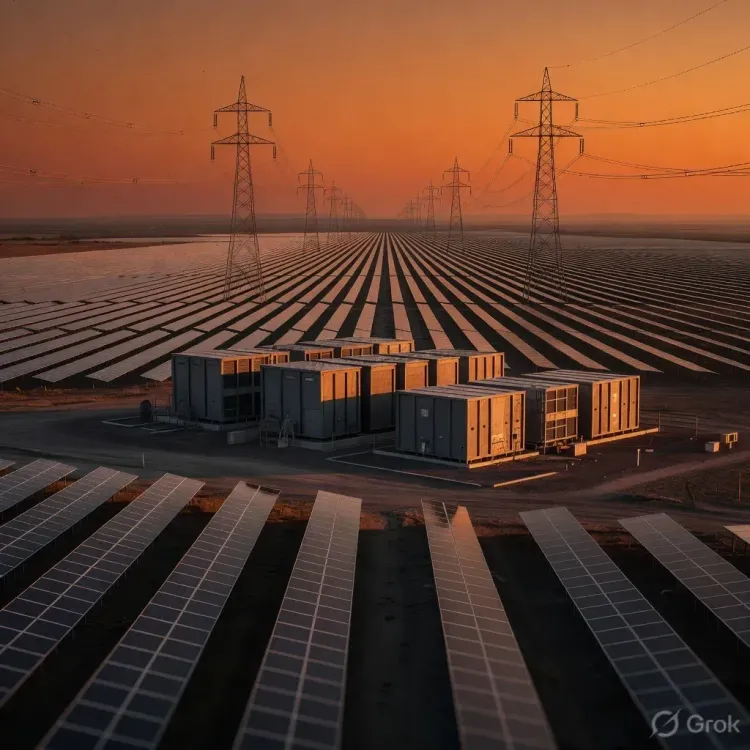
Rajasthan hosts the Bhadla Solar Park , one of the world's largest solar installations, whose output has historically been constrained by transmission limits.
State discoms and private renewable developers are the primary stakeholders awaiting tender and funding details.
The twin investment aligns with India's national target of 50 percent non-fossil installed capacity , which depends significantly on Rajasthan's contribution.
Rajasthan is building not just for the sun it already harvests — but for the moment the sun goes down. The Chief Minister's Office of Rajasthan announced on Wednesday, 19 August 2026 that the state government is simultaneously strengthening its power transmission network and developing battery energy storage capacity, signalling a two-track push to make the state's electricity grid future-ready.
The post, attributed to Chief Minister Bhajanlal Sharma under the hashtag #आपणो_अग्रणी_राजस्थान ('Our Leading Rajasthan'), framed the twin effort as part of the government's broader infrastructure agenda: 'The state government is working on strengthening the broadcast [transmission] network as well as developing battery energy storage capacity.'
Why transmission and storage go hand in hand in Rajasthan
Rajasthan is not starting from scratch. The state's desert belt — anchored by the Bhadla Solar Park, one of the world's largest — has spent the better part of a decade generating more renewable power than its ageing grid could reliably carry out. Transmission bottlenecks have long been the quiet saboteur of the state's clean-energy ambitions. Fixing the wires is the obvious first step.
But transmission alone does not solve intermittency. Solar peaks at noon; demand peaks at night. That gap is precisely where battery energy storage systems (BESS) become indispensable — storing surplus daytime generation and releasing it when the grid needs it most. The government's decision to pursue both upgrades in parallel reflects a more sophisticated understanding of grid management than earlier rounds of renewable expansion.
Rajasthan's role in India's non-fossil fuel push
India has committed to sourcing 50 percent of its installed electricity capacity from non-fossil sources — a target that leans heavily on states like Rajasthan with abundant solar and wind resources. The state's power distribution companies (discoms) and private renewable energy developers are the key stakeholders watching how quickly these infrastructure investments translate into actual tenders and viability-gap funding announcements.
Without robust storage and transmission, even the greenest generation assets sit stranded. With them, Rajasthan can export clean power reliably to the national grid — and make a credible claim to the 'leading state' identity the hashtag asserts.
The next test is specifics: project names, capacities, timelines, and financing structures. When those details land, the ambition becomes a blueprint.
Point of View
Worry about evacuation later' approach that plagued the Bhadla-era expansions. By coupling transmission upgrades with battery storage in a single policy statement, the Bhajanlal government is signalling awareness that storage is now as critical as generation to India's clean-energy credibility. The political calculus is also clear: 'Leading Rajasthan' branding requires visible infrastructure wins, and energy self-sufficiency is one of the few development metrics that resonates across urban and rural voter blocs equally. The real test will be whether this translates into awarded contracts before the next election cycle.
NationPress
5 Oct 2026
Frequently Asked Questions
What did the Rajasthan government announce about battery energy storage?
The Chief Minister's Office of Rajasthan stated on 19 August 2026 that the state government is working to develop battery energy storage capacity alongside upgrades to its power transmission network, as part of a broader infrastructure push under CM Bhajanlal Sharma.
Why does Rajasthan need battery energy storage?
Rajasthan generates large amounts of solar and wind power, but these sources are intermittent — output peaks during the day while demand peaks at night. Battery storage systems bridge this gap by storing surplus power and releasing it when the grid needs it.
What is the Bhadla Solar Park and why does it matter here?
The Bhadla Solar Park in Rajasthan is one of the world's largest solar installations. Transmission bottlenecks have historically limited how much of its power can be evacuated to the grid, making transmission upgrades a longstanding priority for the state.
Who is Bhajanlal Sharma and what is his role in Rajasthan's energy plans?
Bhajanlal Sharma has been the Chief Minister of Rajasthan since December 2023, leading the BJP government. The CMO's post on 19 August 2026 was attributed to him, indicating the grid and storage push is a priority under his administration.
How does Rajasthan's grid upgrade connect to India's national renewable energy targets?
India aims to source 50 percent of its installed electricity capacity from non-fossil sources. Rajasthan, with its vast solar and wind resources, is a key contributor to this target — but only if its transmission and storage infrastructure can reliably deliver that power to the national grid.