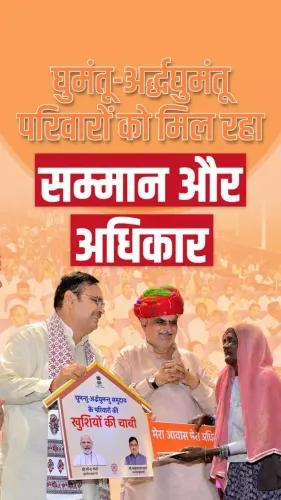
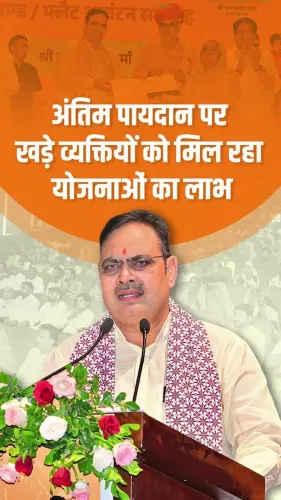
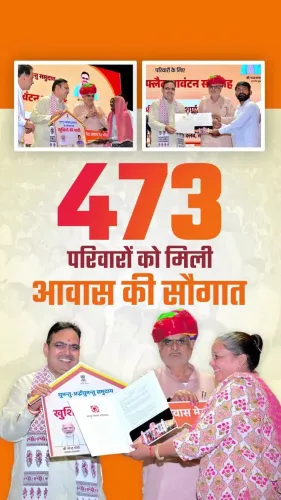
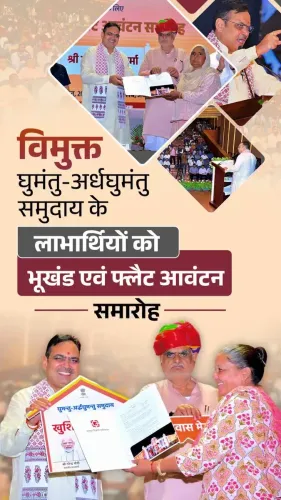
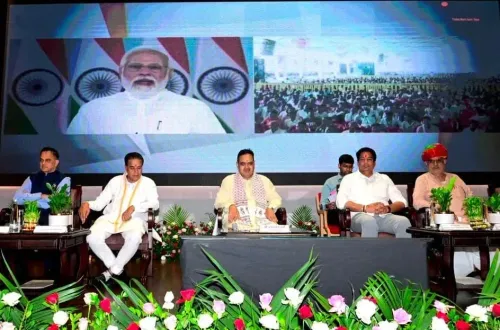
Rajasthan CM Bhajanlal Settles Nomadic Families With Land Pattas

Synopsis
The Rajasthan CMO says CM Bhajanlal Sharma's government is granting permanent land pattas to denotified, nomadic and semi-nomadic families under the Seva Sankalp Abhiyan, addressing a decades-old colonial-era marginalisation rooted in the former Criminal Tribes Act framework.
Key Takeaways
The Chief Minister's Office of Rajasthan announced on 25 September 2026 that permanent land pattas are being issued to denotified, nomadic and semi-nomadic families.
CM Bhajanlal Sharma is directly tagged, anchoring state-level accountability for the settlement drive.
The initiative operates under the Seva Sankalp Abhiyan and Seva Yatra campaign framework.
A patta unlocks access to housing schemes, ration cards, bank accounts and school enrolments for families that previously lacked official addresses.
The National Commission for Denotified, Nomadic and Semi-Nomadic Tribes (2006–2008) had first recommended land rights and rehabilitation as urgent national priorities.
Specific patta distribution numbers and a district-wise rollout timeline have not yet been disclosed.
For generations, India's denotified, nomadic, and semi-nomadic communities have lived without an address to call their own — a legacy of colonial-era stigma that stripped them of land and identity. Now, the Chief Minister's Office of Rajasthan says the state government, under Chief Minister Bhajanlal Sharma, is actively settling these families by issuing permanent land pattas under the ongoing Seva Sankalp Abhiyan and Seva Yatra campaign.
The CMO posted on Friday, 25 September 2026, stating — 'Vimukt, ghumantu tatha ardh ghumantu parivaron ko patte dekar, unko sthayi roop se basane ka kaam kiya ja raha hai' — 'Work is being done to permanently settle denotified, nomadic and semi-nomadic families by granting them land pattas.' The post tags CM Bhajanlal Sharma directly, anchoring accountability at the top of the state administration.
Who These Families Are — and Why a Patta Changes Everything
Denotified tribes are communities that were branded as 'born criminals' under the British-era Criminal Tribes Act, a framework that was repealed after Independence but whose social and administrative aftershocks persisted for decades. Nomadic and semi-nomadic groups — cattle herders, artisans, performers — have historically lacked fixed addresses, making them invisible to land records, welfare rosters, and electoral rolls.
A land patta is not just a piece of paper. It is the legal keystone that unlocks housing schemes, ration cards, bank accounts, and school enrolments. Without it, entire families fall through every government net, however wide that net is cast.
A National Recommendation Finally Finding State Action
The National Commission for Denotified, Nomadic and Semi-Nomadic Tribes first flagged land rights and rehabilitation as urgent priorities in its 2006–2008 report. Indian state governments have periodically launched settlement drives in response, but implementation has been uneven across the country. Rajasthan, which has one of the largest concentrations of such communities in the country, has periodically run patta-issuance campaigns tied to broader welfare pushes.
The current drive is framed within the Seva Sankalp Abhiyan — a state-wide outreach initiative — signalling that the government is packaging land settlement as part of a larger, visible welfare effort rather than a quiet administrative exercise.
What to Watch as the Campaign Rolls Forward
The post does not specify how many families have received pattas so far, nor does it detail a district-wise rollout timeline. Those numbers will matter enormously — the difference between a symbolic gesture and a structural intervention is measured in actual deeds distributed and homes built. Progress reports on patta distribution volumes, and whether follow-up housing or livelihood support is linked to each grant, will be the real test of the campaign's reach.
For now, the state has drawn a clear line: permanent settlement of India's most historically marginalised communities is a named government priority — and CM Bhajanlal Sharma's name is on the post.
Point of View
Projecting visible welfare delivery ahead of any future electoral calculus. Addressing denotified and nomadic communities directly aligns with BJP's broader push to consolidate support among historically overlooked OBC and tribal sub-groups. However, the absence of disclosed numbers is a known gap in such drives: past state campaigns have often announced targets without transparently reporting outcomes. The real measure of this initiative will be auditable patta counts and whether downstream entitlements — housing, credit, education — actually follow the land grant.
NationPress
25 Sept 2026
Frequently Asked Questions
What is a land patta and why does it matter for nomadic families in Rajasthan?
A land patta is an official land-ownership or allotment document issued by the state government. For nomadic and denotified families who have historically lacked fixed addresses, receiving a patta legally establishes their residence, enabling them to access housing schemes, ration cards, bank accounts, and government welfare programmes they were previously excluded from.
Which communities are covered under Rajasthan's settlement drive?
The drive covers three categories: denotified tribes (communities stigmatised under the British-era Criminal Tribes Act), nomadic tribes (groups with no fixed settlement), and semi-nomadic tribes (groups that move seasonally). Together these communities represent some of India's most historically marginalised populations.
What is the Seva Sankalp Abhiyan in Rajasthan?
The Seva Sankalp Abhiyan is a state-wide welfare outreach campaign run by the Rajasthan government under Chief Minister Bhajanlal Sharma. The land patta settlement drive for nomadic communities is one of the activities being carried out under this campaign, though specific scope and timelines have not been officially disclosed.
What national policy backs land rights for denotified tribes in India?
The National Commission for Denotified, Nomadic and Semi-Nomadic Tribes, which submitted its report between 2006 and 2008, recommended land rights and rehabilitation measures for these communities at the national level. State governments, including Rajasthan, have periodically implemented settlement drives in response to those recommendations.
How many families have received pattas under this Rajasthan campaign?
Specific figures on the number of families that have received pattas under the current Seva Sankalp Abhiyan drive have not been officially disclosed. Progress reports and distribution numbers are expected to be key indicators of the campaign's actual impact.