Rajasthan CM flags MGNREGA fraud: fake cards, inflated rolls
Synopsis
The Chief Minister's Office of Rajasthan on 3 July 2026 publicly identified fake job cards, bogus beneficiaries, inflated muster rolls and wage theft as persistent MGNREGA frauds enabled by weak verification, signalling a push for stronger oversight under CM Bhajanlal Sharma.
Key Takeaways
The Chief Minister's Office of Rajasthan on 3 July 2026 publicly identified structural fraud in MGNREGA implementation in the state.
Specific malpractices cited include fake and duplicate job cards , bogus beneficiaries , inflated or fabricated muster rolls , and partial or non-payment of wages .
The statement tags CM Bhajanlal Sharma directly, framing the anti-fraud drive as a personal governance priority.
MGNREGA , enacted in 2005 , guarantees up to 100 days of wage employment to rural households and is the world's largest rural employment programme.
Central government reforms since 2014 — including Aadhaar seeding and DBT — have sought to curb such leakages nationally, but irregularities persist across states.
The post is part of the state government's #आपणो_अग्रणी_राजस्थान campaign, signalling a broader governance-reform narrative.
The Chief Minister's Office of Rajasthan on Friday, 3 July 2026, flagged systemic irregularities in the implementation of MGNREGA across the state, highlighting the absence of robust verification mechanisms as the root cause of fraud affecting rural wage workers.
Context
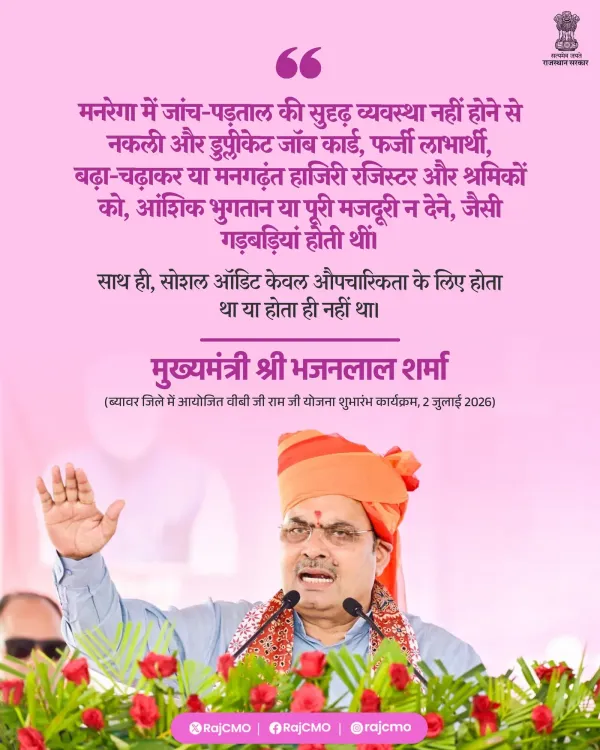
The post, attributed to the office of Chief Minister Bhajanlal Sharma, states that weak oversight in MGNREGA has enabled a range of malpractices: 'नकली और डुप्लीकेट जॉब कार्ड, फर्जी लाभार्थी, बढ़ा-चढ़ाकर या मनगढ़ंत हाजिरी रजिस्टर और श्रमिकों को आंशिक भुगतान या पूरी मजदूरी न देने जैसी गड़बड़ियां' — that is, fake and duplicate job cards, bogus beneficiaries, inflated or fabricated muster rolls, and partial or non-payment of wages to workers. The statement is tagged under the hashtag #आपणो_अग्रणी_राजस्थान ('Our Leading Rajasthan'), the state government's governance campaign.
Policy Backdrop
The Mahatma Gandhi National Rural Employment Guarantee Act (MGNREGA), enacted by Parliament in 2005, guarantees up to 100 days of wage employment annually to rural households, making it the world's largest rural employment programme. The central government mandated Aadhaar seeding and Direct Benefit Transfer (DBT) for MGNREGA wages from 2014 onwards to plug financial leakages. Social audits and geo-tagging of works were further strengthened through Ministry of Rural Development guidelines issued in 2017-18.
Despite these reforms, irregularities such as duplicate job cards and fabricated muster rolls have been documented across multiple states through Comptroller and Auditor General (CAG) audits and social audit reports over the past decade. Rajasthan has historically featured in such audit findings, making the current government's emphasis on tighter checks a continuation of a nationwide push for transparency.
Stakeholders and Impact
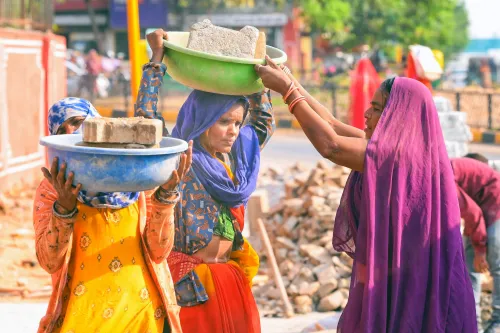
The primary victims of MGNREGA fraud are rural labourers — among the most economically vulnerable citizens — who are either denied work they are entitled to or receive only partial wages for work completed. Fake and duplicate job cards divert funds meant for genuine beneficiaries, directly reducing the programme's poverty-alleviation impact in Rajasthan's rural districts.
For the Bhajanlal Sharma government, publicly naming these structural failures signals a governance posture focused on accountability. By tagging @BhajanlalBjp directly, the CMO is framing the crackdown as a personal priority of the Chief Minister rather than a routine administrative action.
What's Next
The statement sets the stage for the Rajasthan government to announce new verification protocols — potentially including expanded Aadhaar-linked biometric attendance, independent social audits, and purges of ineligible job cards from district databases. Observers will watch for published data on the number of fake cards deleted and wages recovered across Rajasthan's districts as a measure of how far the stated intent translates into action. A credible follow-through could also serve as a model for other states grappling with similar leakages in MGNREGA implementation.
Point of View
Ghost beneficiaries, doctored attendance — the Bhajanlal Sharma government is doing something politically deliberate: establishing a 'before' picture that can be contrasted with reform outcomes later. This is a well-worn playbook in Indian governance communications, where naming inherited problems pre-empts accountability for the present. The broader significance lies in the fact that MGNREGA fraud is not a Rajasthan-specific failure; it is a systemic national challenge that successive regimes have struggled to resolve despite Aadhaar-linking and DBT mandates since 2014. Whether this public framing is followed by verifiable data — job-card deletions, recovered wages, social audit results — will determine whether it registers as genuine reform or political signalling.
NationPress
3 Jul 2026
Frequently Asked Questions
What MGNREGA irregularities has the Rajasthan government flagged?
The Chief Minister's Office of Rajasthan flagged fake and duplicate job cards, bogus beneficiaries, inflated or fabricated muster rolls, and partial or non-payment of wages to workers as key MGNREGA irregularities in the state.
What is MGNREGA and who does it benefit?
MGNREGA — the Mahatma Gandhi National Rural Employment Guarantee Act — was enacted by Parliament in 2005. It guarantees up to 100 days of wage employment per year to rural households, making it the world's largest rural employment programme and a critical safety net for India's rural poor.
What steps has the central government taken to prevent MGNREGA fraud?
The central government mandated Aadhaar seeding and Direct Benefit Transfer for MGNREGA wages from 2014 onwards. Social audits and geo-tagging of works were further strengthened through Ministry of Rural Development guidelines in 2017-18 to reduce leakages.
Who is Bhajanlal Sharma and why is he mentioned in the MGNREGA post?
Bhajanlal Sharma is a BJP politician who has served as Chief Minister of Rajasthan since December 2023. The Chief Minister's Office tagged him directly in the post to signal that the crackdown on MGNREGA fraud is a personal governance priority of the Chief Minister.
Is MGNREGA fraud a problem only in Rajasthan?
No. Irregularities such as duplicate job cards and fabricated muster rolls have been documented across multiple Indian states through CAG audits and social audit reports over the past decade, making it a nationwide challenge in implementing the rural employment guarantee programme.