Rajasthan CM Office Announces New Industrial Parks for Future Economy
Synopsis
The Chief Minister's Office of Rajasthan announced plans to develop Solar Panel Manufacturing, Ceramic, Data Centre, and Defence Manufacturing Parks, positioning the state as a future-economy industrial hub under CM Bhajanlal Sharma's government.
Key Takeaways
The Rajasthan CMO announced four new specialised industrial parks on June 28, 2026 .
Parks include a Solar Panel Manufacturing Park , Ceramic Park , Data Centre Park , and Defence Manufacturing Park .
The initiative is framed around building a future economy industrial base for Rajasthan.
The announcement is linked to CM Bhajanlal Sharma and the hashtag #आपणो_अग्रणी_राजस्थान ('Our Leading Rajasthan').
Specific timelines, locations, and investment figures have not yet been disclosed.
The move aligns with national schemes including PLI for solar and the Aatmanirbhar Bharat defence manufacturing push.
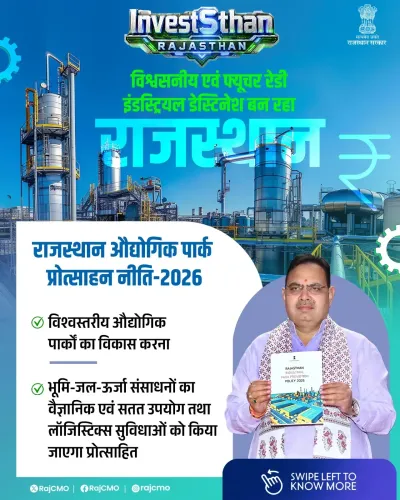
The Chief Minister's Office of Rajasthan announced on Sunday, June 28, 2026 that the state government is developing a new generation of specialised industrial parks — including a Solar Panel Manufacturing Park, a Ceramic Park, a Data Centre Park, and a Defence Manufacturing Park — aimed at positioning Rajasthan as a forward-looking economic hub.
Context
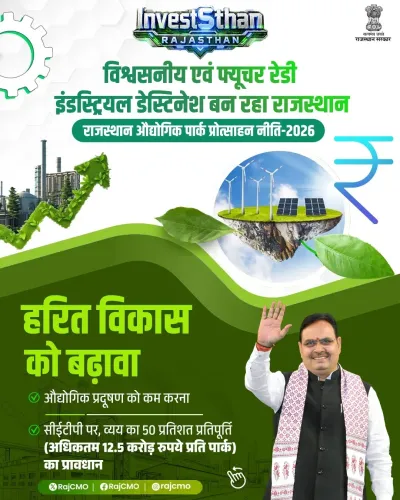
The post, attributed to the office of Chief Minister Bhajanlal Sharma and tagged '#आपणो_अग्रणी_राजस्थान' ('Our Leading Rajasthan'), signals a deliberate push to diversify the state's industrial base beyond traditional sectors. The announcement frames these parks as part of a vision aligned with the future economy — encompassing clean energy, advanced manufacturing, digital infrastructure, and defence production.
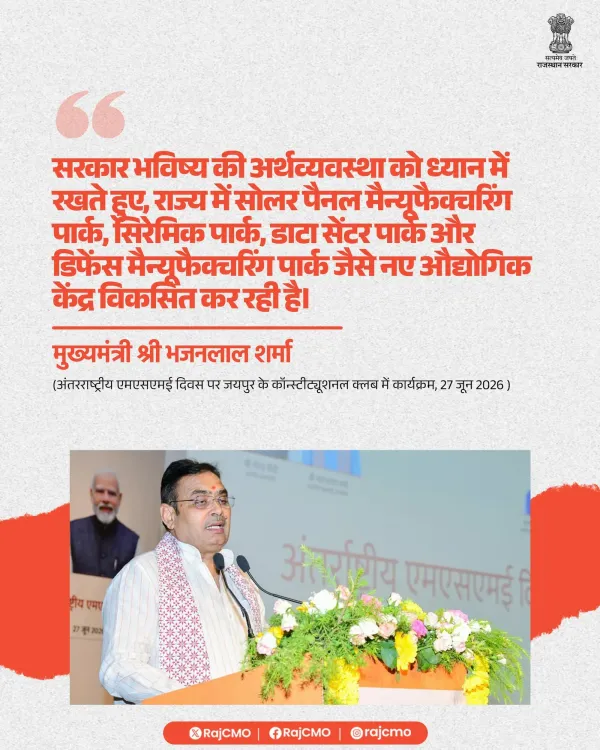
The CMO stated: 'Sarkar bhavishy ki arthvyavastha ko dhyan mein rakhte hue...' ('Keeping the future economy in mind, the government is developing new industrial centres in the state such as a Solar Panel Manufacturing Park, Ceramic Park, Data Centre Park, and Defence Manufacturing Park.')
Policy Backdrop
Rajasthan has historically been a significant contributor to India's ceramic and mineral sectors, particularly through clusters in Bikaner and Morbi-adjacent supply chains. The inclusion of a Solar Panel Manufacturing Park aligns with India's national push under the Production Linked Incentive (PLI) scheme for solar modules, as the country targets 500 GW of renewable energy capacity by 2030.
The Defence Manufacturing Park component echoes India's broader 'Aatmanirbhar Bharat' (self-reliant India) agenda, under which states have been encouraged to develop dedicated defence corridors and manufacturing zones. A Data Centre Park reflects the rapid expansion of digital infrastructure demand across India, driven by cloud adoption and the government's push for data localisation.
Stakeholders and Impact
The initiative is expected to attract domestic and foreign investment across four distinct high-growth sectors, generating employment in both skilled and semi-skilled categories. Rajasthan, with its large land availability, relatively stable power infrastructure, and improving logistics connectivity, is increasingly competitive for large-footprint industrial projects.
Local entrepreneurs, MSMEs in the ceramics and solar component supply chains, and global defence Original Equipment Manufacturers (OEMs) are among the stakeholders likely to be engaged as the parks take shape. The Data Centre Park could attract major technology companies seeking tier-2 locations with lower real-estate costs.
What's Next
The announcement does not specify timelines, investment targets, or locations for individual parks — details that will be critical for assessing the initiative's scale and credibility. Formal policy notifications, land allocation announcements, or investment summits are likely to follow as the government moves from intent to implementation.
If executed, this cluster-based industrial strategy could meaningfully shift Rajasthan's economic profile — from a state historically associated with tourism and mining to one with a diversified, technology-linked manufacturing base aligned with India's 2047 Viksit Bharat ambitions.
Point of View
Digital infrastructure, traditional manufacturing, and defence into a single political narrative of economic modernisation. By tagging CM Bhajanlal Sharma directly and invoking the 'Agrani Rajasthan' (Leading Rajasthan) brand, the ruling dispensation is clearly building an investor-confidence story ahead of potential investment summits or state elections. The choice of sectors — solar, ceramics, data centres, and defence — is strategically calibrated to align with both central government priority schemes and global capital flows. Whether this translates into ground-level implementation will depend on land acquisition clarity, single-window clearance efficiency, and the state's ability to compete with more established industrial corridors in Gujarat and Tamil Nadu.
NationPress
28 Jun 2026
Frequently Asked Questions
What industrial parks is the Rajasthan government planning to build?
The Rajasthan government has announced plans to develop four new industrial parks: a Solar Panel Manufacturing Park, a Ceramic Park, a Data Centre Park, and a Defence Manufacturing Park, aimed at building a future-ready economy.
Who is the Chief Minister of Rajasthan in 2026?
Bhajanlal Sharma of the BJP is the Chief Minister of Rajasthan. The announcement was made by his office on June 28, 2026.
Where will Rajasthan's new industrial parks be located?
The Rajasthan CMO's announcement did not specify the exact locations of the planned industrial parks. Detailed notifications are expected in subsequent policy communications.
How does Rajasthan's Defence Manufacturing Park connect to Aatmanirbhar Bharat?
India's Aatmanirbhar Bharat initiative encourages states to set up dedicated defence manufacturing zones. Rajasthan's planned Defence Manufacturing Park aligns with this national push to reduce dependence on imported defence equipment.
What is the significance of a Solar Panel Manufacturing Park in Rajasthan?
Rajasthan receives among the highest solar irradiation in India, making it a natural fit for solar manufacturing. The park aligns with India's target of 500 GW renewable energy capacity by 2030 and the national PLI scheme for solar modules.