Rajasthan CM rolls out Equal Opportunity Policy 2025 for disabled
Synopsis
Rajasthan's Chief Minister's Office announced the implementation of the Equal Opportunity Policy, 2025 for persons with disabilities, fulfilling a mandate under the Rights of Persons with Disabilities Act, 2016. CM Bhajanlal Sharma's BJP government has formally notified the state-level policy to ensure equal access and non-discrimination.
Key Takeaways
Rajasthan's BJP government has implemented the Equal Opportunity Policy, 2025 for persons with disabilities ( vishesh yogyajan ).
The announcement was made by the Chief Minister's Office of Rajasthan on November 1, 2026 , crediting CM Bhajanlal Sharma .
The policy fulfils a state-level obligation under the Rights of Persons with Disabilities Act, 2016 , which expanded recognised disability categories from 7 to 21 .
The central law mandates a 4% reservation in government employment for persons with disabilities.
Exact provisions, accessibility norms, and grievance mechanisms of the 2025 policy are yet to be detailed in publicly available notifications.
Rajasthan joins several other Indian states in operationalising the national disability rights law at the state level.
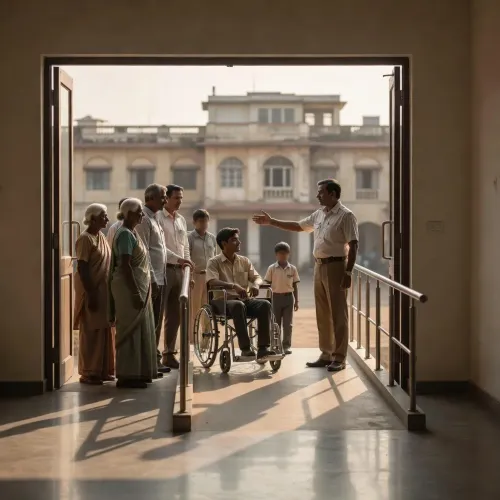
Rajasthan has taken a significant step in disability rights by implementing the Equal Opportunity Policy, 2025 — a state-level framework designed to guarantee equal access, non-discrimination, and meaningful participation for persons with disabilities across the state. The Chief Minister's Office of Rajasthan announced the move on Sunday, November 1, 2026, crediting Chief Minister Bhajanlal Sharma's BJP government with the rollout.
The post reads: 'प्रदेश में हमारी सरकार ने भी विशेष योग्यजनों के लिए समान अवसर नीति, 2025 लागू की है।' ('Our government in the state has implemented the Equal Opportunity Policy, 2025 for persons with special abilities.') The hashtag #आपणो_अग्रणी_राजस्थान — meaning 'Our Progressive Rajasthan' — underscores the administration's push to brand the state as a welfare-forward leader.What the 2016 central law demands from every state
The policy did not emerge in a vacuum. The Rights of Persons with Disabilities Act, 2016 — India's landmark disability rights legislation — explicitly requires every state to formulate and notify an Equal Opportunity Policy covering employment reservations, accessibility standards, and grievance redressal. Nearly a decade after that law was enacted, several Indian states have been at different stages of compliance; Rajasthan's notification under the current government signals the state is now formally meeting that legal obligation.
The 2016 Act broadened the definition of disability from 7 to 21 categories, raising the reservation benchmark in government jobs from 3% to 4%. Any Equal Opportunity Policy framed under it is expected to address employment, education, accessible infrastructure, and mechanisms for persons with disabilities to raise grievances — though the precise provisions of Rajasthan's 2025 policy are yet to be detailed in publicly available government notifications.
Rajasthan's place in the national disability-rights picture
Rajasthan is among several BJP-governed and opposition-governed states alike that have moved to operationalise the central disability law at the state level. The pattern reflects a pan-India administrative push, but execution quality varies significantly — from states that have issued comprehensive rules with dedicated nodal officers to those where the policy exists largely on paper.
For Rajasthan, a state with a large rural population spread across challenging terrain, the practical value of the policy will hinge on implementation: whether district-level authorities receive clear mandates, whether government recruitment rolls actively reflect the 4% reservation, and whether accessibility norms reach public schools, hospitals, and transport in tier-2 and tier-3 towns.
The CMO's announcement draws attention to the welfare plank of a government that came to power in December 2023. With CM Bhajanlal Sharma publicly tagged in the post, the political ownership of the policy is explicit — a signal that disability welfare will feature in the BJP government's governance narrative heading forward. The real test, as always, begins with the notification details and the machinery that follows.
Point of View
2016 operational at the state level — an effort that has been uneven across India. For the Bhajanlal Sharma government, publicly branding the rollout carries a dual purpose: it addresses a genuine legal compliance gap while simultaneously reinforcing a welfare governance identity ahead of political cycles. The deeper question is whether the policy will be backed by measurable implementation — recruitment data, accessibility audits, and functional grievance channels — or remain largely declaratory. Disability rights advocates have consistently flagged the gap between policy notification and on-ground change as the central challenge in India's disability governance landscape.
NationPress
1 Nov 2026
Frequently Asked Questions
What is Rajasthan's Equal Opportunity Policy 2025?
It is a state-level policy implemented by the Rajasthan BJP government under CM Bhajanlal Sharma to provide equal opportunities, non-discrimination, and access to persons with disabilities, as required under the Rights of Persons with Disabilities Act, 2016.
What does the Rights of Persons with Disabilities Act 2016 require from states?
The Act requires every state to formulate and notify an Equal Opportunity Policy covering employment reservations (at least 4% in government jobs), accessibility norms, and grievance redressal mechanisms for persons with disabilities.
Who announced the Equal Opportunity Policy 2025 in Rajasthan?
The Chief Minister's Office of Rajasthan announced the policy on November 1, 2026, crediting Chief Minister Bhajanlal Sharma's government with its implementation.
How many disability categories are recognised under the 2016 central disability law?
The Rights of Persons with Disabilities Act, 2016 expanded the number of recognised disability categories from 7 to 21.
Is Rajasthan the first state to implement an equal opportunity policy for persons with disabilities?
No. Several Indian states have framed or updated equal opportunity policies following the 2016 central Act. Rajasthan's move continues a broader national pattern of state-level implementation of disability rights mandates.