Rajasthan CMO launches sandalwood forest initiative for biodiversity
Synopsis
The Chief Minister's Office of Rajasthan announced on 20 June 2026 that the state government has launched an innovative initiative to develop sandalwood forests to promote biodiversity, a move tagged to Chief Minister Bhajanlal Sharma under the 'Our Leading Rajasthan' campaign.
Key Takeaways
The Chief Minister's Office of Rajasthan announced a sandalwood forest ( chandan van ) development initiative on 20 June 2026 .
The stated goal is to promote biodiversity across the state through this 'innovative initiative.' The announcement is attributed to the government of Chief Minister Bhajanlal Sharma , who has led Rajasthan since December 2023 .
Sandalwood cultivation in Rajasthan's arid ecology would require adapted techniques, as the species is traditionally grown in southern India.
The initiative aligns with India's broader National Action Plan on Climate Change goals of expanding forest cover and biodiversity.
Key metrics to watch include pilot site selection, sapling survival rates, and Rajasthan Forest Department implementation reports.
The Chief Minister's Office of Rajasthan announced on Saturday, 20 June 2026 that the state government has launched an innovative initiative to develop sandalwood forests (chandan van) as part of its effort to promote biodiversity across the state. The announcement, made on behalf of Chief Minister Bhajanlal Sharma, signals a push toward high-value ecological forestry in one of India's most arid regions.
Context
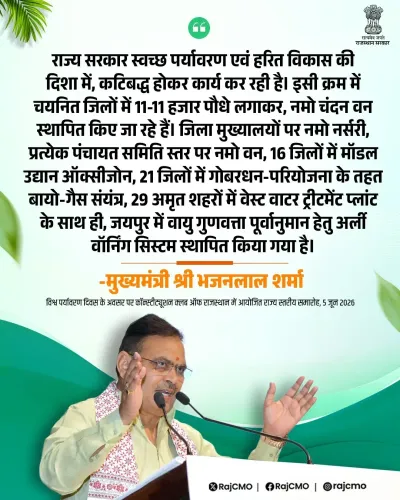
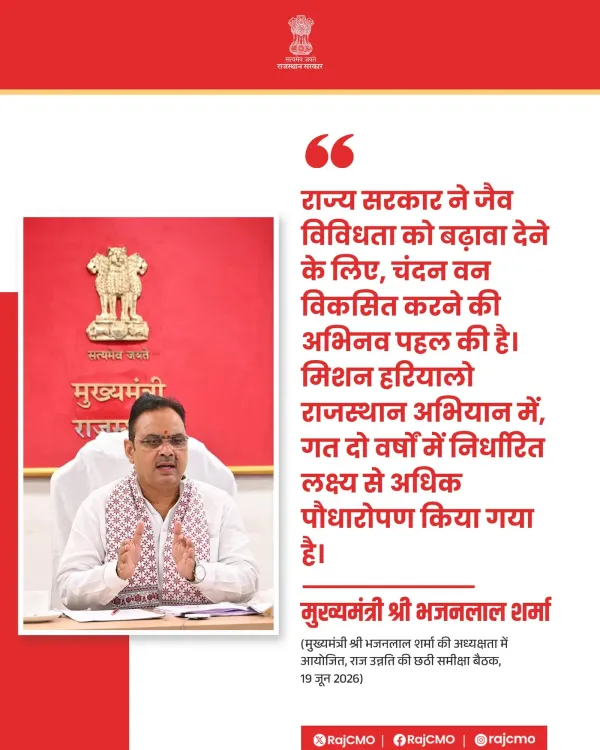
The post, shared under the hashtag #आपणो_अग्रणी_राजस्थान ('Our Leading Rajasthan'), states: 'राज्य सरकार ने जैव विविधता को बढ़ावा देने के लिए, चंदन वन विकसित करने की अभिनव पहल की है' — 'The state government has taken an innovative initiative to develop sandalwood forests in order to promote biodiversity.' The message was tagged to Chief Minister Bhajanlal Sharma, positioning the initiative as a flagship environmental action of his administration.
Sandalwood (Santalum album) is among India's most economically valuable tree species, historically cultivated in southern states such as Karnataka and Tamil Nadu. Its cultivation in Rajasthan's semi-arid and arid zones would represent a significant ecological experiment requiring adapted horticultural techniques suited to low-rainfall conditions.
Policy Backdrop
India's National Action Plan on Climate Change (NAPCC) includes a dedicated mission on green India, encouraging states to expand forest cover and enhance biodiversity. Several state governments have pursued targeted plantation drives combining ecological restoration with economic returns from high-value species. Rajasthan, which covers roughly 10.4 per cent of India's total land area but has historically low forest cover, has periodically undertaken afforestation programmes under both central and state schemes.
The BJP government under Chief Minister Bhajanlal Sharma, which assumed office in December 2023, has sought to position Rajasthan as a forward-looking state on environmental governance. Developing sandalwood forests aligns with a broader national trend of states pursuing species-specific plantation drives that promise both ecological and revenue benefits over the long term, given sandalwood's high market value.
Stakeholders and Impact
Rural communities and state forest department staff are among the primary stakeholders of such an initiative. If scaled effectively, sandalwood cultivation could offer supplementary livelihoods to communities involved in forest management, while also contributing to carbon sequestration targets. The initiative may also draw interest from private nurseries and agro-forestry practitioners looking to partner with the state.
Ecologically, introducing a species like sandalwood — which is semi-parasitic in its early growth stages, requiring host plants — into Rajasthan's landscape would demand careful planning. The success of any such programme will likely depend on site selection, soil preparation, and sustained monitoring by the Rajasthan Forest Department.
What's Next
Observers and environmental groups will watch closely for detailed operational plans, including the number of saplings targeted, districts selected for pilot sites, and the budget allocated. Survival rates at any pilot sandalwood sites are expected to be a key metric in upcoming state forest department reports. The initiative, if backed by robust implementation, could establish a replicable model for high-value biodiversity forestry in India's arid western states.
Point of View
And framing the drive around biodiversity broadens its political appeal. For the Bhajanlal Sharma administration, which is still consolidating its environmental credentials two-and-a-half years into office, such high-visibility green initiatives serve a dual purpose: meeting national climate commitments and differentiating Rajasthan as a proactive BJP-governed state. The choice of sandalwood, a species alien to the region's ecology, also carries risk — implementation gaps or poor survival rates could undercut the narrative. The broader pattern of Indian states pursuing species-specific plantation drives suggests this initiative will be judged not by the announcement, but by verifiable on-ground outcomes.
NationPress
20 Jun 2026
Frequently Asked Questions
What is the Rajasthan sandalwood forest initiative?
The Rajasthan state government, under Chief Minister Bhajanlal Sharma, has announced an initiative to develop sandalwood forests (chandan van) to promote biodiversity, as announced by the Chief Minister's Office on 20 June 2026.
Why is sandalwood being planted in Rajasthan?
Sandalwood is a high-value species that can contribute to both biodiversity and potential economic returns. The state government is pursuing it as part of a broader push toward ecological forestry, though adapted cultivation techniques will be needed for Rajasthan's arid conditions.
Who is the Chief Minister of Rajasthan in 2026?
Bhajanlal Sharma of the BJP has been the Chief Minister of Rajasthan since December 2023 and is the political face of this sandalwood forest initiative.
Is sandalwood grown in Rajasthan?
Traditionally, sandalwood cultivation in India has been concentrated in southern states like Karnataka and Tamil Nadu. Rajasthan's initiative to grow sandalwood in its arid ecology is considered innovative and will require specially adapted horticultural methods.
What is the 'Aapno AgraNi Rajasthan' hashtag about?
'Aapno AgraNi Rajasthan' translates to 'Our Leading Rajasthan' and is a campaign hashtag used by the Rajasthan government to highlight flagship development and governance initiatives under the Bhajanlal Sharma administration.