Rajasthan Expands Compassionate Appointment to Include Daughters-in-Law
Synopsis
The Rajasthan government has expanded compassionate appointment eligibility to include daughters-in-law of deceased state government employees, CM Bhajan Lal Sharma's office announced on 13 July 2026, marking a step toward women's economic empowerment.
Key Takeaways
Daughters-in-law of deceased Rajasthan government employees are now eligible for compassionate appointment under revised state service rules.
The announcement was made by the Chief Minister's Office of Rajasthan on 13 July 2026 , tagged to CM Bhajan Lal Sharma .
Compassionate appointment allows dependents of deceased government employees to be appointed to government posts outside standard competitive recruitment.
The move is framed as a women's empowerment initiative under the government's #आपणो_अग्रणी_राजस्थान campaign.
Exact eligibility conditions, required documents, and an implementation timeline are yet to be detailed in a formal government notification.
The revision continues a broader national pattern of Indian states incrementally expanding compassionate appointment eligibility to reflect evolving family structures.
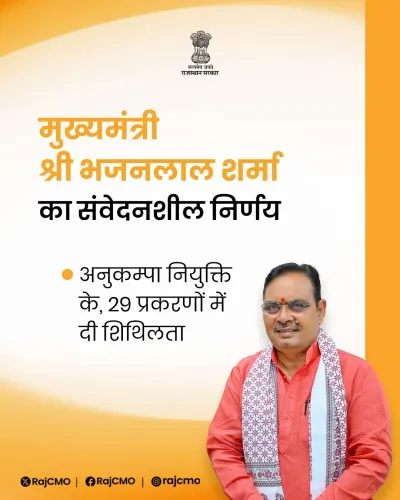
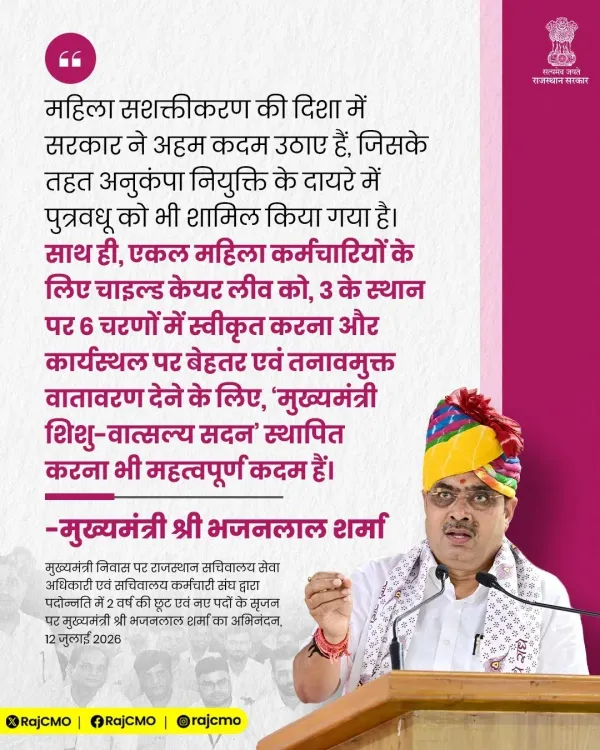
The Chief Minister's Office of Rajasthan announced on Monday, 13 July 2026 that the state government has taken a significant step toward women's empowerment by expanding the scope of compassionate appointment rules to include daughters-in-law of deceased government employees.
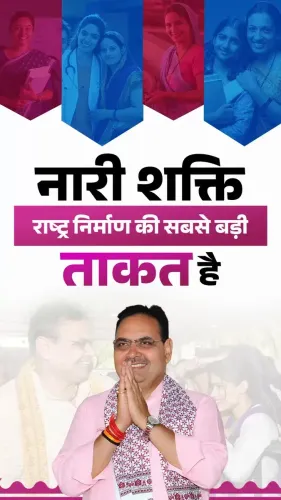
The official post stated: 'महिला सशक्तीकरण की दिशा में सरकार ने अहम कदम उठाए हैं, जिसके तहत अनुकंपा नियुक्ति के दायरे में पुत्रवधू को भी शामिल किया गया है' — translating to: 'The government has taken important steps toward women's empowerment, under which daughters-in-law have also been included in the ambit of compassionate appointment.' The post was tagged to Chief Minister Bhajan Lal Sharma and carried the hashtag #आपणो_अग्रणी_राजस्थान ('Our Leading Rajasthan').
Context
Compassionate appointment is a provision under state service rules that allows a dependent family member of a government employee who dies in harness — or is medically retired — to be considered for a government job, bypassing the standard competitive recruitment process. The intent is to provide immediate livelihood support to a bereaved family. Until this revision, the eligible category in Rajasthan typically covered spouses, sons, and daughters of the deceased employee.
By adding daughters-in-law to the eligible list, the Government of Rajasthan is recognising a class of dependents who, in many households, are primary caregivers and contributors to the family's income but were previously excluded from this safety net.
Policy Backdrop
Indian states have periodically revised compassionate appointment frameworks to reflect changing family structures and social realities. Over the past two decades, several state governments have incrementally broadened eligibility criteria — adding adopted children, unmarried daughters, and now, in Rajasthan's case, daughters-in-law — while keeping appointments within existing recruitment quotas and eligibility frameworks.
Chief Minister Bhajan Lal Sharma, who assumed office in December 2023, has framed administrative and social welfare reforms as a core priority of his BJP-led government. This move aligns with a broader push to position the administration as responsive to women's economic security, a theme that has featured prominently in the government's public messaging under the #आपणो_अग्रणी_राजस्थान campaign.
Stakeholders and Impact
The primary beneficiaries of this change are daughters-in-law of deceased Rajasthan government employees who are dependents of the deceased and meet the eligibility conditions set out in the service rules. Families of government employees in Rajasthan — a large employer given the state's size and its extensive public service apparatus — stand to benefit directly.
Women's welfare advocates have long argued that daughters-in-law, particularly in joint family setups common across Rajasthan, often bear the economic burden after a government employee's death yet fall outside formal support structures. This revision addresses that gap. The exact eligibility conditions, required documentation, and implementation timeline are expected to be detailed in the formal government notification.
What's Next
The state government is expected to release a formal notification specifying the precise eligibility criteria — including conditions such as the daughter-in-law's age, marital status, and dependency proof — along with the categories of posts to which this provision will apply. Applicants and families of eligible employees will need to watch for the official gazette notification and departmental circulars from the Government of Rajasthan's personnel department.
If implemented smoothly, this policy revision could serve as a template for other states looking to modernise their own compassionate appointment frameworks, further cementing Rajasthan's position as a state actively updating its service rules in line with evolving social needs.
Point of View
A numerically important constituency. For CM Bhajan Lal Sharma, it reinforces a governance narrative built around incremental but visible welfare actions rather than large-scale expenditure. The move also reflects a wider trend across BJP-governed states of framing service-rule tweaks as women's empowerment wins, blurring the line between administrative housekeeping and political messaging. The real test will be in implementation: whether the formal notification sets eligibility conditions broad enough to be genuinely inclusive or narrow enough to limit actual uptake.
NationPress
13 Jul 2026
Frequently Asked Questions
What is compassionate appointment in Rajasthan?
Compassionate appointment in Rajasthan is a provision under state service rules that allows a dependent family member of a government employee who dies in service or is medically retired to be appointed to a government post without going through the standard competitive recruitment process, in order to provide immediate livelihood support to the bereaved family.
Who is now eligible for compassionate appointment in Rajasthan after the 2026 change?
Following the July 2026 announcement, daughters-in-law of deceased Rajasthan government employees have been added to the list of eligible dependents for compassionate appointment, alongside categories such as spouses, sons, and daughters who were already covered under existing rules.
What did Bhajan Lal Sharma's government announce on 13 July 2026?
The Chief Minister's Office of Rajasthan, under CM Bhajan Lal Sharma, announced that daughters-in-law of deceased government employees would be included in the scope of compassionate appointment, framing it as a step toward women's empowerment.
When will the Rajasthan compassionate appointment rule for daughters-in-law come into effect?
The exact effective date and detailed eligibility conditions are expected to be specified in a formal government notification; the July 2026 announcement confirmed the policy decision but the implementation timeline had not been publicly detailed at the time of reporting.
How does Rajasthan's compassionate appointment expansion compare to other Indian states?
Several Indian states have broadened compassionate appointment eligibility over the past two decades, adding categories such as adopted children and unmarried daughters; Rajasthan's inclusion of daughters-in-law continues this national pattern of incremental updates to state service rules to reflect evolving family structures.