Rajnath Singh Highlights India's Self-Reliant Health System
Synopsis
Union Defence Minister Rajnath Singh on 13 July 2026 praised India's healthcare transformation under PM Modi, citing progress in affordable care, indigenous medical technologies, gene therapy, and CAR-T Cell Therapy as markers of a self-reliant, people-centric health system.
Key Takeaways
Union Defence Minister Rajnath Singh posted on 13 July 2026 crediting PM Narendra Modi for making India's health system self-reliant and people-centric.
Singh specifically highlighted CAR-T Cell Therapy and gene therapy as areas where India is achieving indigenous capability.
The Ayushman Bharat Pradhan Mantri Jan Arogya Yojana (launched 2018 ) forms the affordable-healthcare pillar of this narrative.
The Production Linked Incentive scheme for pharma and medical devices ( 2020 ) has been central to reducing import dependence.
The National Health Policy 2017 set the framework for increased public health spending and domestic R&D capacity.
Future Union Budget allocations and regulatory approvals for indigenous advanced therapies are key milestones to watch.
Union Defence Minister Rajnath Singh on Monday, 13 July 2026, praised the growth of India's healthcare sector under Prime Minister Narendra Modi, highlighting advances ranging from affordable healthcare access to cutting-edge indigenous medical technologies including gene therapy and CAR-T Cell Therapy.
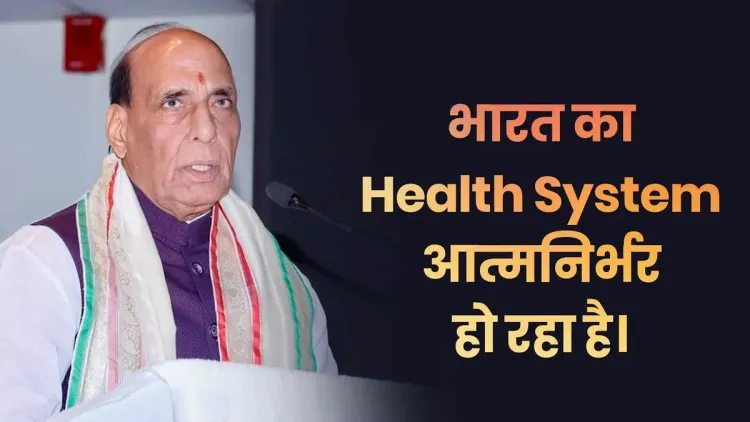
Posting on X, Singh wrote: 'प्रधानमंत्री @narendramodi के नेतृत्व में भारत का Health System आत्मनिर्भर और जन-केंद्रित बनकर उभरा है' — 'Under the leadership of Prime Minister Narendra Modi, India's health system has emerged as self-reliant and people-centric.' He added that the country is 'scaling new heights in the health sector,' spanning affordable healthcare, indigenous medical technologies, gene therapy, CAR-T Cell Therapy, and medical research.
Context
The post reflects a broader government narrative around Atmanirbhar Bharat — the self-reliance mission — being extended to the healthcare domain. India's push for health-sector self-sufficiency gained significant momentum after the COVID-19 pandemic exposed vulnerabilities in import-dependent supply chains for drugs, devices, and critical equipment. Singh's remarks signal the ruling dispensation's intent to project healthcare autonomy as a political and policy achievement.
CAR-T Cell Therapy — Chimeric Antigen Receptor T-Cell Therapy — is an advanced immunotherapy used primarily in cancer treatment. Indian research institutions have been working on developing affordable, indigenous versions of this therapy, which is prohibitively expensive when imported from abroad.
Policy Backdrop
Several flagship initiatives underpin the claims made in Singh's post. The Ayushman Bharat Pradhan Mantri Jan Arogya Yojana, launched in 2018, extended health insurance coverage to low-income households, forming the bedrock of the 'affordable healthcare' narrative. The National Health Policy 2017 set targets for raising public health expenditure and strengthening domestic medical research capacity.
On the manufacturing side, the Production Linked Incentive (PLI) scheme for pharmaceuticals and medical devices, rolled out in 2020, aimed to reduce import dependence and incentivise domestic production. Together, these schemes form the policy architecture that the government credits for India's growing self-reliance in healthcare.
Stakeholders and Impact
The most direct beneficiaries of affordable healthcare expansion are low- and middle-income patients, particularly those in rural and semi-urban India who previously lacked access to insurance or specialist care. If indigenous CAR-T and gene therapies reach commercial viability, they could dramatically reduce treatment costs for cancer patients who currently rely on expensive imported options.
Medical researchers, academic institutions, and domestic pharmaceutical companies also stand to gain from increased policy focus and potential budget allocations toward high-end R&D. Healthcare providers — from primary health centres to tertiary hospitals — are central to translating these policy gains into on-ground outcomes.
What's Next
Observers will watch the next Union Budget closely for health research allocations and any new regulatory approvals for indigenous gene or CAR-T therapies. Parliamentary discussions on whether advanced treatments such as gene therapy should be brought under public insurance schemes like Ayushman Bharat are likely to intensify. Singh's statement, coming from a senior Cabinet minister, may also be read as a signal ahead of policy announcements in the health sector.
As India positions itself as a global hub for affordable, high-quality healthcare — from generics to frontier therapies — the political stakes around delivering on that promise to ordinary citizens will only rise.
Point of View
The BJP is crafting a dual narrative: welfare for the many, and scientific ambition for the nation. The timing suggests a coordinated messaging effort ahead of potential health-sector announcements. For a senior minister whose portfolio is defence, the foray into health commentary underscores how the ruling party is mobilising its entire leadership to reinforce the self-reliance message across sectors.
NationPress
12 Oct 2026
Frequently Asked Questions
What did Rajnath Singh say about India's healthcare system?
Rajnath Singh said that under PM Narendra Modi's leadership, India's health system has become self-reliant and people-centric, with progress in affordable healthcare, indigenous medical technologies, gene therapy, CAR-T Cell Therapy, and medical research.
What is CAR-T Cell Therapy and is India developing it indigenously?
CAR-T Cell Therapy is an advanced immunotherapy used mainly for cancer treatment. Indian research institutions have been working on developing affordable, indigenous versions to reduce dependence on costly imported treatments.
What is Ayushman Bharat and how does it relate to affordable healthcare in India?
Ayushman Bharat Pradhan Mantri Jan Arogya Yojana, launched in 2018, provides health insurance coverage to low-income households and is the government's primary vehicle for expanding affordable healthcare access across India.
What is the PLI scheme for healthcare in India?
The Production Linked Incentive scheme for pharmaceuticals and medical devices, launched in 2020, incentivises domestic manufacturing to reduce India's import dependence in the health sector.
Why is India focusing on self-reliance in healthcare?
India accelerated its push for healthcare self-reliance following the COVID-19 pandemic, which exposed vulnerabilities in import-dependent supply chains. This aligns with the broader Atmanirbhar Bharat policy framework linking domestic innovation to affordability.