Rajnath Singh Tours JS Natori Frigate at Yokosuka Naval Base
Synopsis
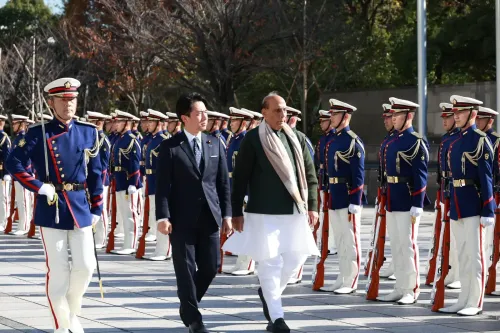
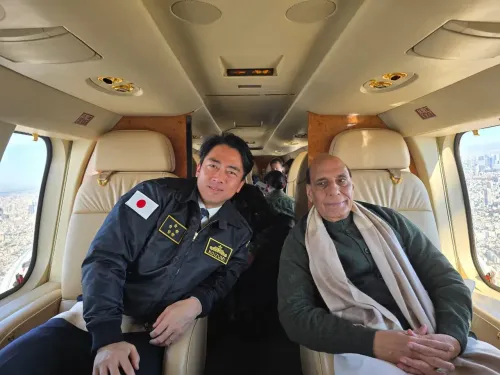
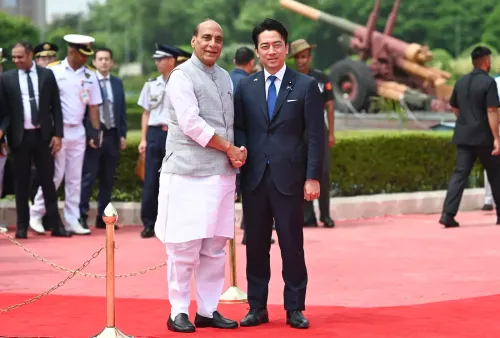
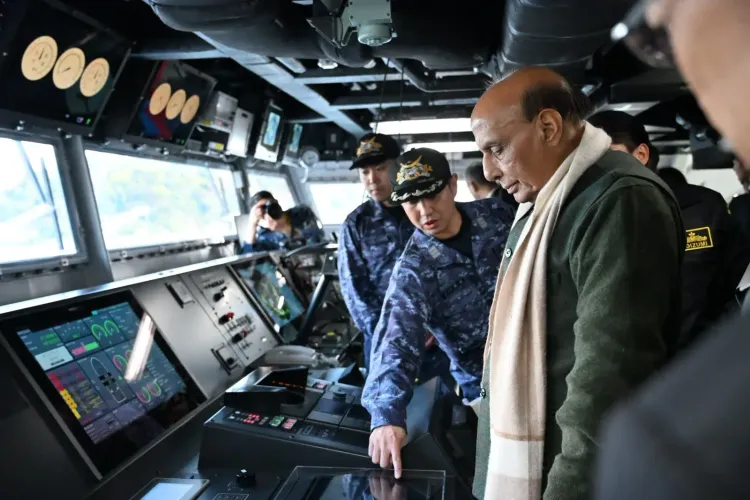
Union Defence Minister Rajnath Singh visited the JMSDF Naval Base in Yokosuka on November 18, 2026, touring the Mogami-class frigate JS Natori with Japan's Defence Minister Shinjiro Koizumi, underscoring growing India-Japan maritime ties and their shared vision for a free, open Indo-Pacific.
Key Takeaways
Rajnath Singh visited the JMSDF Naval Base, Yokosuka on 18 November 2026 .
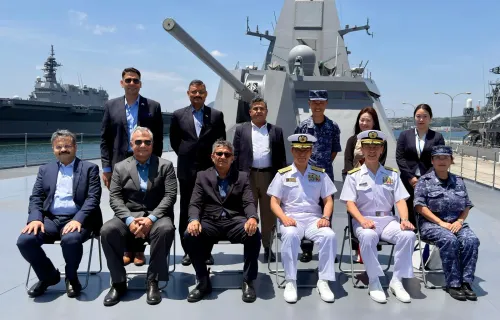
He toured the Mogami-class multi-mission frigate JS Natori alongside Japan's Defence Minister Shinjiro Koizumi .
India and Japan signed the Acquisition and Cross-Servicing Agreement (ACSA) in 2020 , enabling mutual logistics support.
The India-Japan 2+2 Ministerial Dialogue has been in place since 2019 .
Exercise Malabar expanded to full Quad format — India, US, Japan, Australia — in 2020 .
Both nations frame their partnership around a 'free, open, and rules-based Indo-Pacific.'
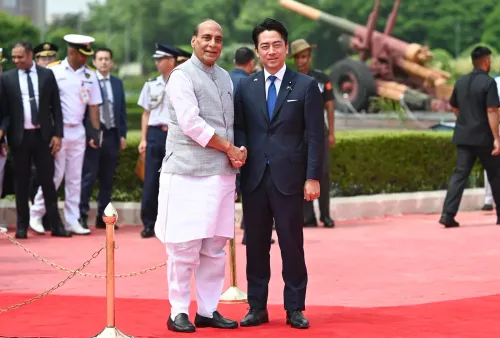
Standing on the deck of a frontline multi-mission warship at one of Japan's most strategically vital naval installations, Union Defence Minister Rajnath Singh made the kind of statement that needs no press release — the visit itself does the talking. Singh toured the JMSDF Naval Base in Yokosuka on Wednesday, November 18, 2026, alongside Japan's Defence Minister Shinjiro Koizumi, walking the length of the Mogami-class multi-mission frigate JS Natori.
Singh described the tour as a reflection of 'deep trust and shared commitment of India and Japan toward ensuring a free, open, and rules-based Indo-Pacific.' The twin national flags in his post — 🇮🇳🇯🇵 — said the rest concisely.
Why Yokosuka, Why JS Natori
Yokosuka, located at the mouth of Tokyo Bay in Kanagawa Prefecture, is the homeport of the Japan Maritime Self-Defence Force's fleet command and arguably the most symbolically loaded naval base in the Pacific. For an Indian Defence Minister to walk its piers alongside a Japanese counterpart is a pointed act of strategic signalling. The Mogami-class frigate is Japan's newest multi-mission surface combatant — lighter, stealthier, and built for exactly the kind of distributed maritime operations that dominate Indo-Pacific planning today. Choosing JS Natori for the tour was not incidental.
A Partnership Built Layer by Layer
The optics at Yokosuka sit on top of a decade of quiet institutional architecture. India and Japan formalised their Special Strategic and Global Partnership and have since built interlocking defence mechanisms — the Acquisition and Cross-Servicing Agreement (ACSA), signed in 2020, allows both militaries to draw on each other's logistics, fuel, and supplies, a practical capability that matters far more than a photo opportunity. The 2+2 Foreign and Defence Ministerial Dialogue, instituted in 2019, provides the high-level political architecture to match.
Then there is Exercise Malabar. Originally a bilateral India-US naval drill, it expanded in 2020 to include Japan and Australia — effectively the entire Quad at sea. Each iteration tightens interoperability, doctrine alignment, and the kind of human-to-human familiarity that makes combined operations possible under pressure.
The Indo-Pacific Framing India and Japan Share
Both nations have consistently anchored their bilateral language in the concept of a 'free, open, and rules-based Indo-Pacific' — a phrase that carries enormous diplomatic weight without naming specific adversaries. It signals shared concern about freedom of navigation, unilateral changes to the maritime status quo, and the importance of international law at sea. That Singh and Koizumi chose a warship deck rather than a conference room to reinforce that framing is deliberate: it shows, rather than merely declares, capability and will.
With the next round of the India-Japan 2+2 dialogue expected to follow high-level visits like this, any announcements on naval exercises or technology collaboration will be the real measure of how much further this partnership can travel.
Point of View
Designed to project capability alongside intent. The consistent 'free, open, rules-based Indo-Pacific' framing by both sides builds a durable normative consensus without the diplomatic friction of naming specific threats. Layered on ACSA logistics ties and the expanded Malabar exercise, this visit advances the India-Japan partnership from rhetorical alignment toward operational readiness. The question the next 2+2 dialogue will answer is whether technology co-development — the logical next rung — is now within reach.
NationPress
18 Nov 2026
Frequently Asked Questions
Why did Rajnath Singh visit Yokosuka naval base?
Union Defence Minister Rajnath Singh visited the JMSDF Naval Base in Yokosuka on November 18, 2026 as part of a high-level defence engagement with Japan, where he toured the Mogami-class frigate JS Natori alongside Japan's Defence Minister Shinjiro Koizumi to reinforce growing India-Japan maritime cooperation.
What is the Mogami-class frigate JS Natori?
JS Natori is a Mogami-class multi-mission frigate of the Japan Maritime Self-Defence Force — Japan's newest class of surface combatant, designed for agile, distributed maritime operations in the Indo-Pacific.
What defence agreements exist between India and Japan?
India and Japan signed the Acquisition and Cross-Servicing Agreement (ACSA) in 2020 for mutual logistics support, and established the 2+2 Foreign and Defence Ministerial Dialogue in 2019. Both also participate in the annual Malabar naval exercise, which expanded to Quad format in 2020.
What is the India-Japan 2+2 dialogue?
The India-Japan 2+2 Ministerial Dialogue, instituted in 2019, brings together the Foreign and Defence Ministers of both countries to coordinate on strategic and security matters, providing a high-level political framework for the defence partnership.
What does 'free, open, and rules-based Indo-Pacific' mean in India-Japan context?
The phrase signals both nations' shared commitment to freedom of navigation, respect for international law at sea, and opposition to unilateral changes to the maritime status quo — a diplomatic formulation that underscores strategic alignment without directly naming any specific adversary.