Rajnath Singh: India targets ₹50,000 cr defence exports by 2029
Synopsis
Union Defence Minister Rajnath Singh declared on 18 July 2026 that India now exports defence products to nearly 100 countries, crediting policy reforms and indigenous technology. He set a national target of ₹50,000 crore in defence exports by 2029, marking a sharp reversal from India's historic import dependence.
Key Takeaways
Rajnath Singh stated on 18 July 2026 that India exports defence products to nearly 100 countries .
India's defence exports have grown from under ₹2,000 crore to significantly higher figures, driven by policy reforms since 2014 .
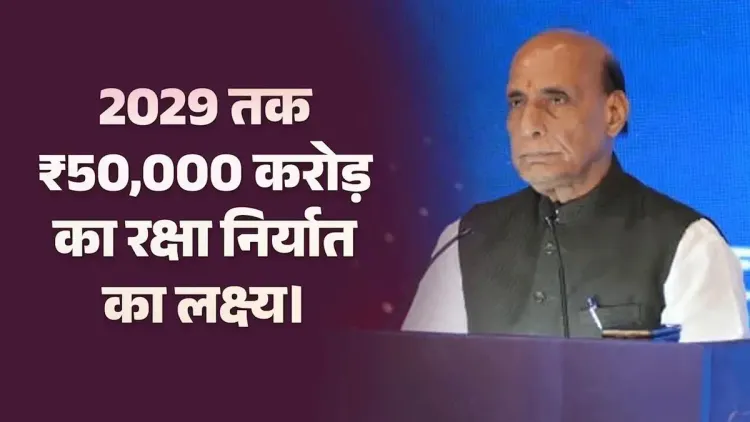
The government has set a target of ₹50,000 crore in defence exports by 2029 .
The Atmanirbhar Bharat Abhiyan (2020) and a negative import list of 101 items have been central to boosting domestic manufacturing capacity.
Policy levers include FDI liberalisation, licensing reforms, and structured public-private partnerships in defence production.
The export push benefits both state-run defence enterprises and private manufacturers, creating skilled employment and reducing per-unit production costs.
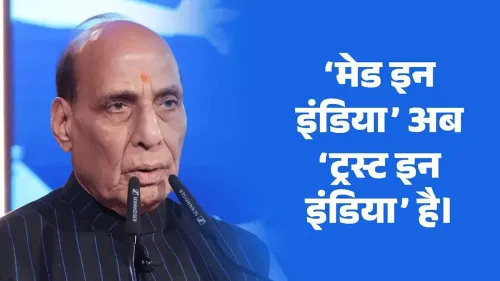
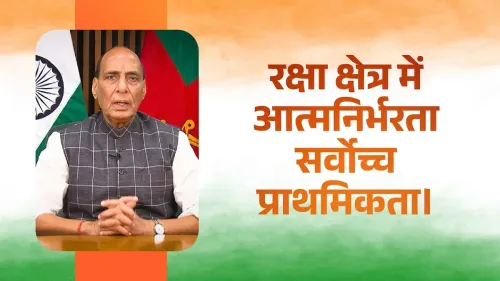
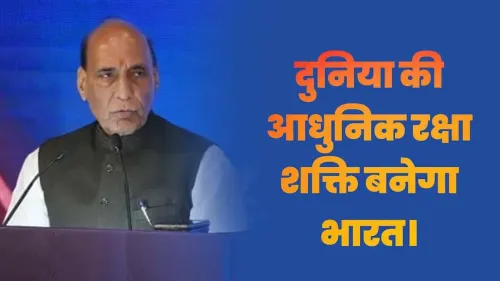
Union Defence Minister Rajnath Singh on Saturday, 18 July 2026, declared that India — once heavily dependent on foreign nations for defence equipment — now exports defence products to nearly 100 countries worldwide, and set a firm national target of reaching ₹50,000 crore in defence exports by 2029.
Posting in Hindi on X, Singh wrote: 'जो भारत कभी रक्षा उपकरणों के लिए दूसरे देशों पर निर्भर था, वही आज दुनिया के लगभग 100 देशों को रक्षा उत्पाद निर्यात कर रहा है' ('The India that was once dependent on other countries for defence equipment is today exporting defence products to nearly 100 countries across the world'). He attributed this transformation to policy reforms, indigenous technology, and the growing capacity of Indian industries.
Context
India's journey from a net defence importer to an emerging global supplier has been one of the more striking industrial shifts of the past decade. For much of its post-independence history, India sourced the bulk of its military hardware from abroad, leaving its armed forces exposed to supply disruptions and technology denials. That dependence became a strategic liability that successive governments sought to address.
The shift gathered decisive momentum after 2014, when the Make in India initiative identified defence manufacturing as a priority sector, opening the door to private participation and foreign direct investment in an industry long dominated by state-run enterprises.
Policy Backdrop
The Atmanirbhar Bharat Abhiyan, announced in May 2020, gave fresh urgency to defence self-reliance, with the sector earmarked for dedicated production and export-promotion measures. A landmark negative import list — first notified in August 2020 with 101 defence items — barred fresh import contracts for those products, forcing domestic manufacturers to fill the gap and creating a pipeline of exportable goods.
Licensing reforms, liberalised FDI norms, and structured public-private partnerships have since enabled both defence public sector undertakings and private firms to scale up in platforms, components, and munitions. Annual defence exports, which stood at under ₹2,000 crore in the early years of the decade, have climbed steeply as a result of these compounding interventions.
Stakeholders and Impact
The beneficiaries of this expansion span a wide ecosystem: private-sector defence manufacturers, ordnance factories, and defence public sector undertakings that have invested in production lines calibrated for export markets. For importing nations — many of them seeking to diversify away from traditional suppliers amid global supply-chain disruptions — India has emerged as a credible alternative source of platforms, ammunition, and electronics.
Domestically, the export push has created a virtuous cycle: higher volumes reduce per-unit costs, improve technology absorption, and generate skilled employment in the defence-industrial corridor. Singh's statement signals that the government views the ₹50,000 crore target not as aspirational but as an operational benchmark to be achieved within the current policy framework.
What's Next
The 2029 deadline aligns with the government's broader vision of making India one of the world's top defence exporters. Analysts and industry bodies will watch the forthcoming Union Budget for any additional fiscal incentives or revised export-promotion schemes that could accelerate progress toward the target. The annual defence export statistics from the Ministry of Defence Production will serve as the primary scorecard.
If the trajectory holds, India's defence export story could reshape its strategic relationships — turning commercial ties into long-term security partnerships with buyer nations across Asia, Africa, and Latin America.
Point of View
The minister is converting a broad policy ambition into a measurable political commitment — one that will be easy to track and hold the government accountable to. The framing of India's transformation from importer to exporter is a well-worn BJP talking point, but the ₹50,000 crore figure gives it fresh specificity. The broader arc here is India's attempt to leverage its defence-industrial expansion as a tool of strategic diplomacy, using arms exports to deepen relationships with nations across the Global South.
NationPress
16 Oct 2026
Frequently Asked Questions
What is India's defence export target for 2029?
India has set a target of ₹50,000 crore in defence exports by 2029 , as announced by Union Defence Minister Rajnath Singh on 18 July 2026 .
How many countries does India export defence products to?
According to Rajnath Singh , India currently exports defence products to nearly 100 countries worldwide.
What policies helped India grow its defence exports?
Key policies include the Make in India initiative (2014), the Atmanirbhar Bharat Abhiyan (2020), and the negative import list of 101 defence items notified in August 2020, alongside FDI liberalisation and licensing reforms.
What was India's defence export value before the current push?
India's annual defence exports stood at under ₹2,000 crore in the early years of the indigenisation drive and have grown significantly since policy reforms accelerated after 2014 .
What is the Atmanirbhar Bharat Abhiyan's role in defence exports?
The Atmanirbhar Bharat Abhiyan , launched in May 2020 , identified defence as a key self-reliance sector, introducing production incentives, an import ban on specified items, and export-promotion measures that have helped domestic manufacturers scale up for global markets.