Rajnath Singh hails PM Modi on 12 years in office
Synopsis
Union Defence Minister Rajnath Singh marked the 12th anniversary of PM Modi's swearing-in on May 26, 2026, crediting the government with transformative shifts in welfare delivery, digital growth, Aatmanirbhar Bharat, and national security over the past twelve years.
Key Takeaways
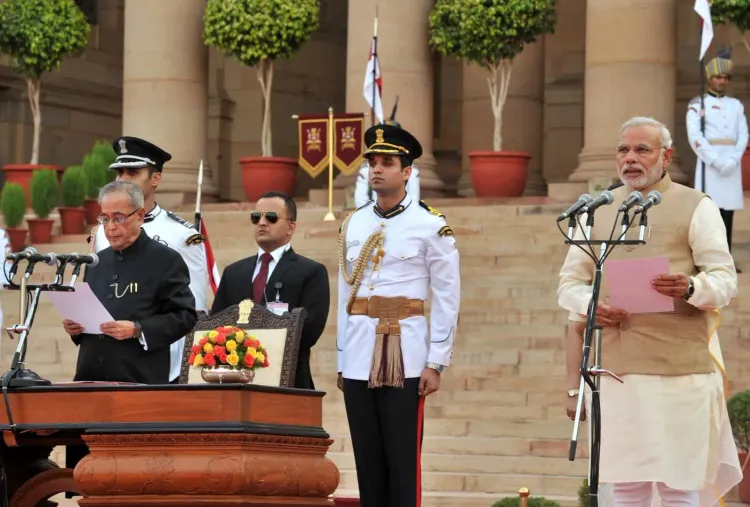
May 26, 2026 marks 12 years since Narendra Modi was first sworn in as Prime Minister on May 26, 2014 .
Union Defence Minister Rajnath Singh posted a detailed tribute on X, calling the period a 'new chapter in India's civilisational and developmental journey.' Singh highlighted Aatmanirbhar Bharat , launched in May 2020 , as a key pillar — directly relevant to his own portfolio of defence indigenisation.
The Antyodaya welfare vision and the slogan 'Sabka Saath, Sabka Vikas, Sabka Vishwas' were cited as having moved from rhetoric to policy reality.
Singh referred to Modi as a 'Pradhan-Sevak' and prayed for his 'good health, long life and continued service to the nation.' Upcoming Union Budget and parliamentary sessions are expected to carry forward debates on defence indigenisation targets and inclusive growth metrics.
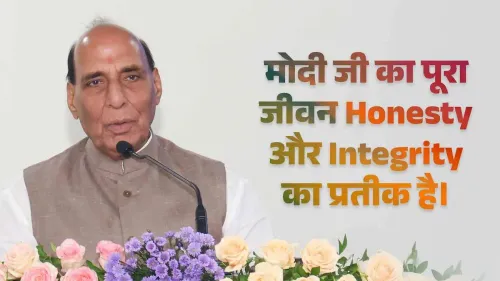
Union Defence Minister Rajnath Singh on Tuesday, May 26, 2026, marked the 12th anniversary of Prime Minister Narendra Modi's swearing-in with a tribute on X, calling the period a 'new chapter in India's civilisational and developmental journey.'
Context
Narendra Modi was first sworn in as Prime Minister on May 26, 2014, following the Bharatiya Janata Party's decisive victory in the general elections that year. The date has since become an annual marker for the ruling dispensation to take stock of governance milestones. Singh's post, running to several paragraphs, is among the more detailed tributes from a senior Cabinet colleague this year.
Singh described the day as one that brought 'a decisive shift in governance, vision, leadership, and national resolve.' He invoked a sweeping arc of policy — from economic development and social welfare to Aatmanirbhar Bharat, digital transformation, infrastructure growth, global leadership, and national security — as evidence of that shift.
Policy Backdrop
Several flagship initiatives anchor Singh's tribute. The Digital India programme, launched in 2015, expanded digital infrastructure and e-governance across the country. The Aatmanirbhar Bharat Abhiyan, announced in May 2020, set out to reduce import dependence and accelerate domestic manufacturing — with particular emphasis on defence indigenisation, an area Singh oversees directly as Defence Minister.
Singh placed special emphasis on the Antyodaya vision — the principle of prioritising the poorest and most marginalised — describing it as having been 'realised in its truest sense' under Modi's tenure. 'Millions who had remained unseen and unheard for decades became active participants in India's growth story,' he wrote. Welfare expansions including scaled-up food security schemes after 2014 are cited by the government as evidence of this outreach.
The governance slogan 'Sabka Saath, Sabka Vikas, Sabka Vishwas' ('Together for all, Development for all, Trust for all') featured prominently. Singh asserted it 'has not remained merely a slogan, but has reflected in governance and policy at every level.'
Stakeholders and Impact
Singh's tribute addresses multiple constituencies simultaneously: citizens who have benefited from welfare delivery, the defence establishment that has seen a push toward indigenisation, and an international audience to whom India's 'assertive global leadership' is being projected. As a senior BJP leader and former Home Minister and former Uttar Pradesh Chief Minister, Singh carries weight beyond his current portfolio when he speaks to the party's governance record.
The reference to Modi as a 'Pradhan-Sevak' ('Prime Servant') — a self-descriptor Modi has used — is deliberate. Singh wrote that Modi 'has dedicated every moment of his life to the service of Maa Bharati and her people,' and offered a prayer for 'his good health, long life and continued service to the nation.'
What's Next
Annual observances of May 26 typically precede fresh policy announcements or progress reports on flagship schemes. Attention will turn to upcoming targets under Aatmanirbhar Bharat — particularly defence indigenisation benchmarks — and welfare scheme coverage figures expected to feature in the next Union Budget. Parliamentary debates on national security architecture and inclusive growth metrics are also anticipated as the government enters the next phase of its term.
Point of View
Policy specificity, and invocation of Antyodaya and Aatmanirbhar Bharat signal an effort to consolidate the government's narrative ahead of what are likely to be budget and legislative milestones. As Defence Minister, his emphasis on Aatmanirbhar Bharat carries institutional weight, linking personal loyalty to a concrete policy domain he steers. The 'Pradhan-Sevak' framing reinforces a long-running BJP communication strategy that positions Modi as a servant-leader rather than a conventional power-holder. Taken together, the post is as much a forward-looking political statement as it is a backward-looking tribute.
NationPress
20 Sept 2026
Frequently Asked Questions
When did Narendra Modi first become Prime Minister of India?
Narendra Modi was first sworn in as Prime Minister of India on May 26, 2014 , after the BJP-led NDA won a decisive majority in the general elections that year.
What is Aatmanirbhar Bharat and why did Rajnath Singh mention it?
Aatmanirbhar Bharat Abhiyan is a self-reliance initiative announced in May 2020 to promote domestic manufacturing and reduce import dependence, especially in defence. Singh, as Defence Minister, oversees the defence indigenisation component and cited it as a key achievement of the Modi government.
What does 'Antyodaya' mean in Indian governance?
Antyodaya means 'upliftment of the last person' and refers to welfare policies prioritising the poorest and most marginalised citizens. The BJP government has used it as a guiding principle for targeted welfare scheme delivery since 2014 .
What is 'Sabka Saath, Sabka Vikas, Sabka Vishwas'?
It is the BJP government's core governance slogan, translating to 'Together for all, Development for all, Trust for all.' It has been used since the 2014 general elections to frame inclusive development and trust-building policies.
Who is Rajnath Singh and what is his political background?
Rajnath Singh is the Union Minister of Defence and a senior BJP leader. He previously served as Chief Minister of Uttar Pradesh and as Union Home Minister before taking charge of the Defence Ministry.